Your ASO Guide for Mobile Games in 2026: How to Actually Rank in the App Stores Right Now
Check out this ASO guide for mobile games. Learn what shifted in ranking algorithms, what to do about it, and a 10-point self-assessment to run with your team.
You updated your metadata six months ago. The keywords were there, the screenshots looked better, and the subtitle did its job. Then the rankings stopped moving, organic install share started to slip, and paid CPI kept climbing. The problem isn't that ASO stopped working. The app store ranking factors that drove installs in 2024 are not the same ones driving them now, and a playbook built for then won't fix a 2026 problem.
Between mid-2025 and early 2026, both Apple and Google moved further away from pre-install signals like keyword match and raw download count, and closer to post-install signals like retention, session frequency, and engagement depth. Eric Seufert described Google’s direction as a shift from ranking by install volume to ranking by retention and engagement. Apple’s own March 2026 research also confirmed behavioral relevance as a first-class ranking signal.
This is a mobile game ASO guide for operators who already know the basics. Not a definition of what app store optimization is, but an honest account of what shifted, why it matters, and what to do about it to help your own game get in front of more users in the stores.
Layer 1: Metadata is still the entry point
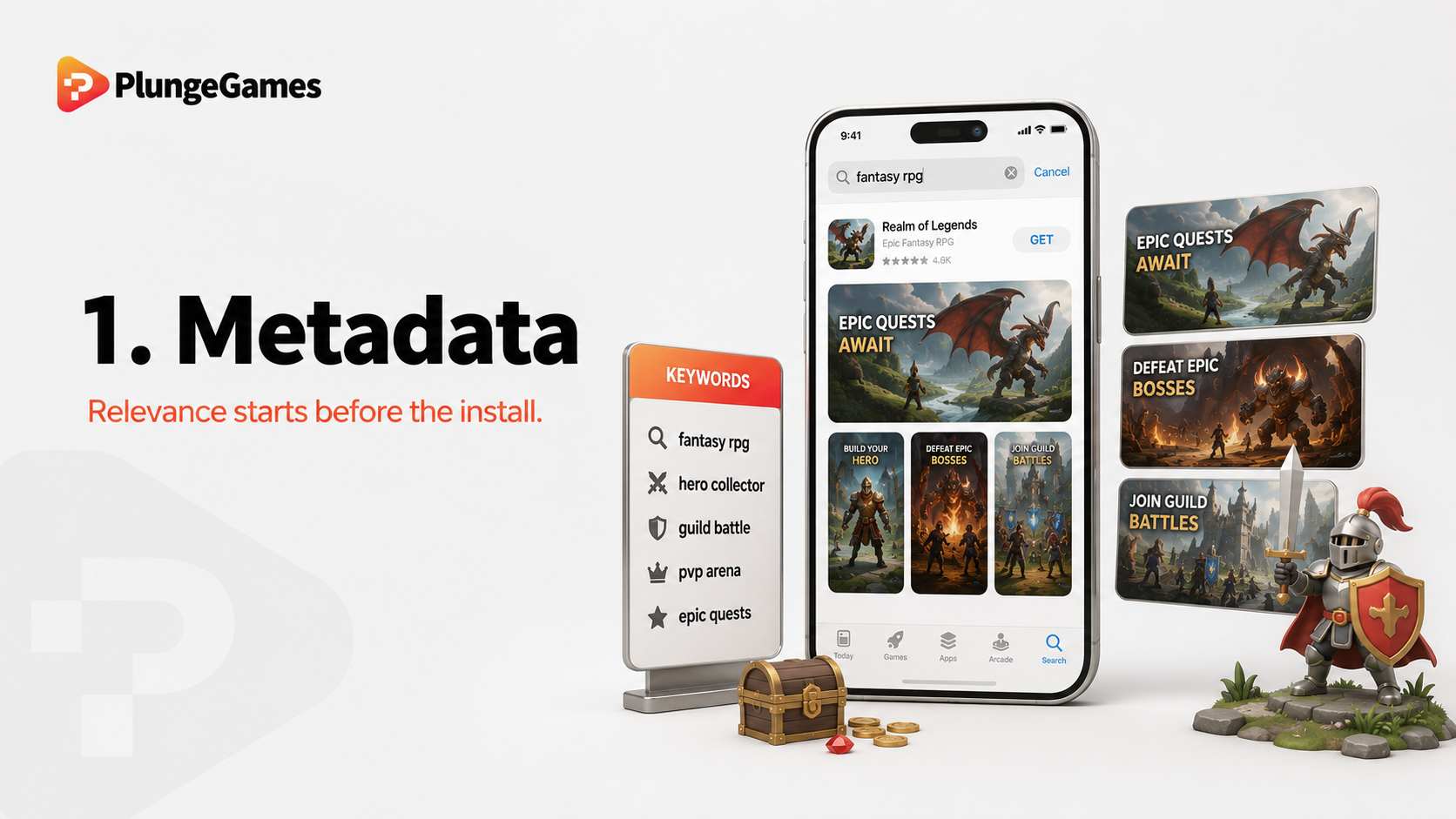
Keywords still matter in ASO for mobile games in 2026. They tell the stores what your game is and who it should show up for. But metadata is now the entry point, not the deciding factor.
For iOS games
On iOS, Apple still indexes the title, subtitle, and keyword field. Since mid-2025, screenshot text has also become part of the searchable surface, which makes screenshot captions one of the easiest places to add relevance without changing the core positioning of the page. Most games still use that space for generic marketing copy. That helps the page feel polished, but it does very little for search.
If the caption says “Play anywhere” or “Join millions of players,” it sounds fine but says almost nothing useful to the algorithm. A better caption tells players what kind of game this is while reinforcing the terms you want to rank for. For a strategy game, that might mean base-building, tactics, or multiplayer. For a casual game, it might be mechanics, mood, or pace.
The mistake most teams make here is optimizing the full screenshot gallery while neglecting what users actually see in search results, which is the first one to two screenshots before they decide whether to tap. If your core value proposition lives in screenshot three or beyond, it effectively doesn't exist for the users who matter most. The first two screenshots need to stand alone as a complete pitch. And captions work harder when they advance a narrative: problem, mechanism, proof, outcome.
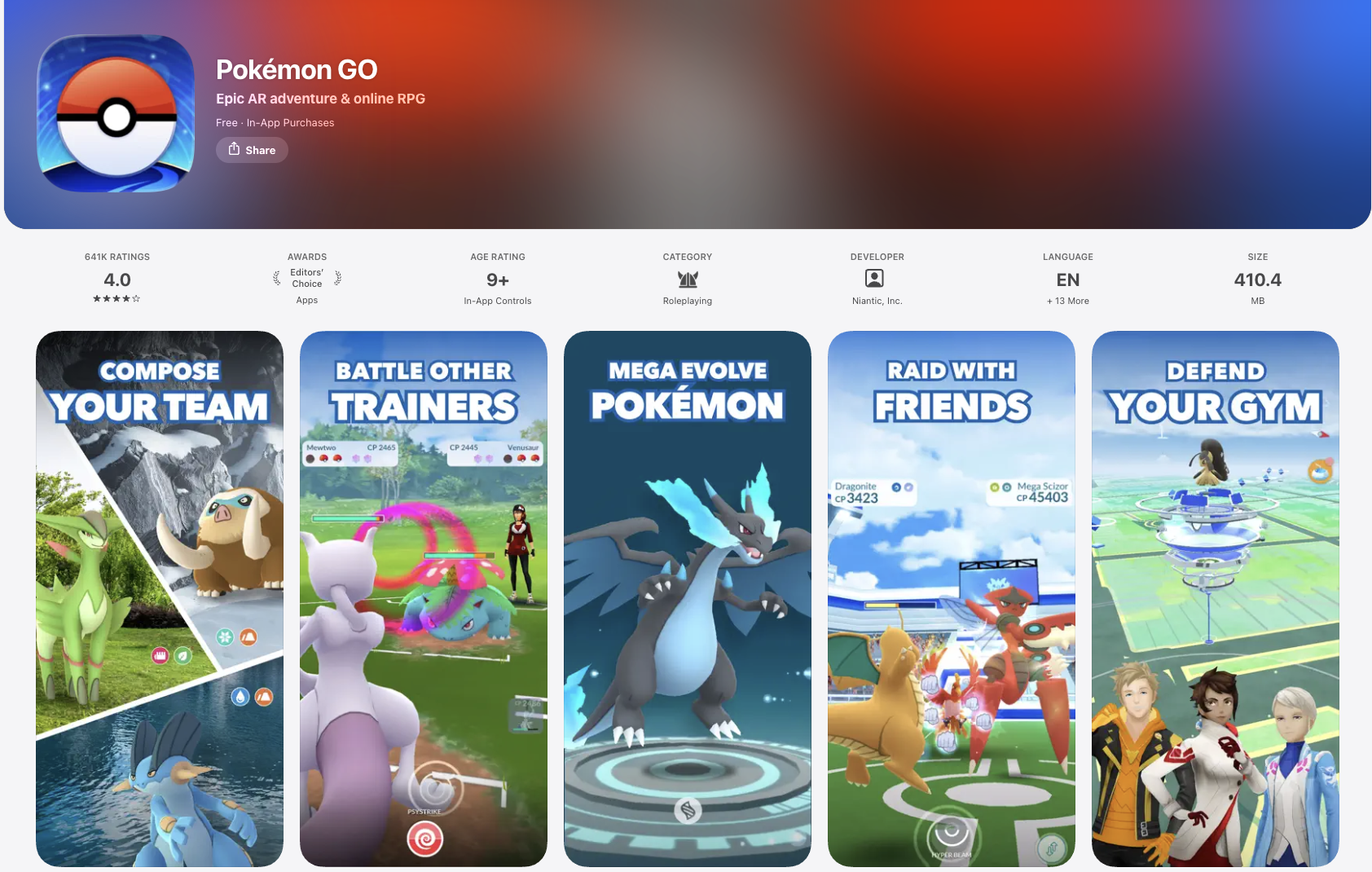
Take Pokémon GO's App Store captions, for example: each one is mechanic-specific and search-relevant.
For Android games
On Google Play, the full long description is indexed, so the job is not to cram keywords into it. The job is to cover the language players actually use when they search for games. Google reads for semantic relevance, not repetition. Players usually search by mood, mechanic, and subgenre: “idle RPG offline,” “merge game relaxing,” “city builder no internet.” That means your keyword matrix should start with player intent, then be checked against what is already ranking in your category. A useful rule of thumb is roughly one keyword per 250 characters, using natural language.
That means your keyword matrix should start with player intent, then be checked against what is already ranking in your category. Volume matters, but it's not enough on its own if the term doesn't match how players describe the game. The best keyword sets usually sound like real search behavior, not a list of marketing terms.
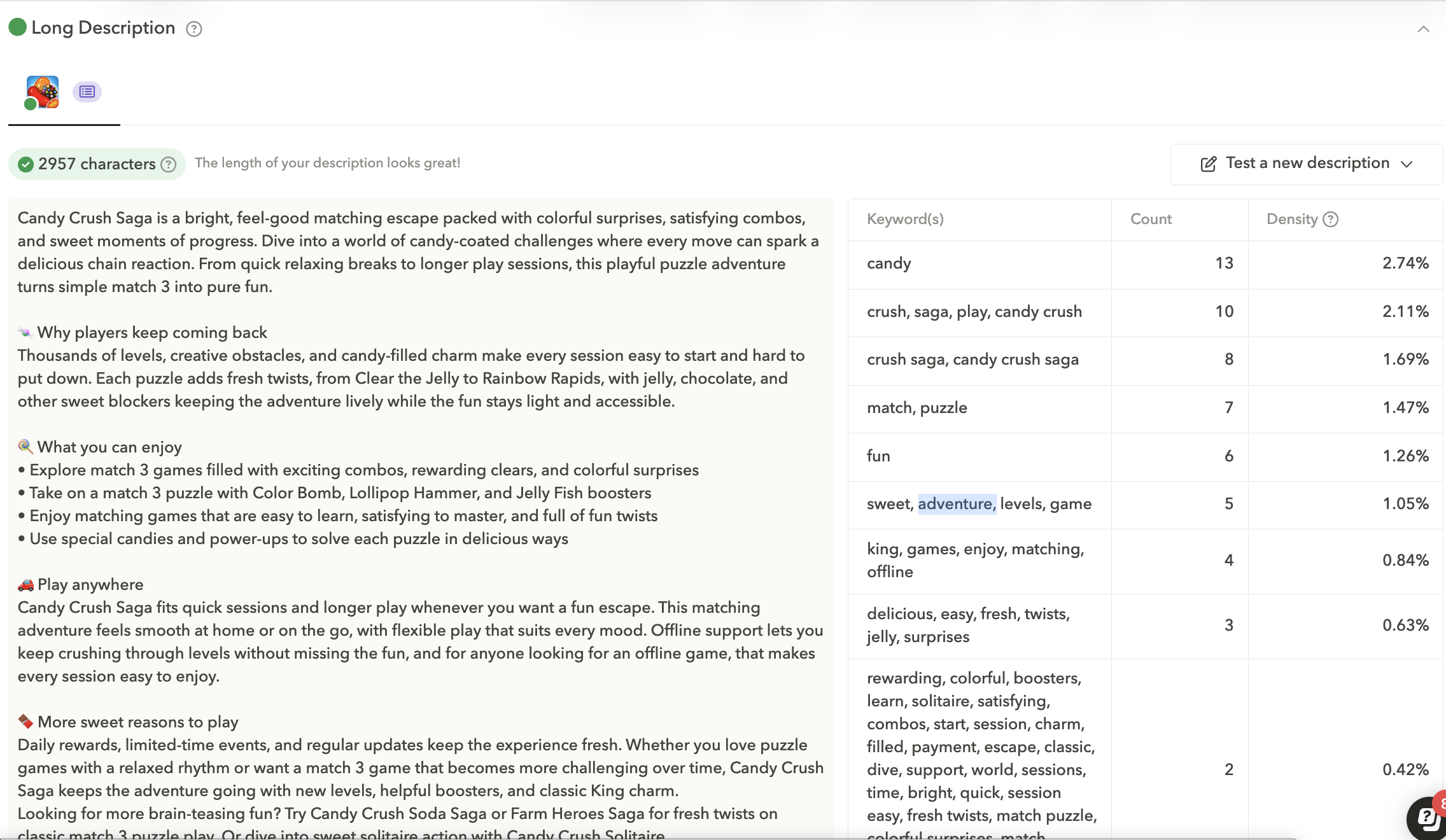
Candy Crush Saga's Google Play description, for example, distributes mood, mechanic, and subgenre terms naturally, with no single keyword dominating the density.
For keyword tracking and visibility monitoring, AppTweak and Sensor Tower are the tools worth knowing at the top end. It's also worth noting that Sensor Tower absorbed data.ai, so the market has effectively consolidated around a smaller set of platforms than it used to be.
Layer 2: Store page conversion is the signal algorithms watch the closest
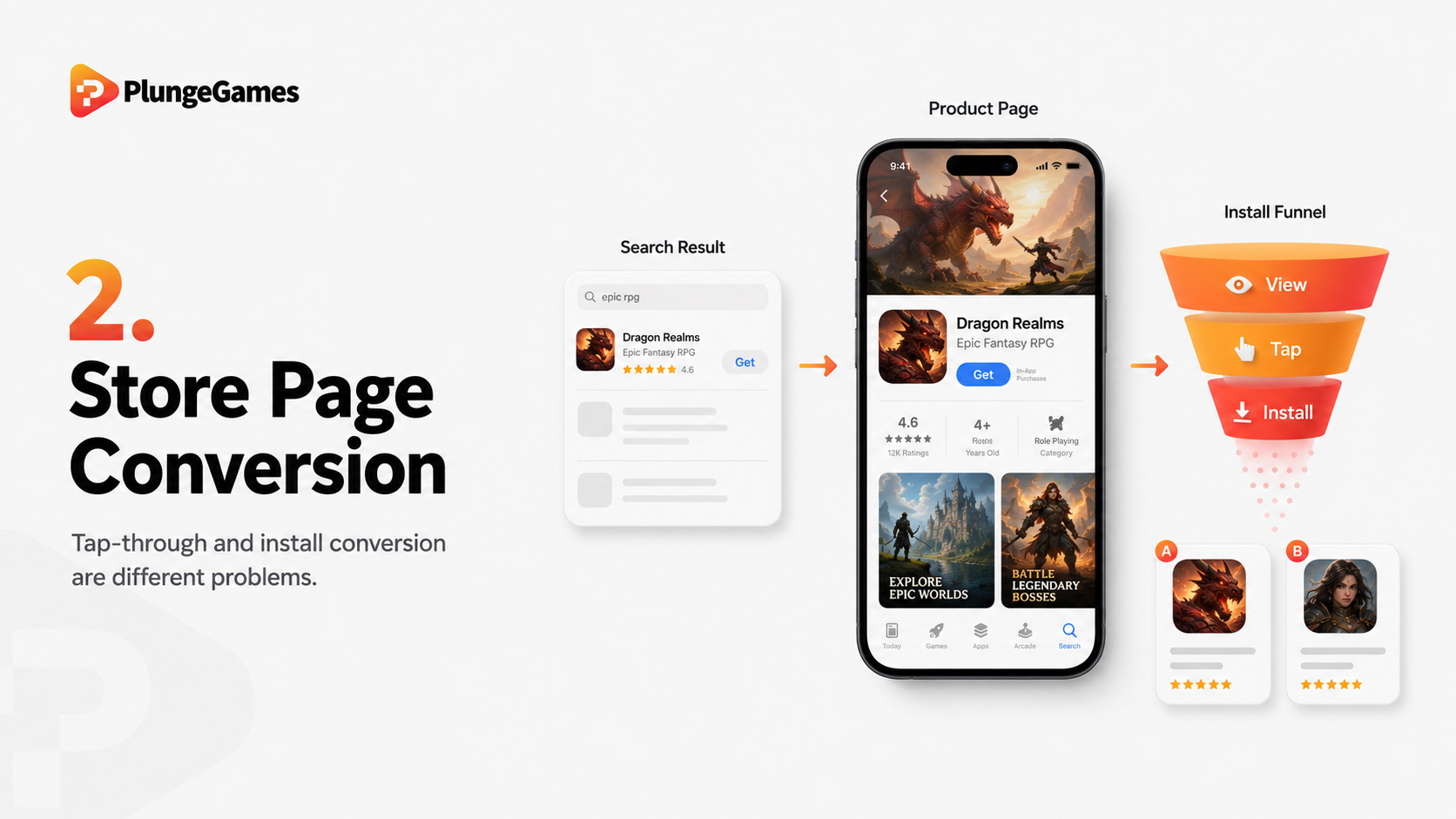
Your icon, first screenshot, and preview video are critical app store ranking factors in 2026. Both stores watch conversion rate closely, because a page that turns impressions into installs tells them the listing matches what people wanted. If the page doesn't convert, keyword coverage alone won't carry it.
One thing worth separating before going further: tap-through rate and conversion rate are not the same signal:
Tap-through rate measures impression to page view. It's driven by your icon, name, and rating in search results
Conversion rate measures page view to install. It's driven by your screenshots, preview video, and description
If you're only looking at overall conversion, you might be fixing the wrong thing.
Apple’s Custom Product Pages
On iOS, Custom Product Pages are the highest-leverage surface here to improve ASO for mobile games in 2026. Apple now lets you create up to 70 versions of a product page, each with its own screenshots, promo text, and preview assets. Apple also says CPPs can surface in relevant search results, which makes them useful for more than paid traffic. The real value is matching the page to the intent behind the tap. A user coming from an idle RPG keyword should not land on the same page as someone who clicked a puzzle creative.
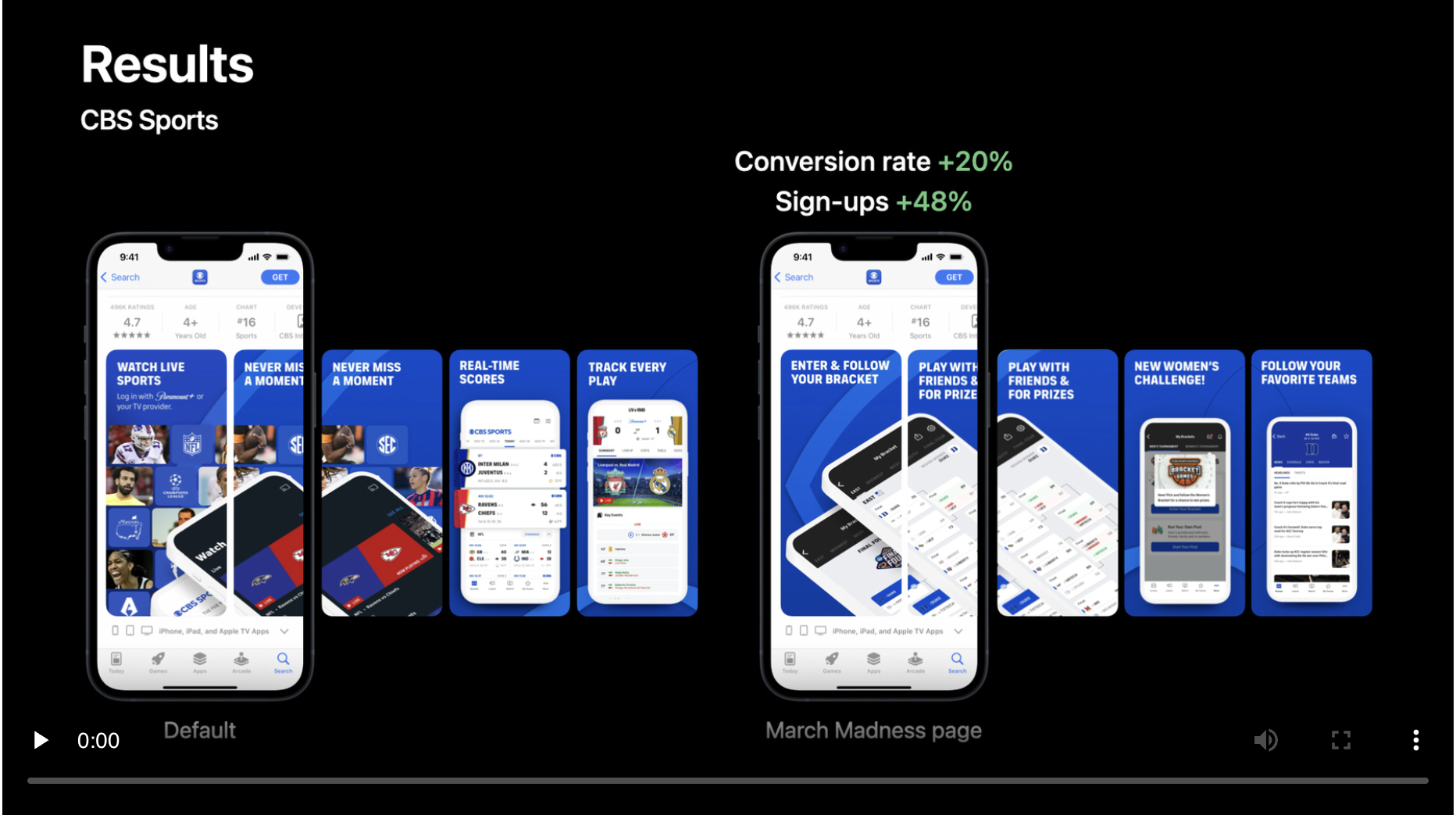
If you optimize CPPs well, the numbers are hard to ignore: Apple says referrals to a custom product page can produce a 156% lift vs the default product page. But, third-party benchmark data suggests most apps still haven't made CPPs part of their regular workflow. That makes it one of the clearest conversion wins still sitting on the table.
When it comes to segmentation logic, it’s drastically different for games than apps:
Apps typically segment CPPs by job-to-be-done or persona
Games segment more effectively by player motivation or fantasy: relaxation vs competition vs narrative, all pointing at the same game
The anti-pattern to avoid on both is building a CPP per campaign rather than per durable intent cluster. You only have 70 slots, and campaigns rotate faster than intent clusters do. Build pages around stable motivations, then route multiple campaigns to the same page.
Google’s Store Listing Experiments
On Google Play, Store Listing Experiments are the native testing layer. Google built them to help optimize installs and conversion, and the console also surfaces 1-day retention for each variant. That matters because you aren’t just testing what gets the most taps. You’re also seeing which creative choices line up with users who stick.
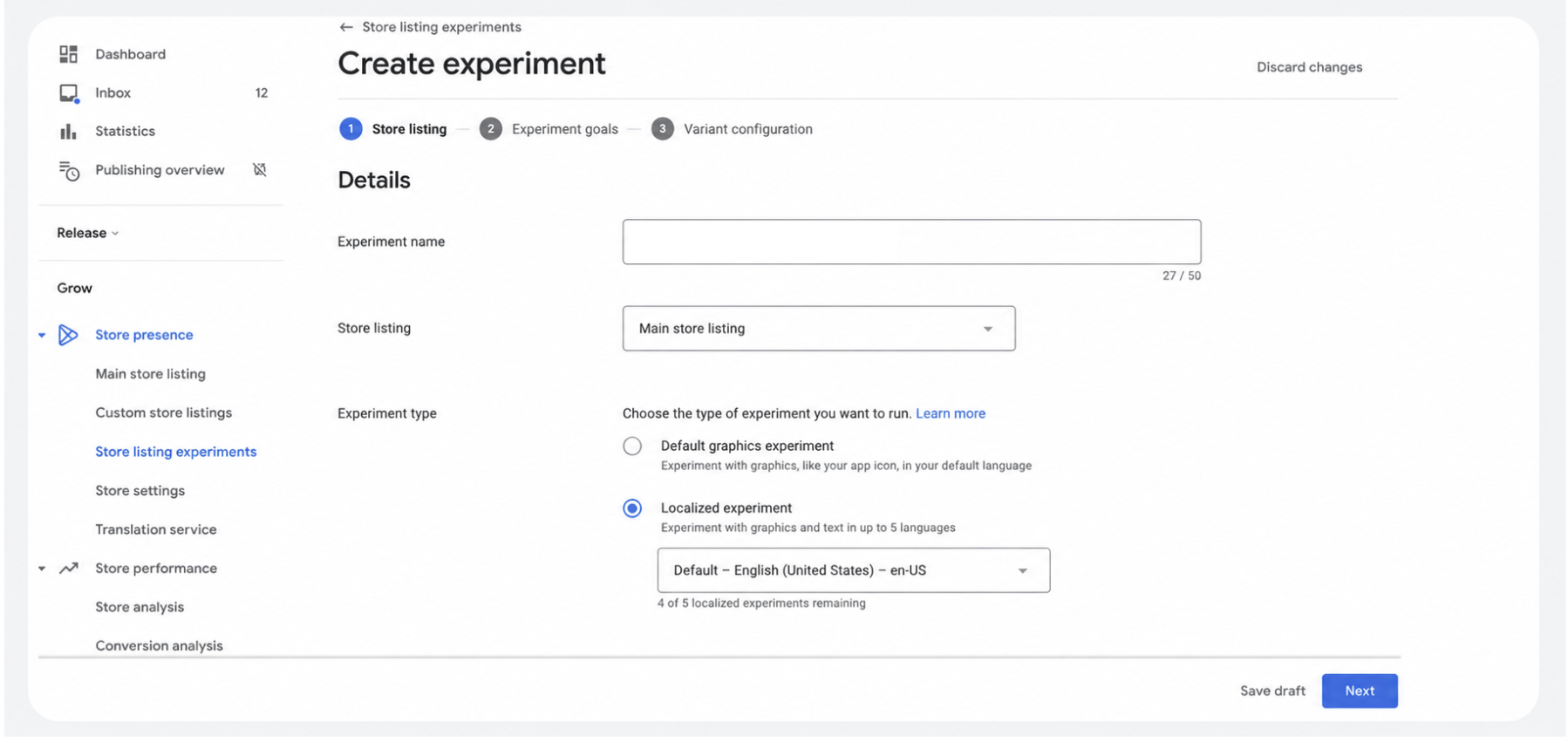
Google Play Console's Store Listing Experiments — set up under Grow > Store presence, with options to test default graphics or localized variants.
Studios running two to three experiments per quarter on icon and screenshot variants consistently see CVR lifts that feed directly into organic ranking. The practical approach is to test one variable at a time - icon vs icon, or first screenshot vs first screenshot - so the result is readable. Run the experiment for a minimum of two to four weeks to get statistical significance before calling a winner — less than that and you risk reading noise as signal. When a variant wins, let it run for at least a week before testing the next element so the new baseline has time to stabilize.
For conversion and creative testing, the native Apple and Google testing platforms cover most needs. SplitMetrics and Geeklab are worth knowing for pre-launch or off-store testing. They let you validate creative before committing to a full experiment cycle.
Layer 3: Post-install signals are where ranking gets shaped
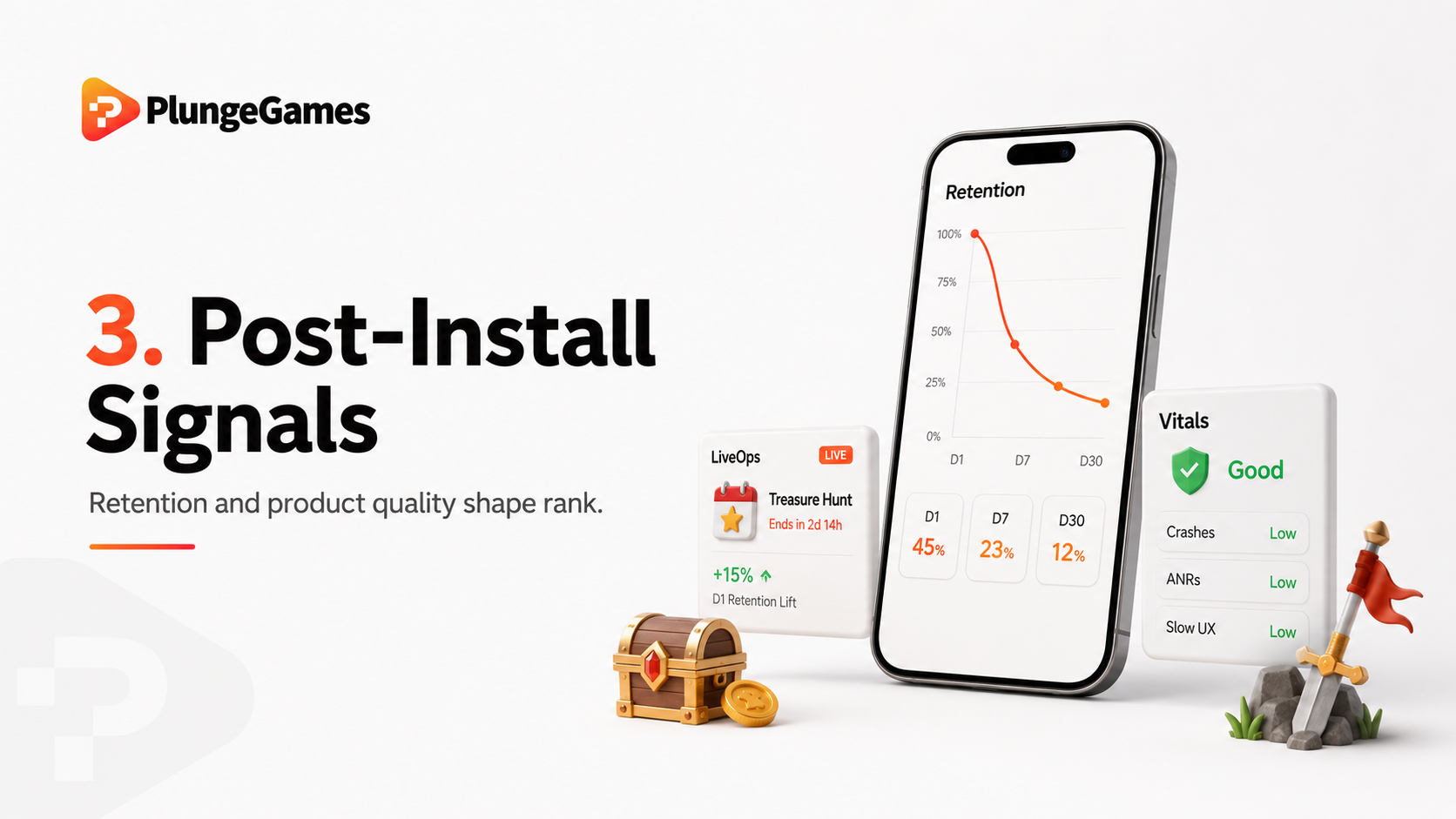
This is the layer most mobile game ASO guides skip because it sits outside the store page itself. But when it comes to app store ranking factors in 2026, what happens after install matters more than ever. D1 and D7 aren’t magic thresholds, but they’re useful markers for whether your game is giving the stores a reason to keep sending traffic. If those numbers are weak, the store page is doing its job and you need to instead look at the game itself.
Level Up Program
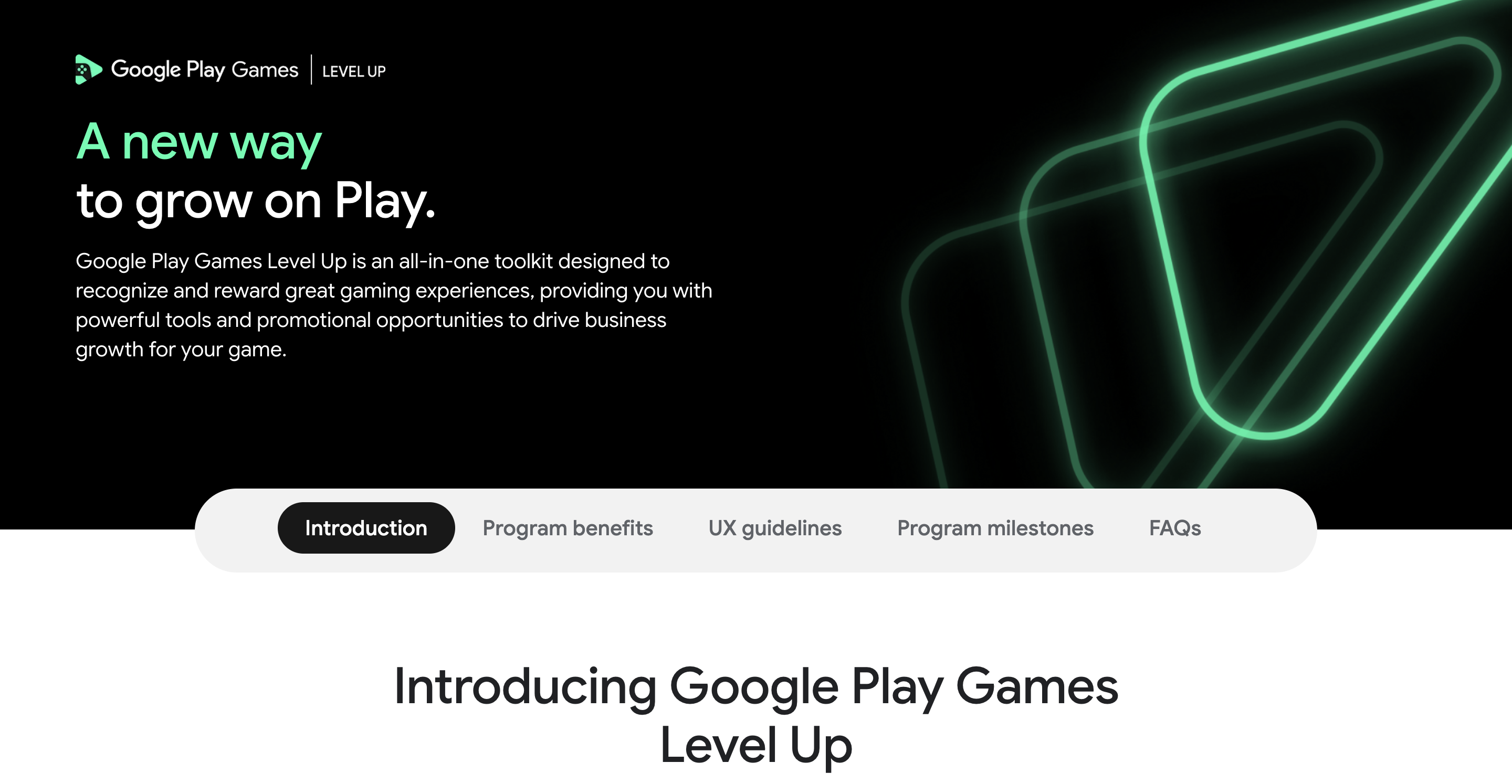
Google Play's Level Up program makes that shift visible. Google says the program is open to all games and is meant to drive engagement and business growth through better tools, insights, and promotional opportunities. It rewards strong player experiences and gives games more ways to surface across Play. That makes LiveOps, rewards, and re-engagement part of how the store decides what to surface.
A seasonal event that pulls lapsed players back in can do more than add short-term revenue. It can raise the kind of engagement signals the Play Store is designed to notice.
In-App Events
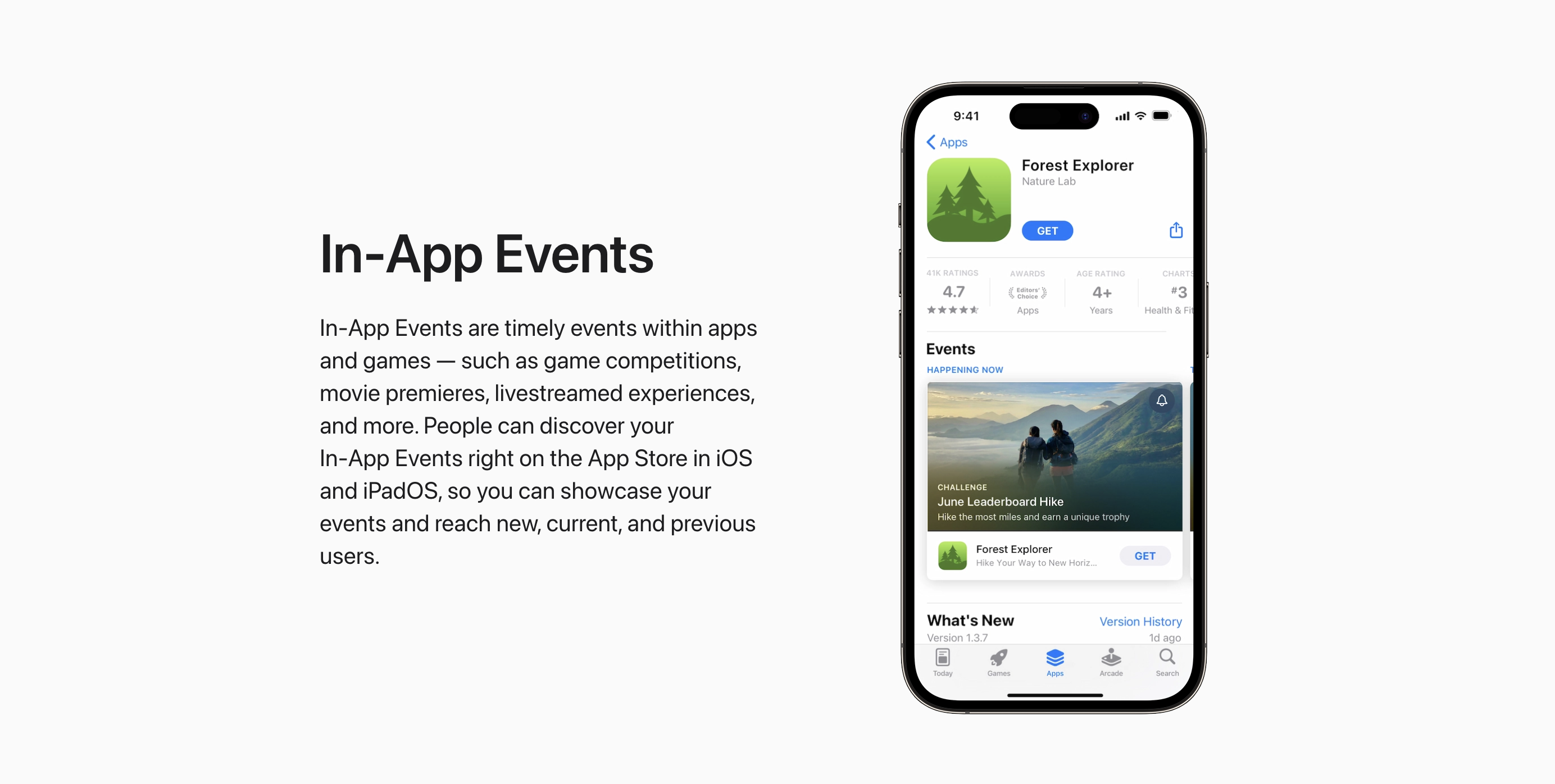
Apple's In-App Events work in a similar way. They appear on the product page, can surface in search, and give you another way to bring back churned users while keeping the listing active.
This is where most teams create an avoidable gap. LiveOps and ASO should share a calendar and a brief. If a seasonal event, feature drop, or progression update is going live, the store presence should be planned around it in advance. Otherwise, one team is creating engagement spikes the other team never turns into visibility.
Android Vitals
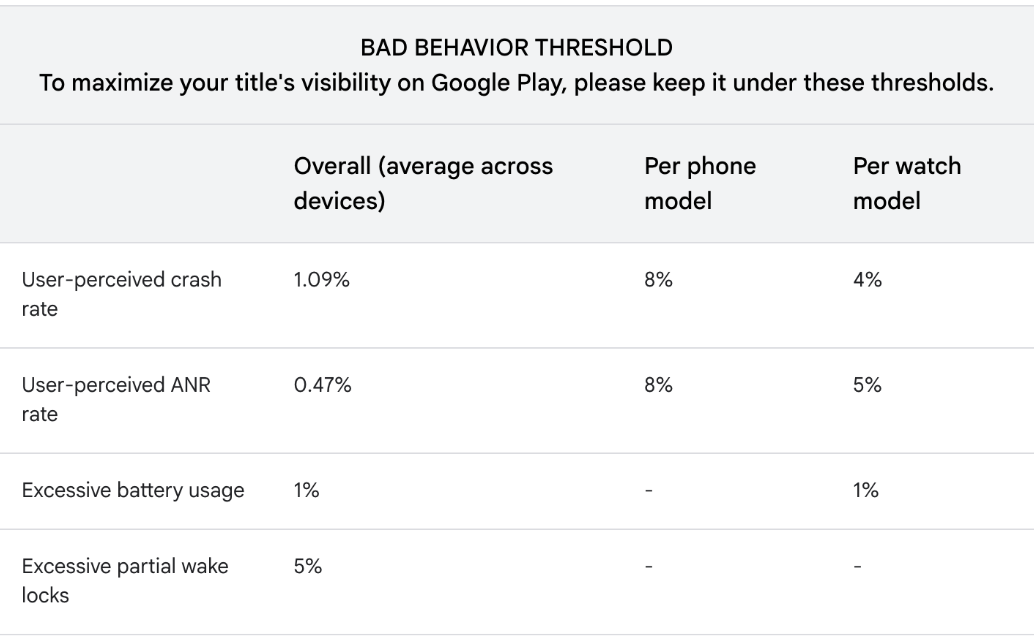
Android Vitals is the technical layer of the same story. Google uses it to track stability and performance, including crash rate and ANR rate on real devices. If rankings drop after a build, this is one of the first places to check before assuming the problem is keywords or metadata.
Layer 4: Paid can inform organic performance
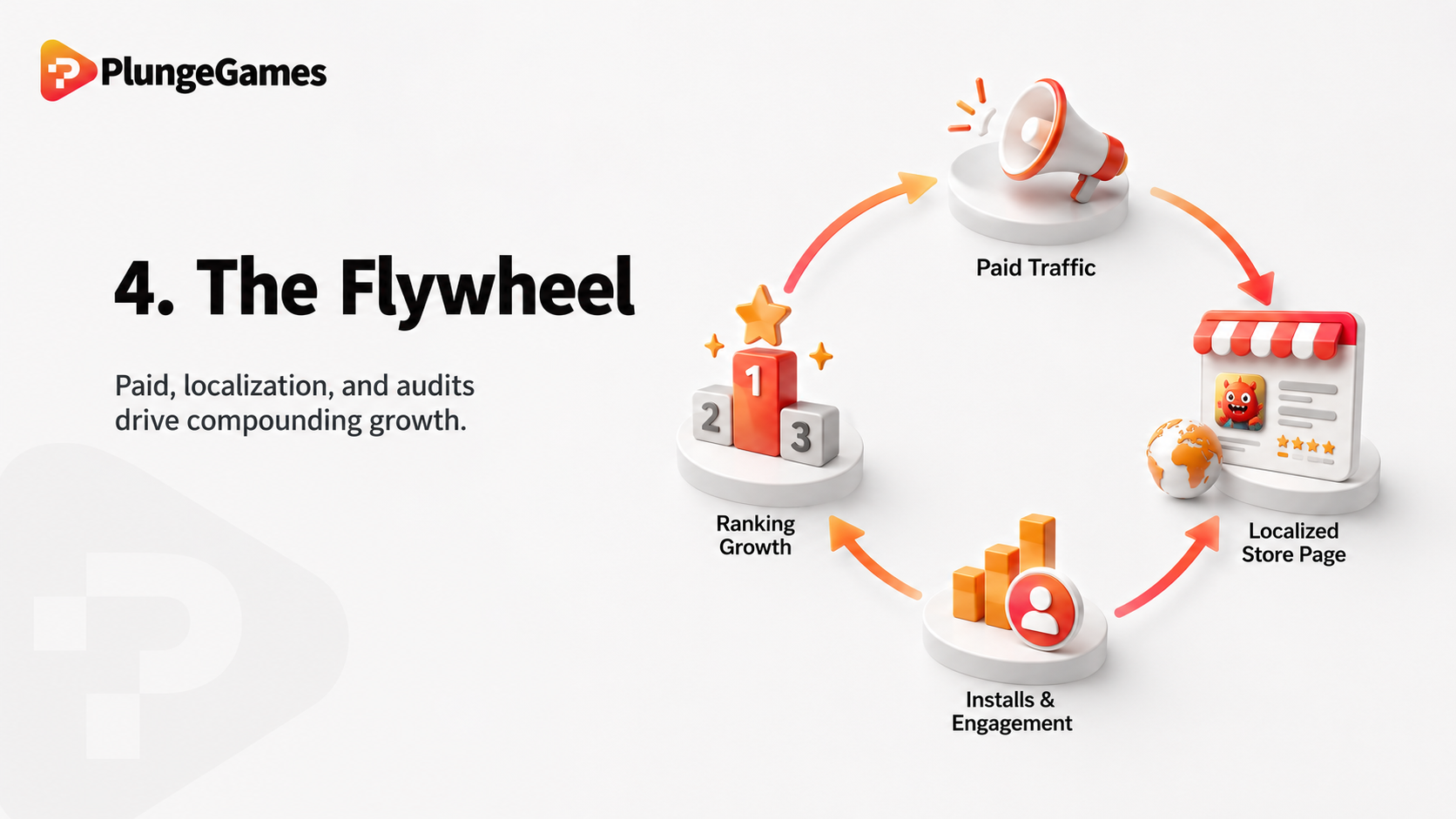
Paid campaigns don't directly boost organic ranking. Neither platform has confirmed a formal link between ad spend and organic positioning, but that doesn't mean paid is irrelevant to how you rank. What paid campaigns do is change the quality of the behavioral signals the algorithm sees. When the installs are good, paid reinforces the same retention pattern your organic growth depends on. When they're not, it does the opposite.
Apple Search Ads and Google App Campaigns are most useful when they're part of the same strategy as the store page. They can validate keyword intent and bring in users whose behavior tells the stores the listing is relevant. That works best when the ad promise, the store page, and the onboarding all line up. A user who clicks an ad for an idle RPG should land on a page that looks and feels like an idle RPG, then hit a first-session experience that delivers on that promise.
The right review question is simple: which paid sources produce users whose D1 and D7 retention look like your best organic cohort? A practical cadence that works:
Review D1 and D7 by channel weekly or on meaningful spend shifts
D30 and LTV monthly
Per-creative retention only once a creative has enough cohort volume to read properly
The trap most teams fall into is rotating creative faster than retention can mature, which means you never actually learn which creative brings sticky users.
This is why app store optimization for mobile games needs to sit in the same conversation as UA, not run separately from it. The keyword set, the creative, the store page, and the onboarding should all tell the same story.
Bonus layer: Localization is the underused ASO lever for mobile games in 2026
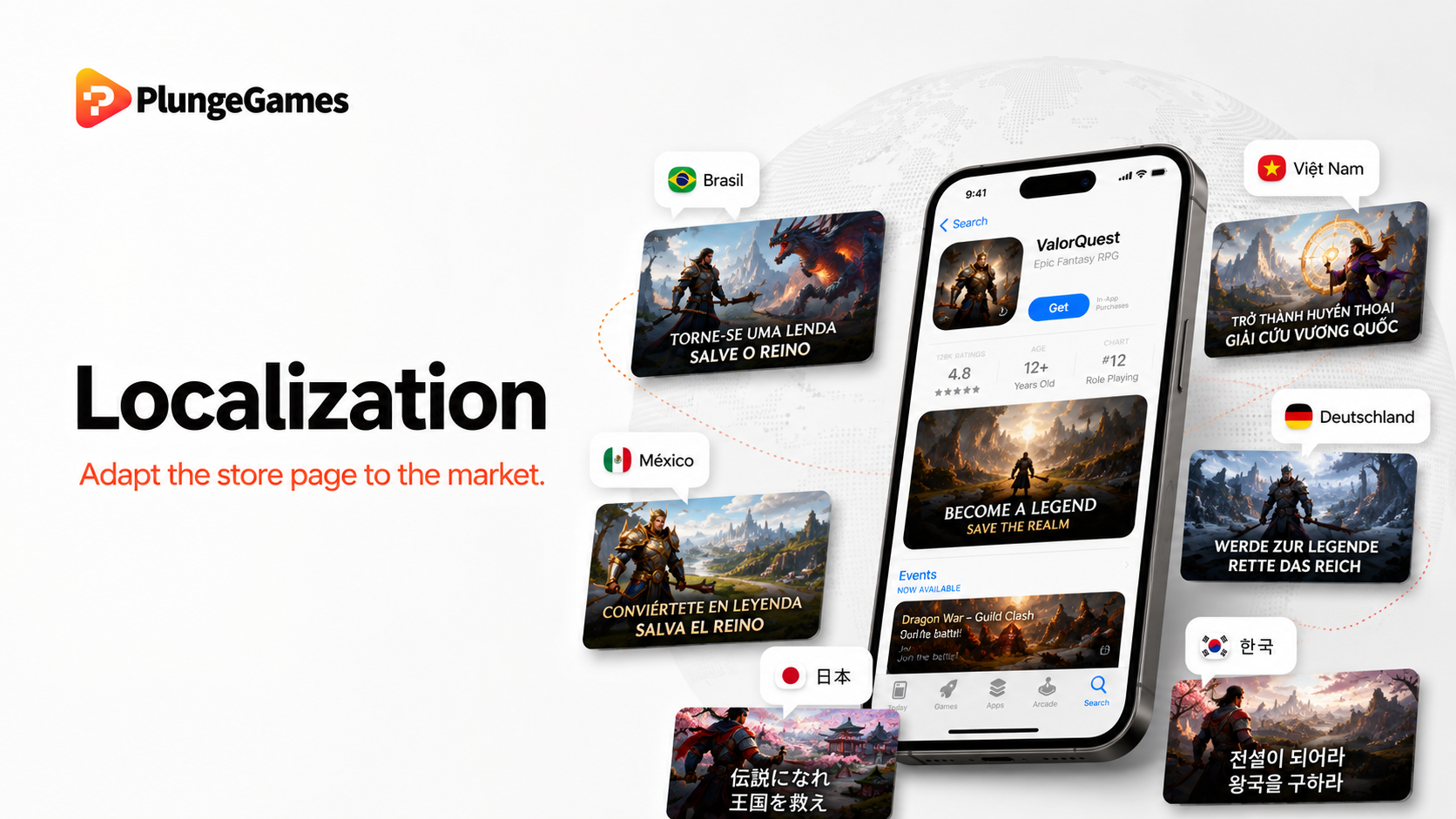
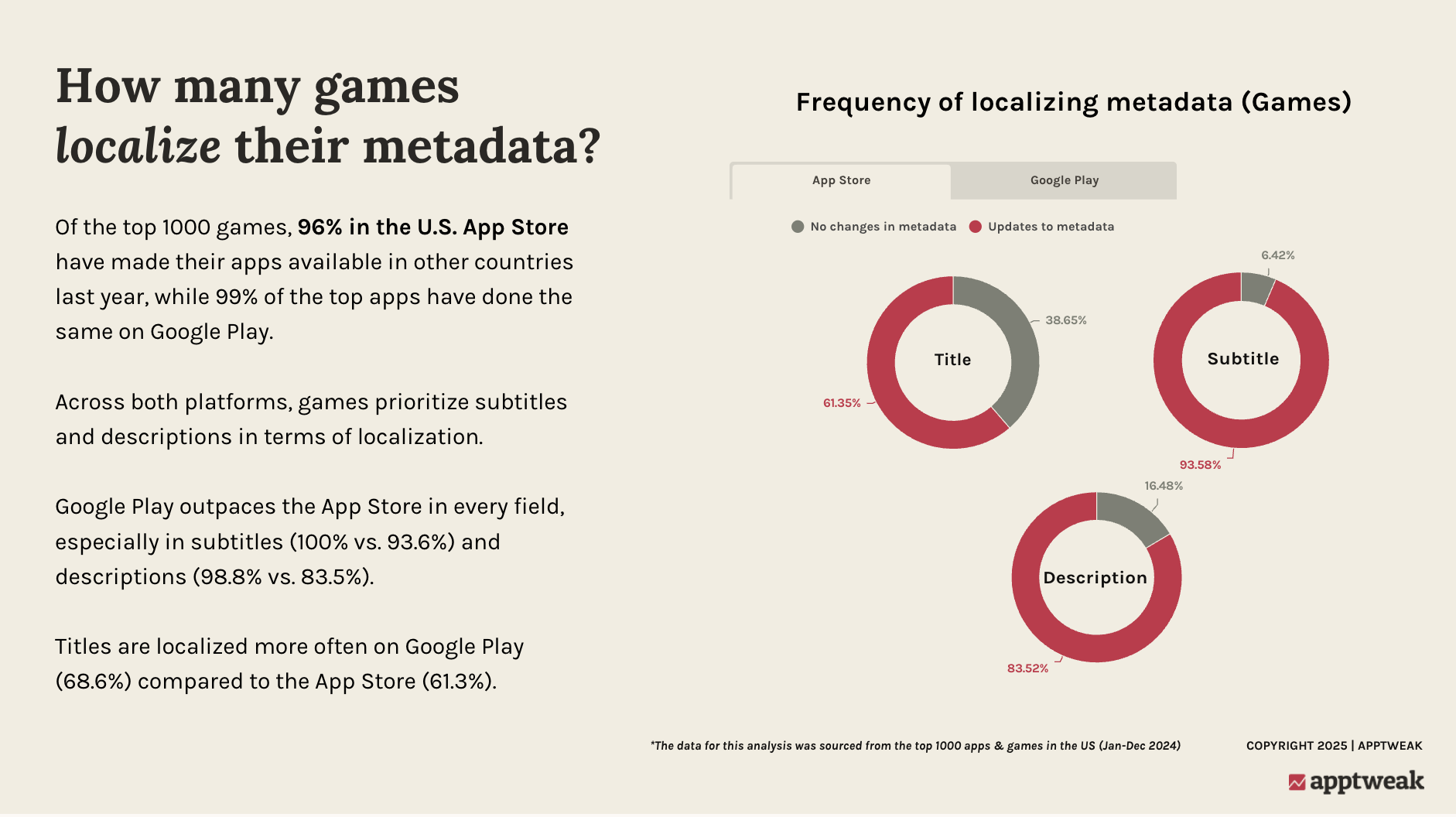
AppTweak's ASO trends & benchmarks report 2025 shows that localization is already widespread among top apps and games, but the gap is still meaningful: 69% of games on Google Play localize their title, and 96% of top games localized their metadata in 2024. The real question isn't whether to localize, but which markets to prioritize first.
The instinct is to start with the biggest markets, but that's not always the best move. A mid-sized market with strong search demand for your subgenre and weaker localized competition can be more valuable than a larger market where you're buried behind better-optimized rivals. High-volume markets that often get underestimated, like Brazil, Indonesia, Vietnam, and Mexico, are worth prioritizing because strong install volume in those markets generates the retention and engagement signals both stores use as ranking inputs. More installs from engaged users means stronger behavioral data, which feeds ranking more broadly, not just locally.
If you're localizing anything first, prioritize the title and screenshots. Those are the parts most immediately visible and most likely to influence the install decision. Apple's Localize app information page and App Store localizations reference explain how localized app information is handled in App Store Connect.
One tactical note to validate in your current setup: adding English variants like UK and AU alongside US English can sometimes expand indexed keyword coverage on iOS, but Apple's behavior can change, so it's worth testing rather than assuming. The practical filter is simple: localize where your genre has real search demand and the charts aren't already saturated with strong local competitors. That makes localization a ranking strategy, not just a translation project.
A 10-point self-assessment
A real audit of how to rank in the app store covers the full funnel and, critically, separates tap-through rate from conversion rate. Most teams react to ranking drops and swap keywords. A better cadence is a full audit quarterly, continuous rank and CVR monitoring in between, and triggered audits on OS releases, major competitor repositions, or your own significant launches.
10 questions to guide your mobile game ASO review:
Do you know which keywords you rank for now, and which ones you lost in the last 90 days?
Do you know your store page conversion rate, and how it compares with your category average?
Do your screenshot captions contain target keywords on iOS, or are they still generic marketing copy. And do your first two screenshots stand alone as a complete pitch before anyone taps through?
Do you know your D1 and D7 retention relative to your category benchmark?
Do you have Custom Product Pages or Store Listing Experiments running, and do you know what they are testing?
Does your LiveOps calendar connect to your ASO strategy, or do they run in parallel without overlap?
Do you know your Android Vitals score, and whether crashes or ANRs are helping or hurting visibility?
Do you know which markets you have localized for, and which ones you are leaving untouched?
Do you know whether paid UA is bringing in users who behave like your best organic cohort, or whether it is diluting that signal?
Do you know when you last ran a structured ASO audit before rankings dropped?
Teams that treat ASO for mobile games in 2026 as an ongoing operating system tend to spot problems before they become expensive. Teams that treat it as a metadata refresh usually find out after organic share has already moved.
Want a second opinion on your ASO strategy? Get in touch — we help studios find and fix the gaps before they show up in the numbers.