Building a LiveOps Engine That Scales From Day One
Learn how to build a LiveOps engine with player-level offers from day one. A practical guide to the data layer, offer logic, and and a quick audit.
Most studios treat LiveOps and monetization as something bolted onto a game after it ships. It’s a content calendar added once the core loop is live or a pricing tier layered on once the game already has an audience. NCsoft just spent $300M proving that a full LiveOps system is the key to profitability - and though they’re building it into existing games, the reality is that the earlier it happens, the better.
Across four separate acquisitions, NC has spent $300M on four studios and isn't stopping there. But the real story isn’t M&A - it's OptiFlow, the centralized, proprietary platform NCsoft is building underneath every casual game studio it swallows. OptiFlow is one engine that handles UA, distribution, and AI-personalized offers across a portfolio that used to be four separate businesses.
That's institutionalized game economy design, and it points at a lesson that has nothing to do with how much cash a Korean publisher has to spend on acquisitions. A scalable LiveOps and monetization model is an architecture decision that should be made at the start of a studio's life, rather than after its portfolio is already live. A solo studio shipping its first game is staring down the exact same foundational decision NCsoft is now retrofitting across four studios at once. The only difference is how expensive it is to fix later.
A single engine driving 30% of a $3.6B portfolio
The headline number is the acquisitions: four casual gaming studios, $300M, in a run that shows no sign of slowing. But the more telling number is that NC's mobile casual portfolio - with OptiFlow running across its titles - is now responsible for 30% of a roughly 5 trillion South Korean won (~$3.6B) business line.
Strip away the acquisition narrative and what's left is a bet on a specific operating thesis: centralized, player-level offer logic outperforms per-game static pricing at scale. And the earlier a studio builds toward that architecture, the less expensive it is to reach. NCsoft isn't treating each newly-acquired studio as an independent P&L bolted onto the balance sheet. Every studio becomes a new distribution surface feeding the same underlying economy engine, aka OptiFlow.
What a centralized offer system actually does differently
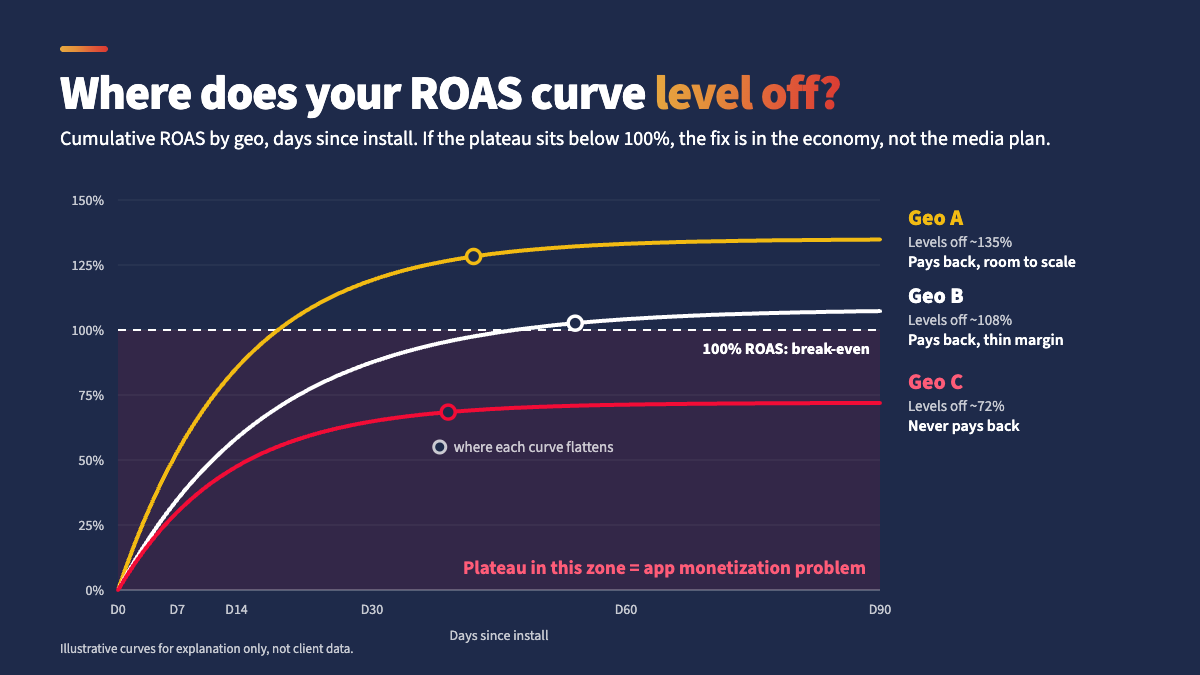
A foundational offer engine like OptiFlow can be simplified into three moves: read player behavior, price per individual, and route offers accordingly.
Mechanic: A centralized system ingests player behavior across every title in a portfolio or across every player segment within a single game. It then generates offers per individual player rather than per static pricing tier or per-game offer ladder.
Psychology: The old way looked like segmenting players into cohorts and pricing each cohort the same. And it’s where offer-fatigue and churn happen as every player in a bucket gets asked to pay the same price regardless of what they'd individually pay right now. Personalization closes that gap by pricing the individual instead of the bucket, so the ask finally matches what that specific player is willing to spend.
Outcome: Higher realized ARPPU per cohort, without raising sticker prices anywhere. The lift comes from the offer surface adapting to the individual instead of the segment.
None of that mechanism requires four studios or $300M to exist. It requires the data layer and the offer logic to be designed as infrastructure from the beginning. This way, LiveOps stops being a content calendar and starts becoming a pricing algorithm.
Designing offer logic that scales
Treat player-level personalization and cross-cohort data infrastructure as a day-one design decision, especially if you’re a single-game studio.
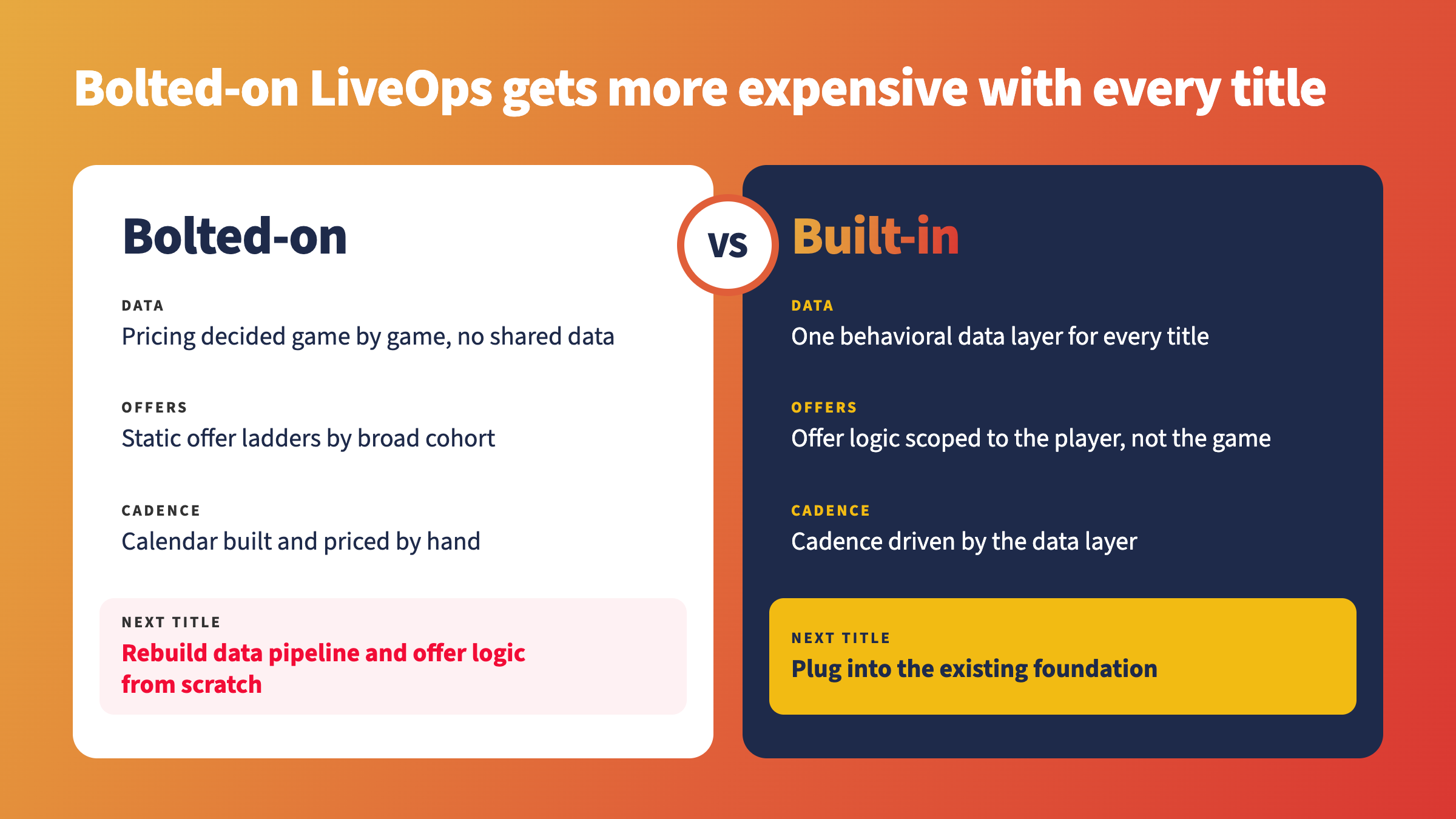
Bolted-on LiveOps
Here's what "bolted on" looks like in practice, and it's the default for most studios:
Static offer ladders segmented by broad cohort
A LiveOps calendar where every offer is built and priced by hand, rather than generated from player data
Pricing decisions made game-by-game with no shared data layer connecting them
Every one of those choices works fine at the scale of a single early-stage title. And yet, every one of them becomes expensive the moment a studio ships a second game, because there's no existing infrastructure to plug the new title into. Each addition means building the data pipeline and offer logic from scratch again.
Built-in LiveOps
Here's what "built-in from the start" looks like instead:
A single behavioral data layer that the offer engine reads from, regardless of how many titles currently exist against it
Offer logic that's scoped to the player, not the game, from the very first release. This way, the architecture doesn't need to be rebuilt when you launch another title
A LiveOps cadence that's structured around that data layer, rather than around a static content calendar that has to be manually synced across titles
The reason this matters is that retrofitting a shared data layer across an already-live portfolio - which is precisely what NCsoft is doing right now, at real cost, across four studios simultaneously - is dramatically more expensive than designing for it from the start. The earlier the foundation goes in, the cheaper it is for you to launch and operate every subsequent title.
What to audit in your own studio right now
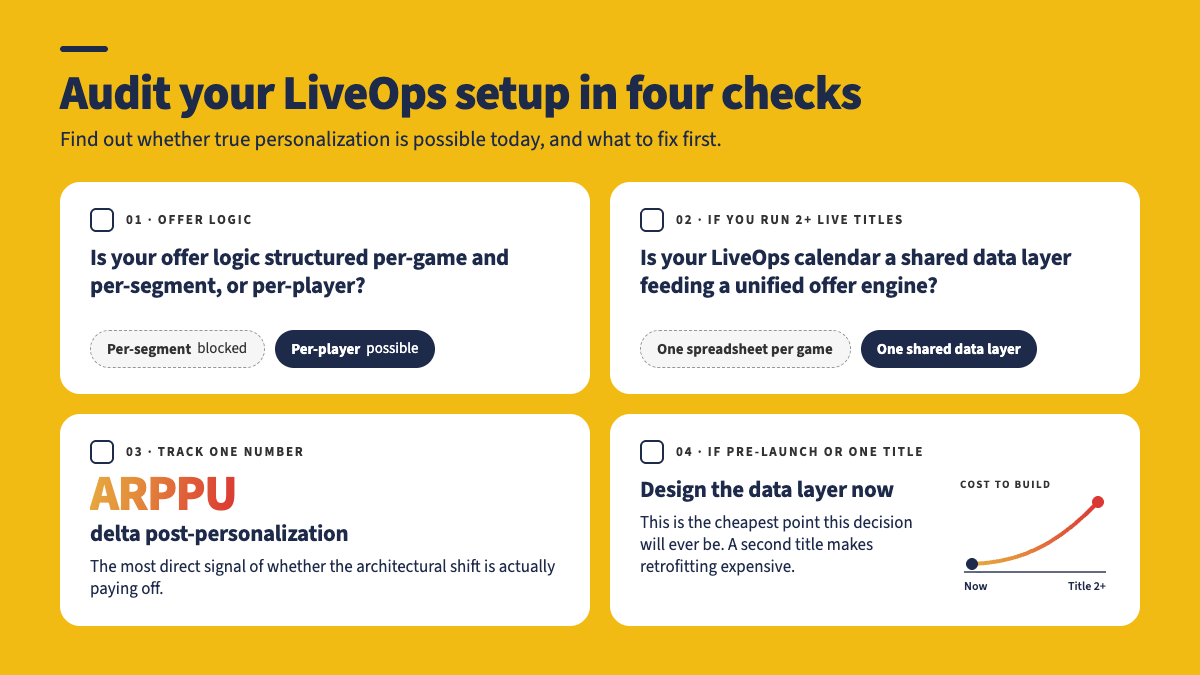
Start with the clearest diagnostic available: is your offer logic structured per-game and per-segment, or per-player? That single question tells you whether true personalization is structurally possible for you today, or whether it's blocked by how the system is architected underneath.
If you're already running more than one live title, check whether your LiveOps calendar is actually a shared data layer feeding a unified offer engine. Or is it a set of disconnected spreadsheets, one per game, that happen to look similar because the same person built them.
Track one number as you make this change: ARPPU delta post-personalization. It's the most direct signal of whether the architectural shift is actually paying off.
If you're pre-launch, or running a single title, this is the cheapest point in your studio's life this decision will ever be. Design the data layer correctly now, before a second title makes retrofitting expensive. Waiting until you need it is waiting until it costs the most to build.
Where per-player LiveOps can fall short
LiveOps personalized on the player level can look like the natural next step. In practice, it doesn’t always work - and here are common reasons why
Lack of human oversight with AI offers
The first is offer quality. We haven't seen AI produce strong offers without a human involved. An algorithm can decide who sees an offer and when. Deciding what makes an offer good, including the bundle contents, the price anchor, and the framing, still depends on someone who understands the game's economy and its players.
Highly complex A/B testing
When every player gets a different treatment, running a clean A/B test becomes very difficult, and reading the results is much harder still. Studios tend to underestimate this cost. In most games, the lift from extreme personalization is smaller than what you lose when you can no longer learn reliably from tests. Testing at that level of complexity generally requires a massive player base, so true per-player LiveOps is out of reach for most studios.
Difficult to diagnose UX issues
When retention dips or conversion drops in a segmented setup, you can trace the problem to a specific cohort and treatment. With full personalization, the player experience becomes largely theoretical. It's hard to know what any individual player actually saw, which makes it hard to calibrate the experience or work out what went wrong.
The right level of personalization depends on the size of your player base, your data infrastructure, and how much you need to keep learning from testing. Plunge Games works with studios to make those monetization calls and build a LiveOps strategy that fits the game, rather than following whatever approach is newest. Talk to us today.