7 ASO Trends Reshaping Mobile Game Discovery in 2026
By Megha Bhargava — ASO Consultant, Plunge Games
Most mobile game teams still treat ASO like a metadata job: update the keyword field, refresh the screenshots, move on. That used to be enough when store visibility was mostly a pre-install problem. In 2026, it isn't. Apple and Google are both indexing more surfaces, AI tools are shaping discovery before players even open a store, and the teams that win are the ones connecting metadata, creative, retention, and LiveOps into one story the store can actually understand.
I watched this shift happen in real time last June. A handful of ASO leads noticed something strange in their App Store rankings: apps with no metadata changes and no ad spend shifts started moving - up or down - for keywords they'd never targeted. AppTweak's anomaly tracker spiked past +6 on June 5-7, the highest reading its Algorithm Change Detector had ever logged. Nobody at Apple confirmed anything for weeks. The ASO community spent that stretch doing what it always does when Apple goes quiet: reverse-engineering a black box from ranking shifts alone.
Source: https://www.apptweak.com/en/free-tools/algorithm-change-detector
That week is a decent proxy for where mobile game ASO sits now. Both stores have been quietly rewriting the rules of discovery over the past eighteen months, and most studios are still optimizing for the rules that applied in 2024. I'm inside these stores every week for game clients, and the gap between top-performing studios and everyone else has never been wider. That gap is the opportunity. Here's the map.
1. AI is now a discovery channel that exists before players reach the store
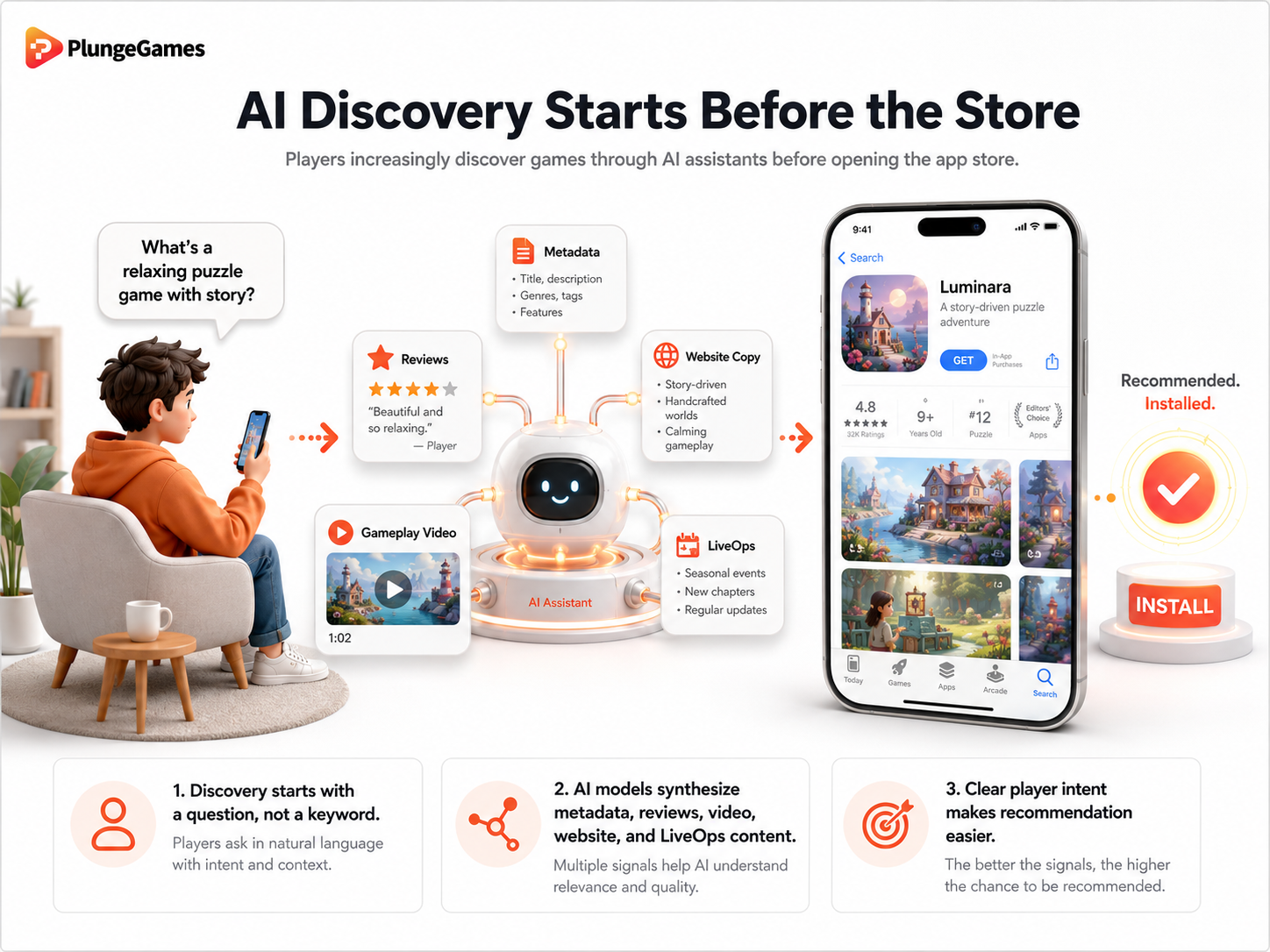
The biggest change in 2026 is that players don't always start inside the store anymore. They ask ChatGPT, Gemini, Perplexity, or Apple Intelligence what to install, and by the time they land on the App Store or Google Play, part of the decision has already been shaped elsewhere. Google's Ask Play rollout in June 2026 makes that shift impossible to ignore on Android: discovery is becoming conversational, semantic, and much less dependent on exact keyword matching.
Source: https://www.yellowhead.com/blog/ask-play-gemini-google-io-2026-aso-strategy/
What changed isn’t just search. Gemini is now recommending apps directly inside conversations, and Google Play is surfacing short-form video and re-engagement content as part of discovery. That means the old question of "how do we rank for puzzle game?" has been replaced by something closer to "how do we become the model's recommendation?" Brand strength helps, but it isn't automatic; visibility depends on how well the model understands your title across metadata, entities, engagement signals, and the way you describe the game on every surface it can see.
Your metadata still matters, but it has to work alongside reviews, gameplay intent, website copy, video, and LiveOps content. If your store listing says one thing, your website says another, and your gameplay clips tell a third story, you're making the model work harder to explain you. AI systems don't pick one source of truth; they synthesize across whatever they can see. More than half of ChatGPT's app citations already point back to a store page. Most teams still undervalue this.
What to do: Start with a surface audit: does your title, subtitle, long description, website, screenshots, and video all tell the same story about why someone plays? For mobile games, this means leading with player motivation - relaxation, competition, progression, story, social play - and not features. Both humans and AI systems route on intent, and the clearer you make it, the less work the model has to do to explain you. Treat short-form video as a storefront asset with an actual production pipeline behind it. And check whether your game is integrated with Play's re-engagement surfaces.
2. Screenshot captions are a ranking signal, but the bigger story is coherence
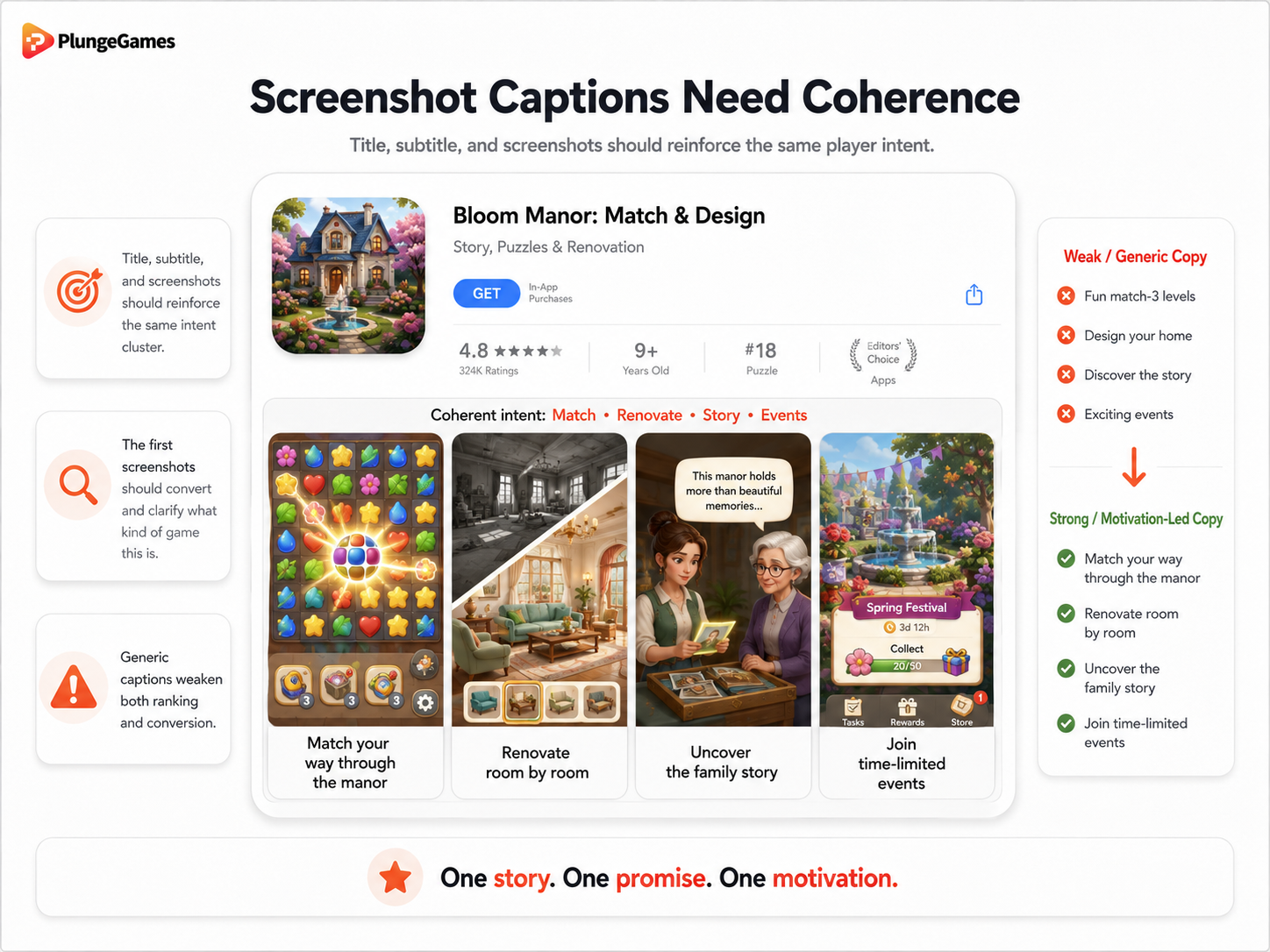
Screenshot captions became part of the ASO conversation after Apple's June 2025 algorithm shift, when teams started seeing signs that caption text could influence search relevance. For me, this update reveals an important pattern: Apple is clearly rewarding richer, more coherent signals across the store surface, and generic screenshot copy still underperforms on conversion either way.
It's about treating screenshots like part of the same semantic system as your title, subtitle, keyword field, reviews, and in-app events. If your screenshots say "Play Anywhere" and your listing is otherwise trying to sell quick matches, team battles, or seasonal events, you're weakening the story the store is trying to understand.

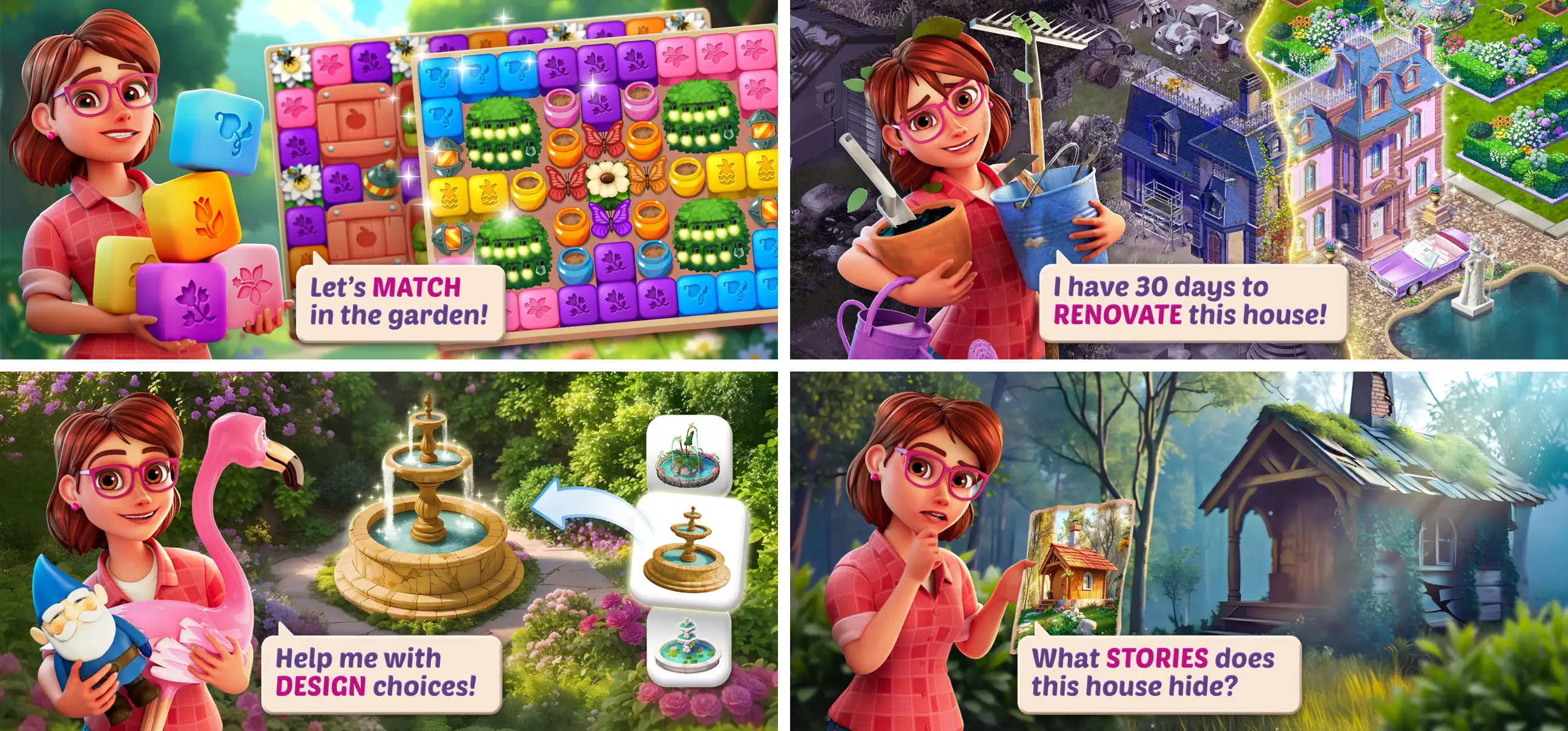
Lily's Garden is a clean example of getting this right: its App Store title is "Lily's Garden: Match & Design" and its subtitle is "Story, Puzzles and Renovation" — match, design, story, and renovation are exactly the four hooks its screenshots lead with. Nothing in the metadata is disconnected from what the screenshots are actually selling.
The first few screenshots should also do two jobs at once: convert the player and reinforce the intent cluster. Lily's Garden's captions do exactly that: "Let's match in the garden!", "I have 30 days to renovate this house!", "Help me with design choices!", "What stories does this house hide?" Four screenshots, four different player motivations, and none of them generic.
What to do: For mobile games, that means the captions need to sound like the game itself, not like a branding exercise. If the game is about quick sessions, say that. If it's about collection, competition, story, or live events, say that. Then test one variable at a time, let each test run long enough to stabilize, and keep the language aligned with the rest of the listing rather than treating screenshots as isolated art direction.
3. Custom Product Pages are now an organic growth lever
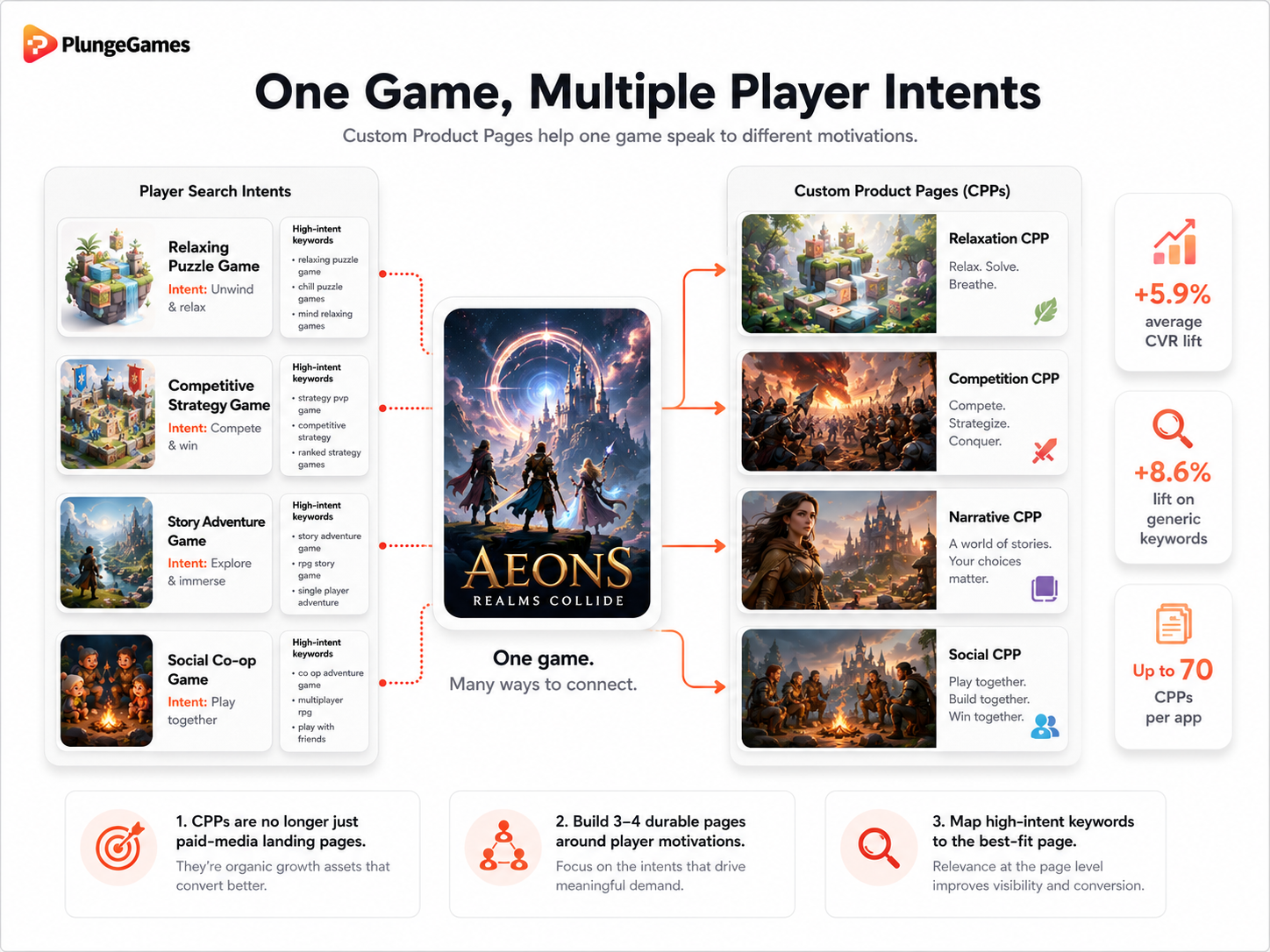
Custom Product Pages used to be a paid traffic tool. Since Apple's July 2025 update let CPPs surface in organic search results, they're part of organic discovery, too, which changes how you should think about them entirely. Apple also doubled the cap to 70 pages per app, which means there's now enough room to build CPPs as a real architecture layer instead of rationing them across a handful of campaigns.
For mobile games, the mistake is still building CPPs around campaigns instead of durable intent clusters. A relaxation player, a competition player, and a narrative player are all looking for different proof points, even if they land on the same game. CPPs give you a way to mirror those motivations with the right screenshots, copy, and promise, instead of forcing every user through one generic page.
That matters because CPPs now do two jobs at once: they can improve conversion and they can help Apple route search traffic into a more relevant page. AppTweak's benchmarks show the upside is real — CPPs lift CVR by 5.9% on average, with the highest lift (+8.6%) coming from generic keyword campaigns. Here's the part worth sitting with: the same report found games mostly build their CPPs around branded terms, while apps lean generic. If generic campaigns are producing the bigger lift and games aren't the ones running them, that's not proof generic doesn't work for games — it's a sign most games haven't tested it. If you're still treating CPPs as temporary campaign landing pages, you're leaving the stronger use case on the table.
What to do: Treat CPPs as a storefront architecture layer, then map each one to a real player intent you expect to keep winning over time. Build 3–4 pages around durable motivations, like relaxation, competition, narrative, and social, with hero art and copy calibrated to that motivation. Link your highest-intent keywords to the matching page so it earns organic placement, not just paid traffic.
4. Google Play is moving from keyword matching to intent matching
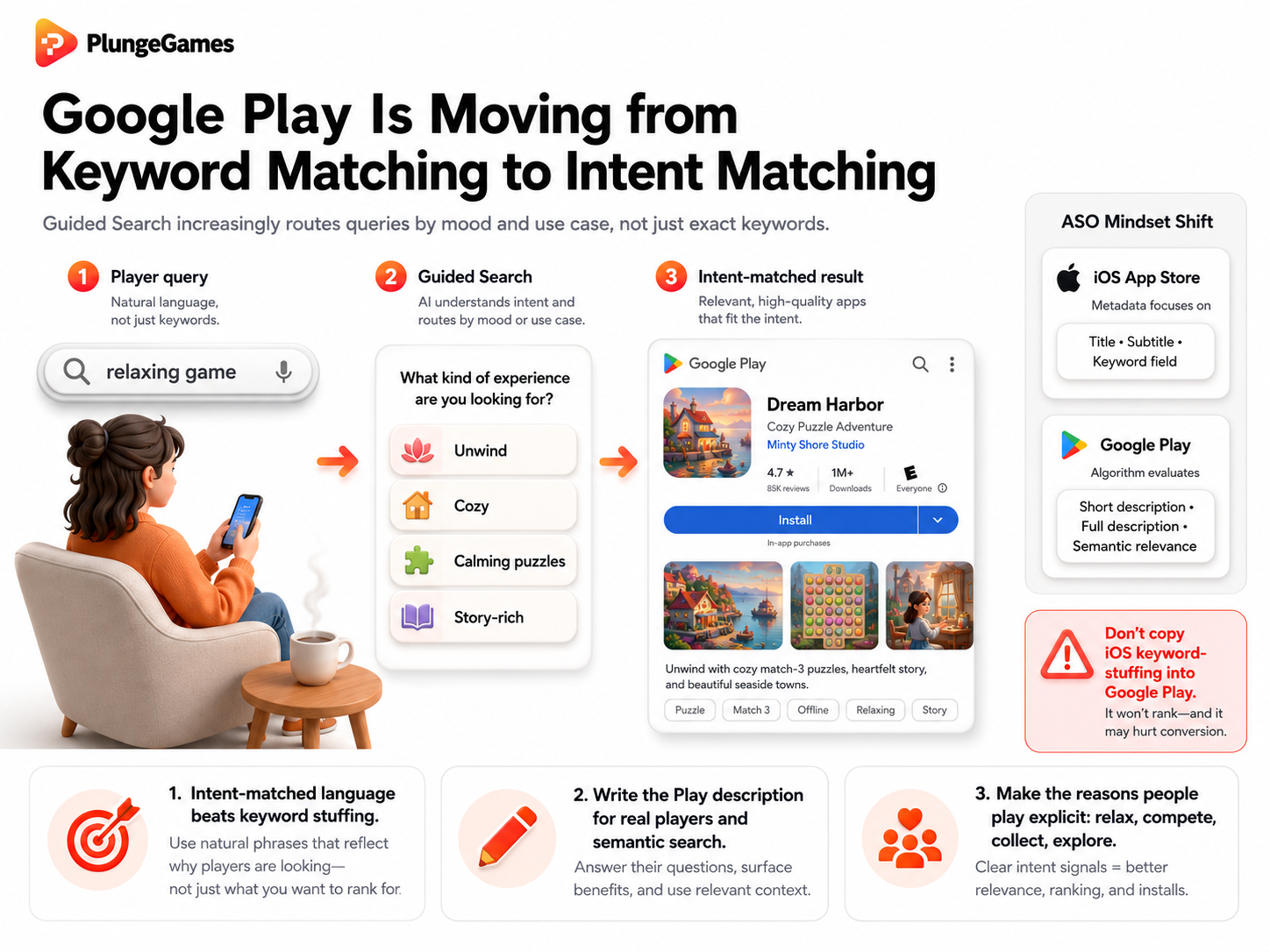
What's actually new in 2026 is Guided Search, and it's easy to mix up with Ask Play since Google rolled out both around the same time — but they're doing different jobs. Ask Play chats with the player. Guided Search doesn't: it takes a normal search query and quietly routes it into narrower, mood- or use-case-based sub-categories — search "relaxing game" and you get matched against a mood-driven set of results, not just a keyword hit. That's a real shift in how the algorithm works, and it's easy to miss because it sits underneath the search bar rather than announcing itself.
It also sharpens something that's been true for a while: iOS and Android are not the same, and applying one metadata strategy across both is still one of the more expensive mistakes a studio can make. Apple indexes title, subtitle, and keyword field; the long description is still a conversion surface there. Google Play, on the other hand, indexes the full description for semantic relevance, and Guided Search is now layering intent matching on top of that. Post-install metrics also matter more on Play, so a game that wins the install but loses the player will see its ranking erode over time.
The failure mode I see most often is a studio writing one "master" description, keyword-stuffing the first 200 characters for iOS logic, and then porting it over to Google Play unchanged. On Play, that same density can read like spam to a semantic algorithm and weaken relevance matching instead of helping it.
What to do: Write your Google Play description as if an actual player is going to read the whole thing and decide whether it's the kind of game they want — because increasingly, that's close to what's happening. Make sure the reasons someone plays show up explicitly, since that's the language Guided Search is matching against. Keep your iOS keyword inventory dense and precise, but don't force that same logic into the full Play description.
5. Retention is now part of discoverability
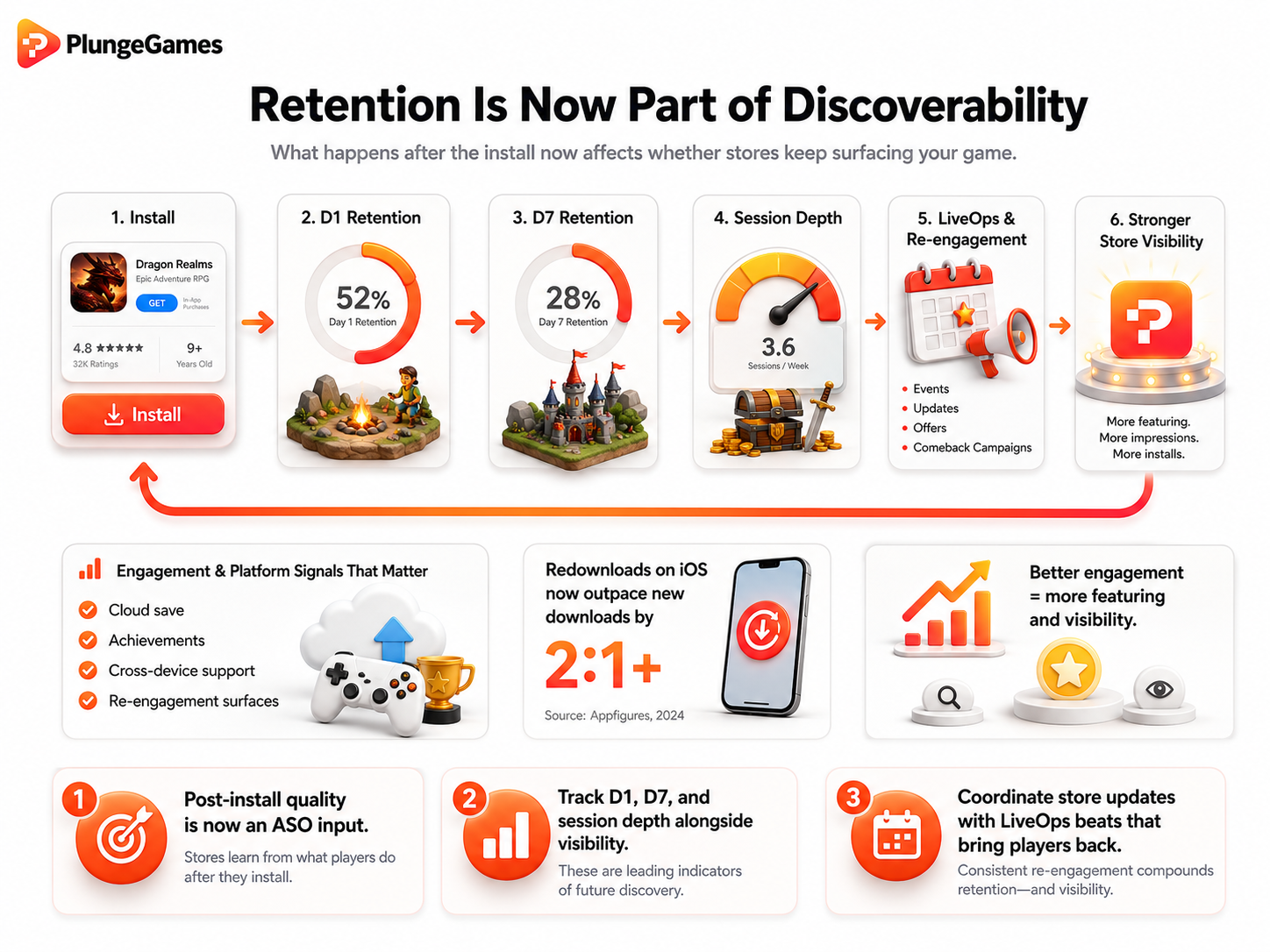
Retention used to be a product metric. In 2026, it's also an ASO signal. Both Apple and Google are paying more attention to what happens after the install, which means a game that gets the click but loses players quickly can see its visibility fade over time.
Apple's own data makes that shift hard to ignore: redownloads on iOS now outpace new downloads by more than 2:1, meaning return behavior matters more than it used to. Google has gone a step further and built an entire program around the same insight. Level Up, rolled out through Play Console, ties enhanced store visibility to engagement guidelines like cloud save, achievements, cross-device support, and Play Games Sidekick.
Source: https://play.google.com/console/about/levelup/
That logic is already showing up in live games. Google says Level Up drove 2.5 billion incremental acquisitions in 2025, with featured games seeing around a 25% average install uplift during featuring windows, and Subway Surfers saw a 45% engagement lift using the program's Leagues mechanic. If you build the engagement layer, you both boost retention and improve the odds that Play keeps surfacing you.
For mobile games, that changes the ASO conversation. LiveOps events, re-engagement loops, session depth, return frequency, and cross-device behavior aren't separate from organic growth anymore. They're part of the system that decides whether the store keeps giving you reach. Google just refreshed the Level Up guidelines on June 24, and the new rate card that comes with them opens up September 30. It's still opt-in, nobody's forcing you in — but here's the catch: even if you're already in the program, you don't get the better rate for free. You have to meet the new bar first, same as anyone walking in the door today.
What to do: Treat post-install quality as an ASO input, not a separate dashboard. Watch D1, D7, and session depth alongside search visibility, and coordinate store pushes with LiveOps beats that give players a reason to return. If you haven't checked your game against the new Level Up guidelines, do it now rather than in August — the rate card is genuinely worth having, and showing up early beats scrambling right before it goes live.
6. Review freshness is becoming a ranking lever
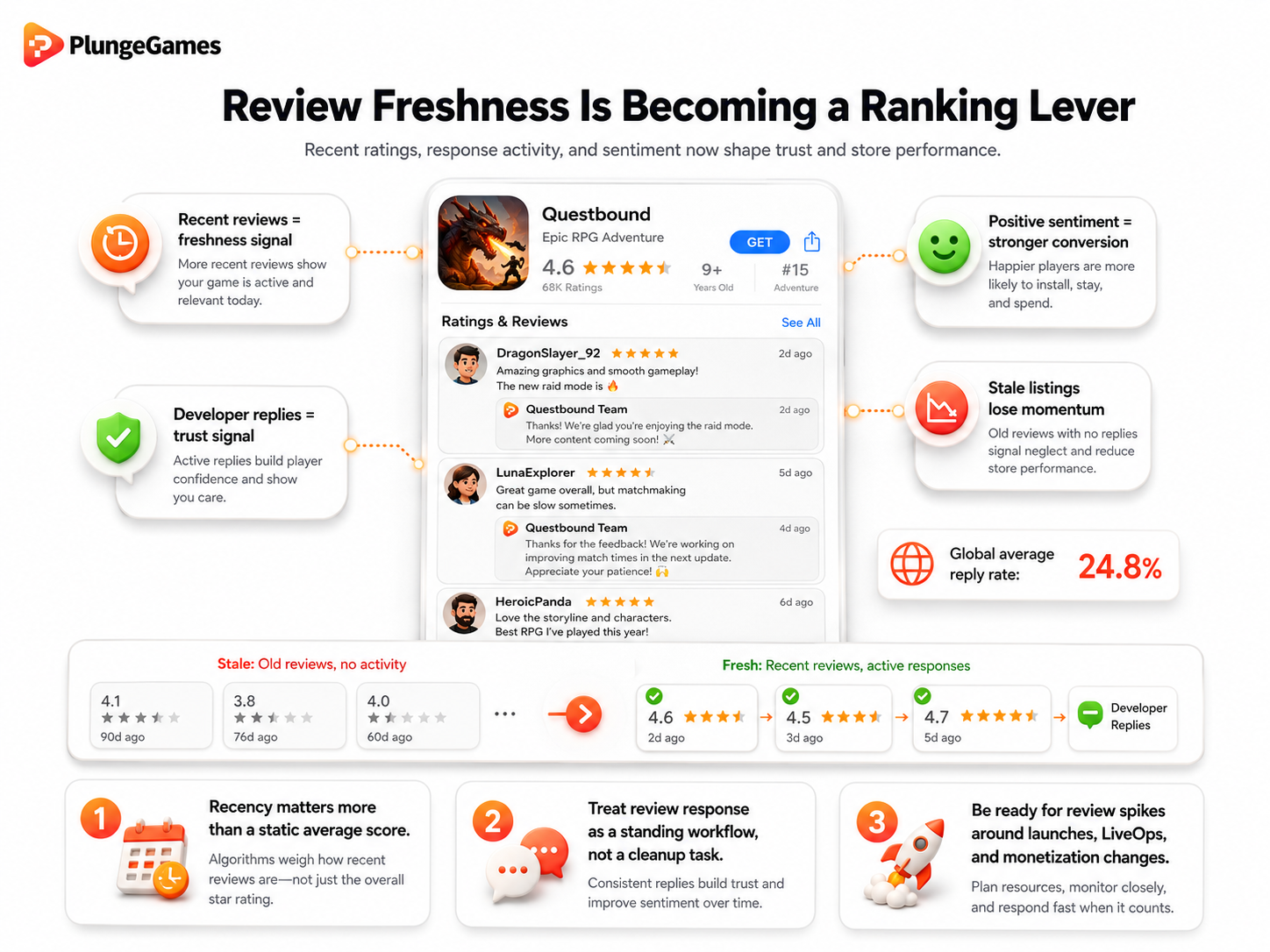
Review management used to be a support function. In 2026, it's part of ASO. Apple appears to be weighting ratings recency more aggressively, which means fresh feedback matters more than a static average score. On Google Play, response activity and review sentiment are part of the engagement picture, too, so a game with unanswered complaints and stale reviews can lose trust fast.
In fact, AppFollow's 2026 data shows a global average reply rate of 24.8%, even though its gaming reputation report found that apps replying to reviews see a noticeable rating lift. In other words, review hygiene isn't just about looking responsive; it's part of how the store reads quality.
For mobile games, the work has changed. Review freshness, developer responses, and sentiment trends now sit alongside metadata and conversion assets as signals that the game is alive and being actively managed. If your latest ratings are stale, or your response cadence drops, you're missing a chance to keep the listing strong. Mobile adventure games are a good example of an opportunity: it’s a top genre, but developers are replying to only about four in every thousand reviews. That's an open lane to improve player sentiment and increase store visibility.
What to do: Treat reviews as a standing ASO workflow, not a quarterly cleanup task. Track rating recency, response rate, and sentiment by genre or market, then build a review-response system that can keep up when LiveOps, launches, or monetization changes trigger spikes.
7. Localization is still the highest-leverage lever nobody's pulling correctly
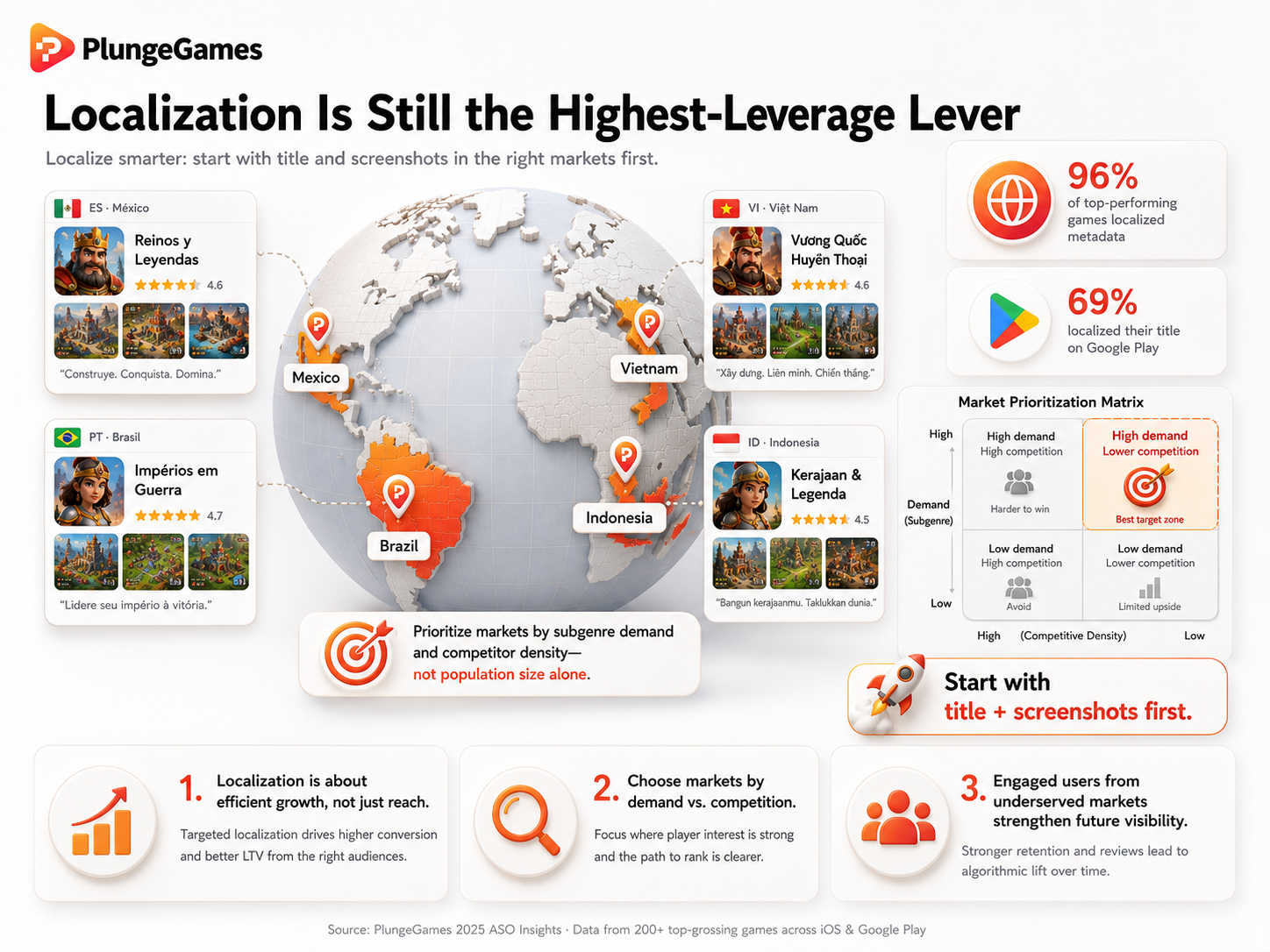
Localization is close to table stakes at the top, but most teams still use it badly. AppTweak's 2025 benchmarks show that 96% of top-performing games localized their metadata, and 69% localized their title on Google Play, which means the real opportunity is no longer "should we localize?" but "where should we localize first?"
Most studios still chase the biggest markets because that's where the download headlines are, but that's often the least efficient place to compete. The higher-leverage move is to prioritize markets where subgenre demand is strong and local competition is thin, especially places like Brazil, Indonesia, Vietnam, and Mexico, which can generate real engaged install volume.
Ranking signals increasingly reflect what happens after install, not just the install itself. An engaged user from an underserved market is doing double duty: it creates a download today and a behavioral signal that can strengthen organic position tomorrow.
What to do: If you're localizing incrementally, start with title and screenshots. Those are the highest-visibility surfaces in both stores and give you the best return without the maintenance burden of fully localizing every description. Then choose your next market by cross-referencing subgenre search demand with competitor density, instead of defaulting to the biggest population.
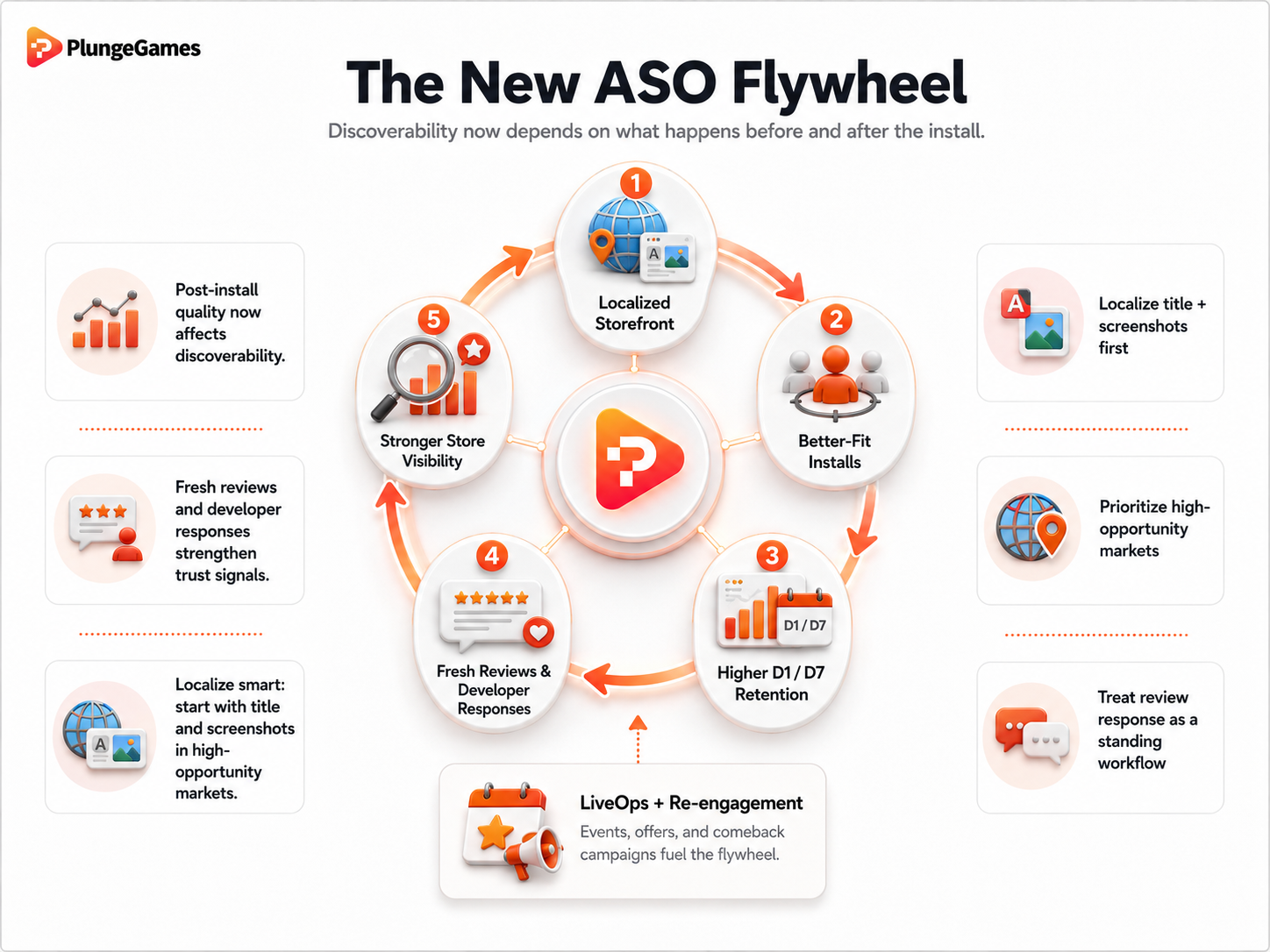
These seven ASO trends represent opportunities for mobile games in 2026.More indexable surfaces, clearer post-install signals, an organic CPP mechanic that most top games still haven't touched, and a review-response gap you could drive a truck through in some genres. That's a genuinely good position to be building from even halfway through this year.
The quarterly ASO checklist
Pin this one. It's built to be checked against every quarter, not read once and filed away.
Metadata and keywords
iOS metadata and Google Play descriptions are written for each store's actual indexing logic, not copied from one platform to the other
Every screenshot caption passes the same test: could this claim apply to any other game in the genre? If yes, rewrite it
Website copy and store listing copy tell the same product story, with no contradictions an AI assistant could surface
In-app events are titled and scheduled with the same keyword discipline as permanent metadata
Testing and iteration
Every live test changes one variable at a time, runs for at least four weeks, and reaches a clear winner before the next test starts
Tap-through rate and conversion rate are tracked separately, so a screenshot can win on one metric and lose on the other
A full ASO audit happens quarterly at minimum, with lightweight continuous monitoring in the gaps between audits
Custom Product Pages
CPPs are organized around player motivation clusters, not campaign structure
Your highest-intent keywords are explicitly linked to the CPP built for that motivation, so they can earn organic placement
CPP performance is reviewed alongside organic keyword rankings, not siloed in a separate paid-media report
Retention and reviews
D1 and D7 retention are reported to the ASO function on the same cadence as install numbers
LiveOps and ASO calendars are coordinated so major content drops, events, and metadata refreshes land together rather than independently
There's a standing cadence for responding to recent reviews, prioritized by recency over volume
Google program eligibility and Apple equivalents are checked against current implementation status, not assumed from initial enrollment
Localization
Title and screenshots are localized in target markets before the full description, if resources are limited
The next market is chosen by subgenre demand versus competitor density, not population size alone
Localized markets are cross-checked against retention data to confirm the install quality justifies continued investment
A team that runs this checklist every quarter is building the kind of store presence that keeps working no matter which way Apple or Google moves next.