A Segment of One
Per-player LiveOps is the real endgame: every config and every reward fit to the individual, optimized for their experience and the business at once. The interesting question isn't whether to do it. It's what to personalize, and the answer changes with every genre.
For years the best we could do with LiveOps was segment. Whales here, mid-spenders there, free players in a third bucket. We called it strategy. It was really a compromise because a segment, however fine you slice it, always averages over people who aren't actually the same.
That compromise is ending. We can now fit LiveOps to the individual and create a segment of one.
I went in assuming per-player optimization works the same across all genres and game mechanics, but the value it unlocks is a completely different animal depending on where it lands. Build it the same way in every genre and you leave most of that value on the floor.
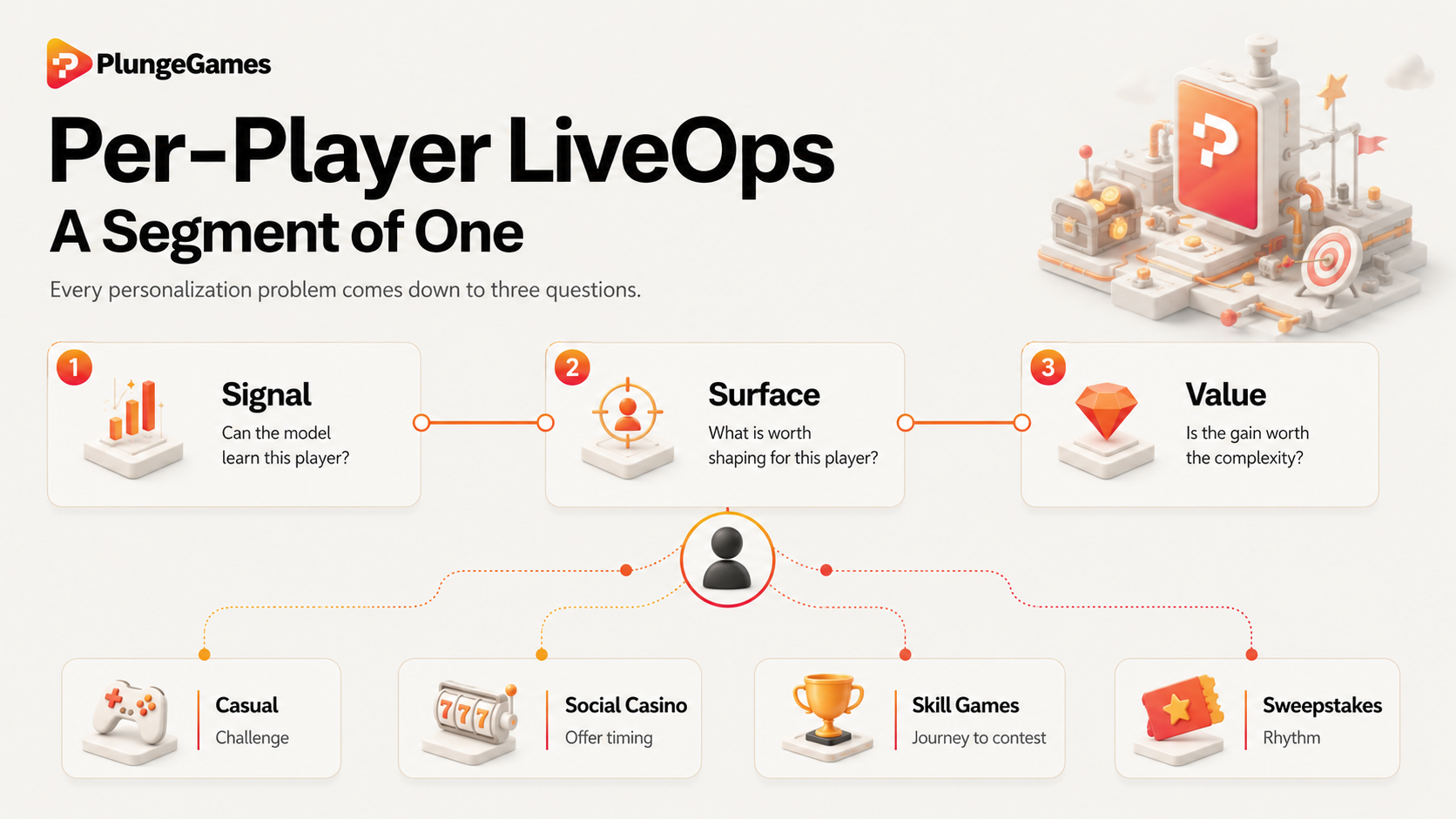
Every personalization problem comes down to three questions:
Can the model learn this player? Call it Signal.
What is the one thing worth shaping to them? That's the Surface.
And is the gain worth the complexity? Value.
The right answer to each one depends entirely on your genre.
Casual: the model learns you fastest, so the trade-off is restraint
Casual is where per-player optimization pays off soonest. Signal is the cleanest of any genre, because you cleared the level or you didn't. The model gets thousands of honest reads per player a week and can fit difficulty and pacing to the individual with real confidence - there’s no ambiguity in the data.
The Surface is difficulty - but defined more precisely than it sounds. It's difficulty plus a designer-set floor on how much struggle the model is allowed to remove. In casual games, friction is often the point, and a win means nothing without a real chance of losing. The surface is to personalize the challenge while protecting the friction.
That constraint is also the answer to the Value question. The gain from per-player difficulty tuning is real and measurable via mobile game KPIs like retention, session length, and return rate. But it only holds when you've defined what the personalization model is and isn't allowed to touch. Build it without the floor and that’s how you raise this week's numbers but sand the soul off the game in the long-term.
Example: a match-3 game uses a "one more try" system
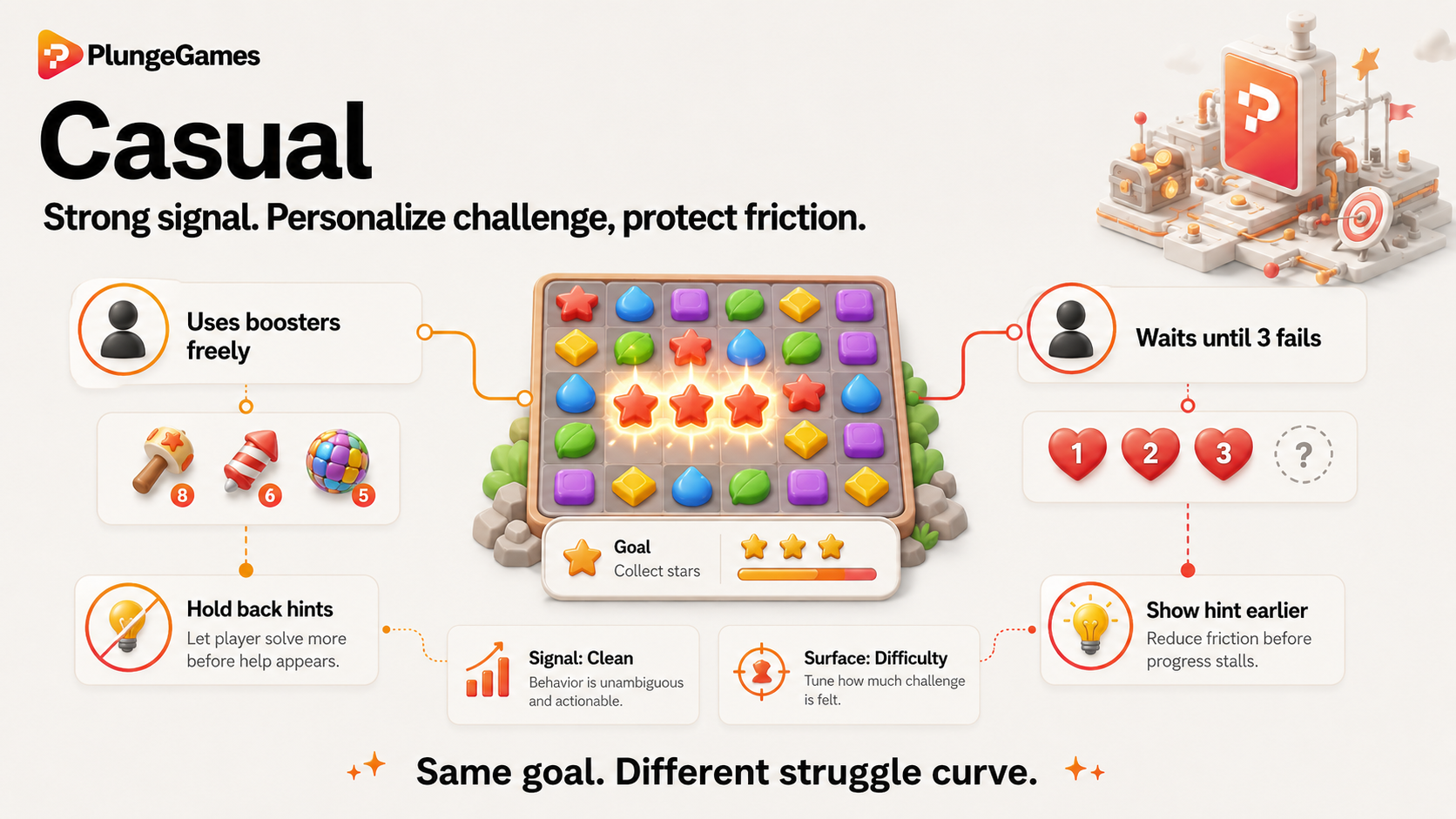
Consider a match-3 game where the model tracks how often a player uses a booster unprompted vs. only after failing a level three times.
For the player who reaches for boosters freely, the model holds back: no nudge, no hint, let them work. For the player who only uses a booster after three fails, the model surfaces the hint earlier, before frustration peaks.
Neither player sees the same level sequence, but both see a game that feels tuned to them. The personalized LiveOps approach isn't changing what winning means - it's changing how long you struggle before you get there.
Social Casino: the most value to unlock, and the most you give up to read it
Social casino has the biggest prize, but the Signal problem is real. The loop runs on perceived luck, so the behavioral data coming back is inherently noisy - a player who churns after a bad session looks identical to one who's just taking a break. The model takes longer to develop confidence here.
The Surface is the offer, but it's not just which bonus or promotion to show. It's the timing, the cadence, and the moment. Most of the player base never pays, so much of the value lives in matching the right offer to the right player at the right point in their session rhythm. Log-in timing, reward frequency, re-engagement windows - all of it individual, all of it worth shaping. Adapt the reward cadence to one player's rhythm and you lift how good it feels and how well it converts at once.
In terms of Value, the ceiling for social casino is the highest of any genre. Personalized offers convert better, and the addressable population is enormous. But a noisy signal means the model can look like it's working - conversions up, engagement up, etc. - while it's actually eroding the player relationship underneath. The gain is worth the complexity, but only when you're measuring the right things, like:
Holdout groups
Long windows before you call a win
Hard rules that stop the model from converting players today at the cost of losing them next month
Adapt aggressively, but measure longer than feels comfortable.
Example: a slots game reads player rhythm
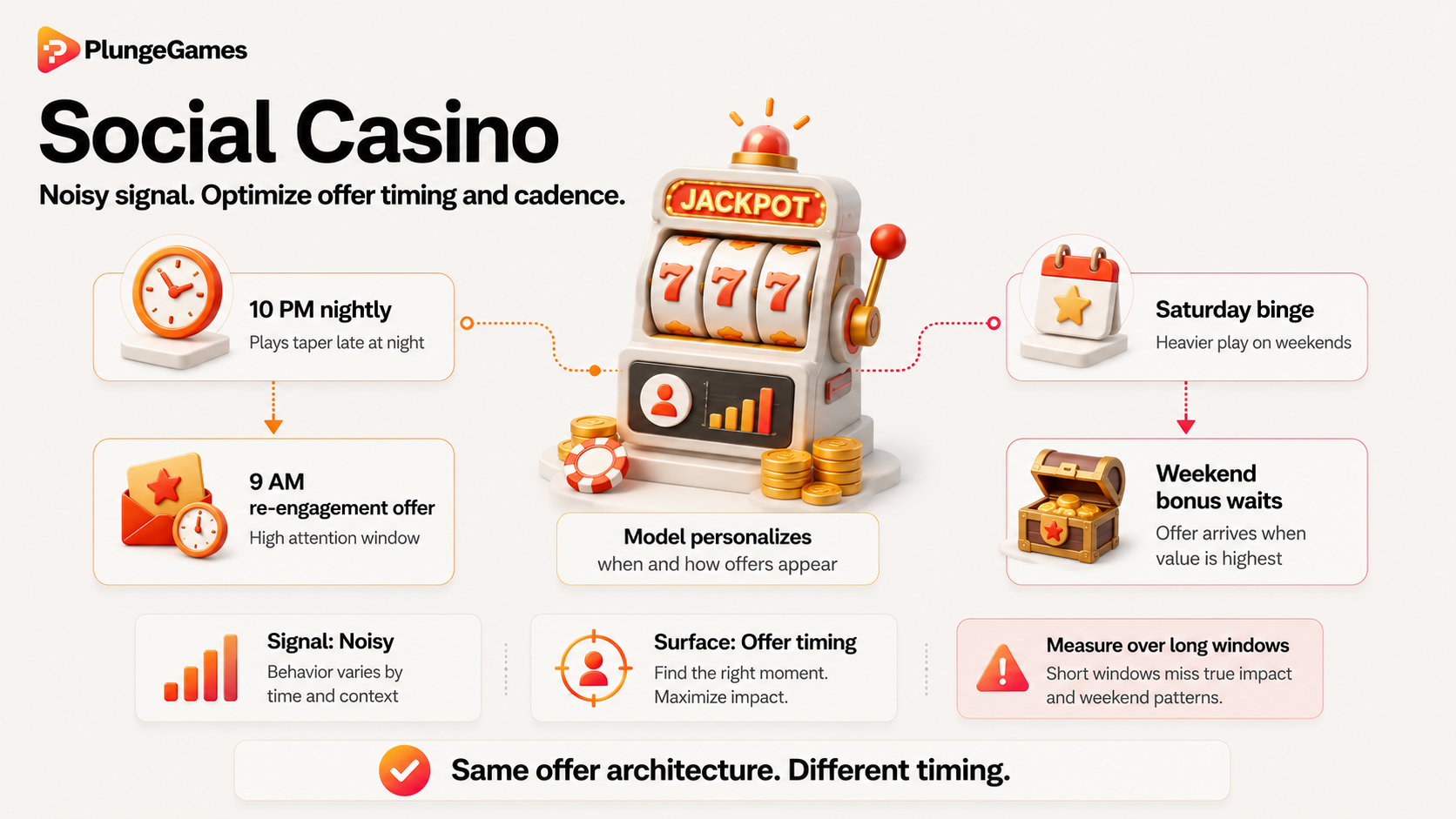
Picture a slots game where the model tracks not just spend, but session rhythm: when a player logs in, it looks at how long they stay and how they behave in the 10 minutes before they leave.
One player logs in at 10 PM nightly and plays two short sessions before dropping off. The model serves their re-engagement offer the next morning at 9 AM, before the habit has a chance to fade. Another player binge-plays Saturday mornings, so their bonus is framed around that window, waiting for them when they open the app.
Same offer architecture, completely different timing.
Just make sure you’re always paying attention to the measurement window, in addition to the LiveOps model itself.
Skill Games: the genre defined by what you refuse to optimize
Real-money skill games are the sharpest case, because the player wins on ability and fair matchmaking is the product.
Signal here is strong: how fast a player learns, which mistakes they repeat, how they respond to a loss. The model can read skill trajectory with real confidence.
The Surface is huge once you draw the line in the right place - you need to tailor everything around the contest, like:
Which modes surface for this player
How onboarding adapts to their learning pace
Which entry tiers and coaching cues fit their level
Which challenges feel worth their time
But you shouldn’t touch anything inside of it because the competitive core should remain untouched. The trade-off here is about restraint you impose on yourself: there is something you can optimize and must choose not to.
That constraint is also the answer to the Value question. Done right, per-player personalization in skill games deepens the exact thing skill players prize most: the sense that the game knows them and still gives everyone a square shot. The value isn't in optimizing the outcome. It's in orchestrating the whole journey toward a contest but keeping your hands off of the contest itself.
Example: a card game personalizes the path to the table
Let’s look at how this would work for a real-money card game.
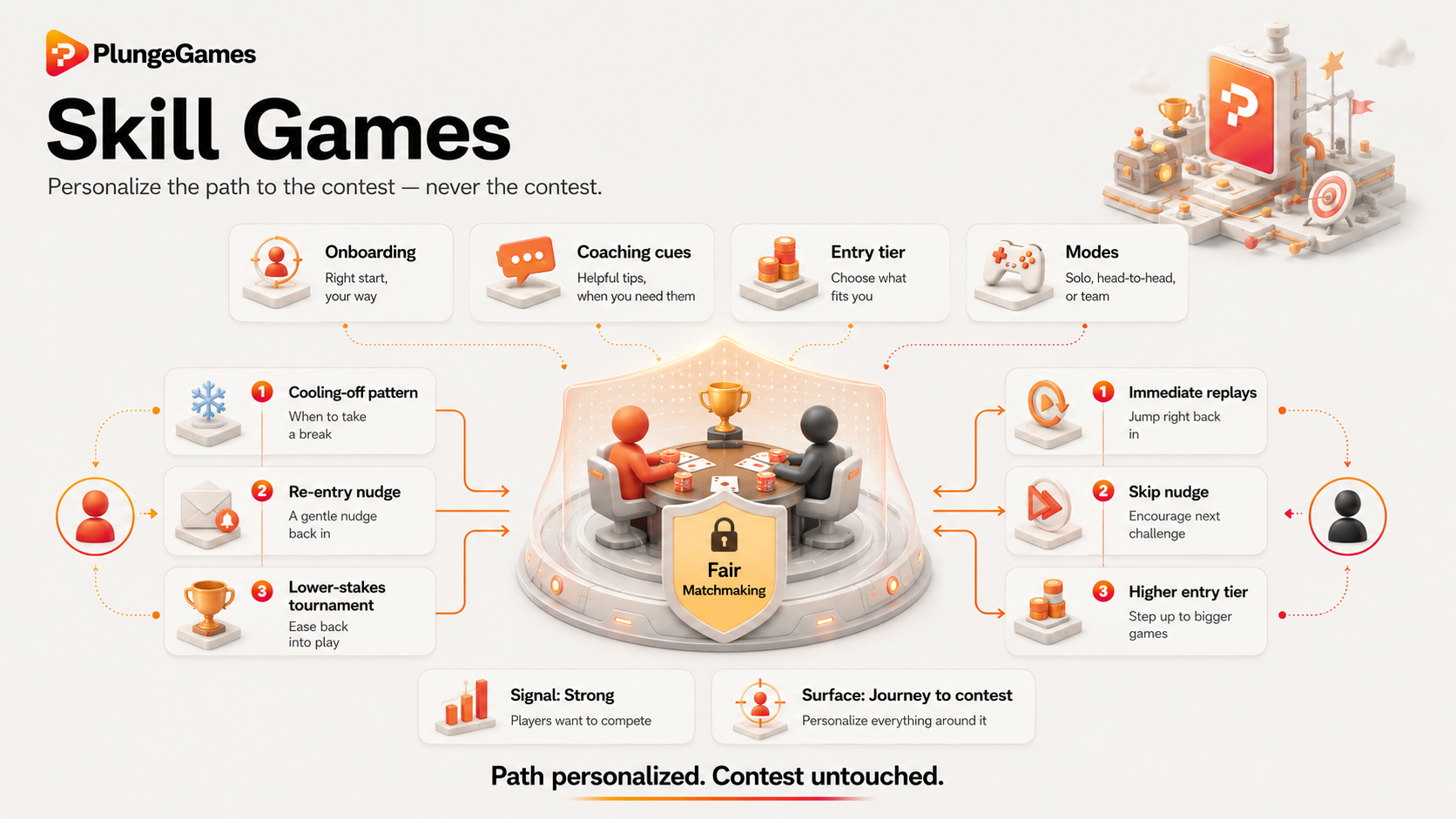
Two new players both lose their first three matches. One quits after each loss and comes back the next day, which the model reads that as a cooling-off pattern and sends a re-entry nudge 18 hours later, with a lower-stakes tournament suggestion. The other replays immediately, which the model reads confidence, skips the nudge, and fast-tracks them to a higher entry tier.
The matchmaking throughout stays skill-based. No thumb on the scale, no softened opponents. What changed is everything leading up to the contest: the onboarding pace, the entry tier suggestion, the timing of the coaching cue.
Sweepstakes: personalize the rhythm, not the moment
Sweepstakes is the one that surprised me. It runs on a long, deliberate cadence - daily logins, weekly missions, streaks that compound - and my instinct was that per-player optimization mattered less here. The opposite is true. It just operates on a different surface.
Signal here is moderate and slow-building. You're not reading pass/fail on a level or spend on a session. You're reading engagement rhythm over weeks, like when a player logs in, how they respond to streak pressure, where they fall off the cadence. The model takes time to develop confidence, but the reads it does get are durable. A player's weekly pattern is stable in a way that a single session isn't.
The Surface isn't a single, tense moment. It's the tempo of a life. When should this player's streak pressure peak? Which mission mix keeps them on cadence without fatigue? How should the long arc of rewards breathe for them specifically? Optimove's work across tens of thousands of players found each person effectively carries their own frequency model, so you should build the surface to fit that.
The Value answer follows from that. In casual games, the surgical unit is the level. In sweepstakes, it's the calendar. Same scalpel, a completely different cut. The gain is real and measurable in streak completion and long-window retention. Optimize for this week's login and you can miss the monthly pattern that actually predicts churn.
Example: a sweepstakes game builds a different week per-player
Two players, same game, same streak mechanic.
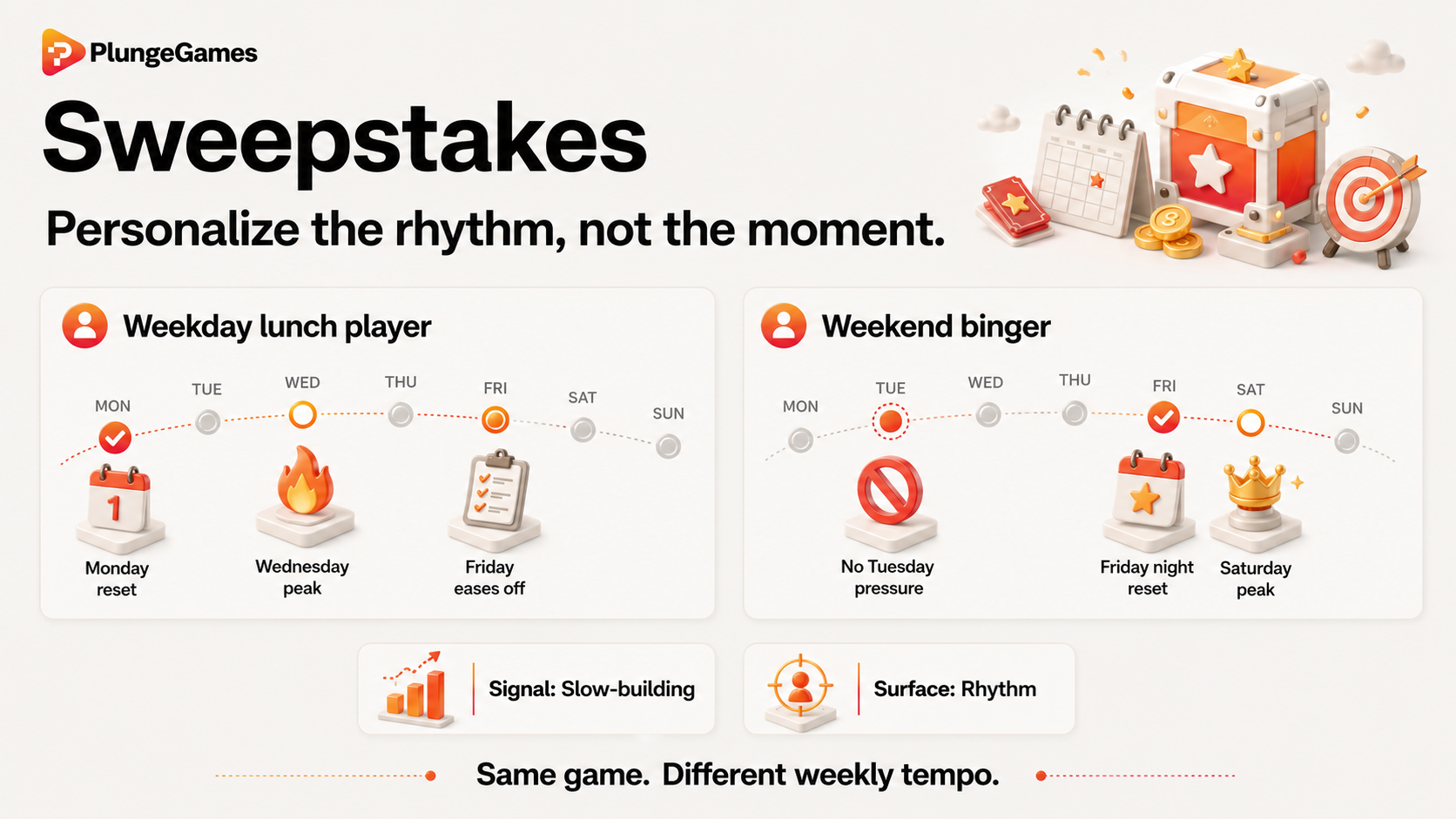
One checks in every weekday at lunch and plays short sessions on a reliable cadence. The model learns the pattern by week two and anchors their mission resets to Monday morning, so the week always starts with something fresh waiting. Streak pressure peaks Wednesday, when their engagement is highest. By Friday it eases off, because the data shows Friday pressure doesn't convert.
The second player is a weekend binger. Monday missions mean nothing to them. The model reads two weeks of near-zero weekday activity and shifts their entire arc to Saturday: mission resets land Friday night, the reward that's been compounding all week pays out when they actually show up, and there's no streak pressure on Tuesday.
Neither player is pushed harder - the tempo just matches the person.
The pattern, which is the point
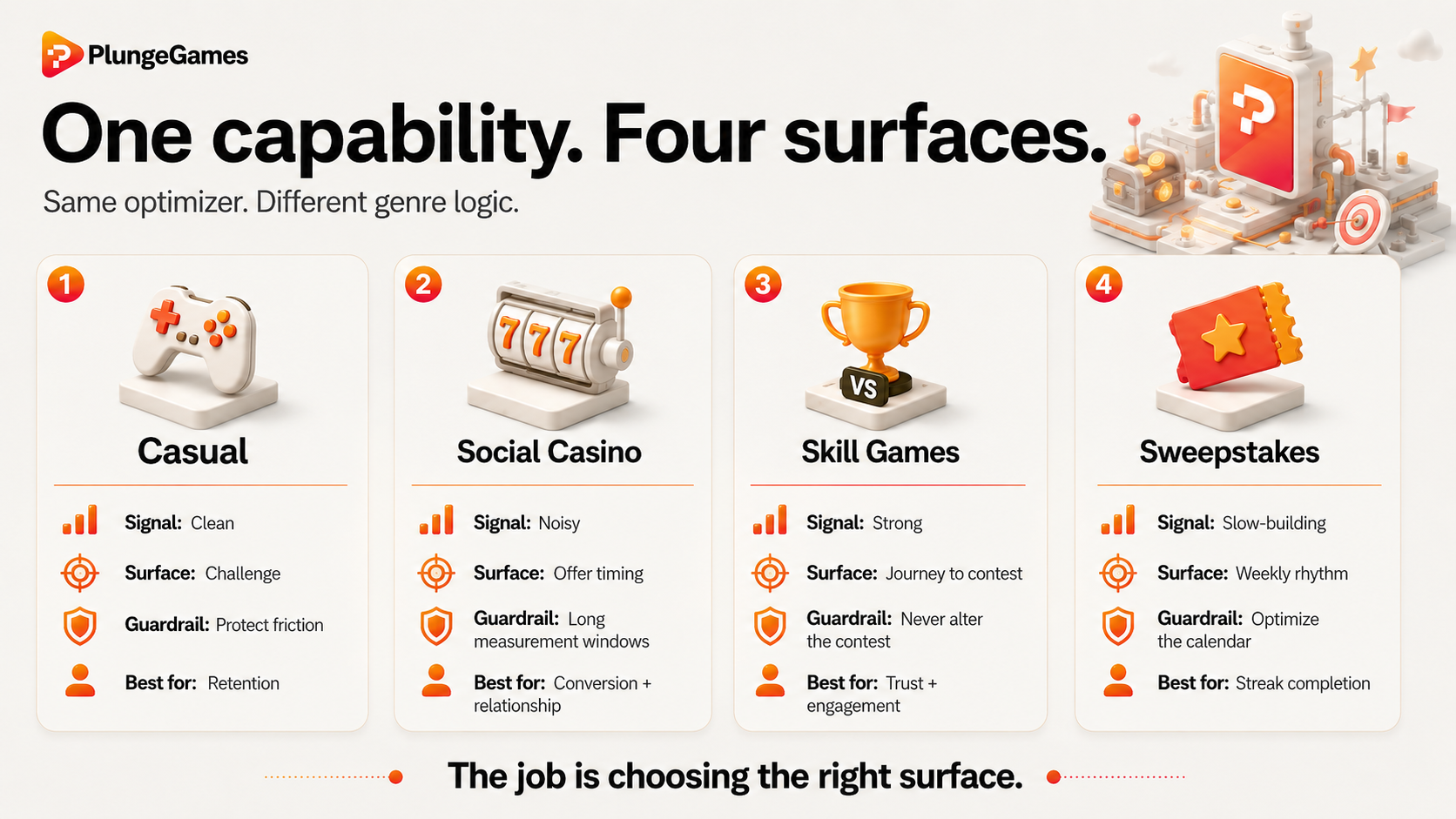
One capability, four surfaces. In casual you shape the challenge and protect the friction. In social casino you adapt the offer and instrument it so you can read it. In skill you orchestrate everything around the contest and never the contest. In sweepstakes you tune the rhythm, not the moment. The optimizer is the same in all four. What changes is Signal, Surface, and Value, and getting the surface right is the entire job.
This is where it stops being about games. Every product that runs on engagement is walking into the same room. Spotify can optimize your next song with ease, but the surface that actually matters is your sense of discovery, and those two pull in opposite directions. Duolingo can remove every lesson that makes you quit, or it can fit the one thing that keeps you coming back, and only one of those still teaches you the language. Netflix can fill the rail with what you'll click and slowly forget how to surprise you. In each case the optimizer is a commodity and the surface choice is everything.
In your genre: what's the one surface worth shaping to the individual, and what are you going to leave alone on purpose?