Rising UA Costs Aren’t Just a Bidding Problem
Global gaming CPI rose 30% in 2025. Learn how to address the challenges of rising UA costs by running product, organic, and paid as one system.
By Aviad Dadon, CEO & Founder, Plunge Games
I spoke with four major studios this week. All of them are rethinking how their business works, for the same reason: CPIs keep climbing. Global gaming CPI reached $0.56 in 2025, up 30% YoY, and the paid-to-organic install ratio jumped 61%, from 2.07 to 3.33.
What stood out to me was that every conversation with these studios - and many of the others I’ve talked to this year - always focused on better creative, tighter targeting, and a smarter budget split. Every fix was on the media-buying side, and none of them brought up organic, creators, AI search, or their webshop.
I don't think paid UA is dead. The problem is expecting paid to carry everything at today's prices. If your LTV can't cover what an install costs now, better bidding won't close that difference. What does work is looking at product, organic, and paid together, as one system. Here's how I'd approach it.
Does your product actually earn enough?
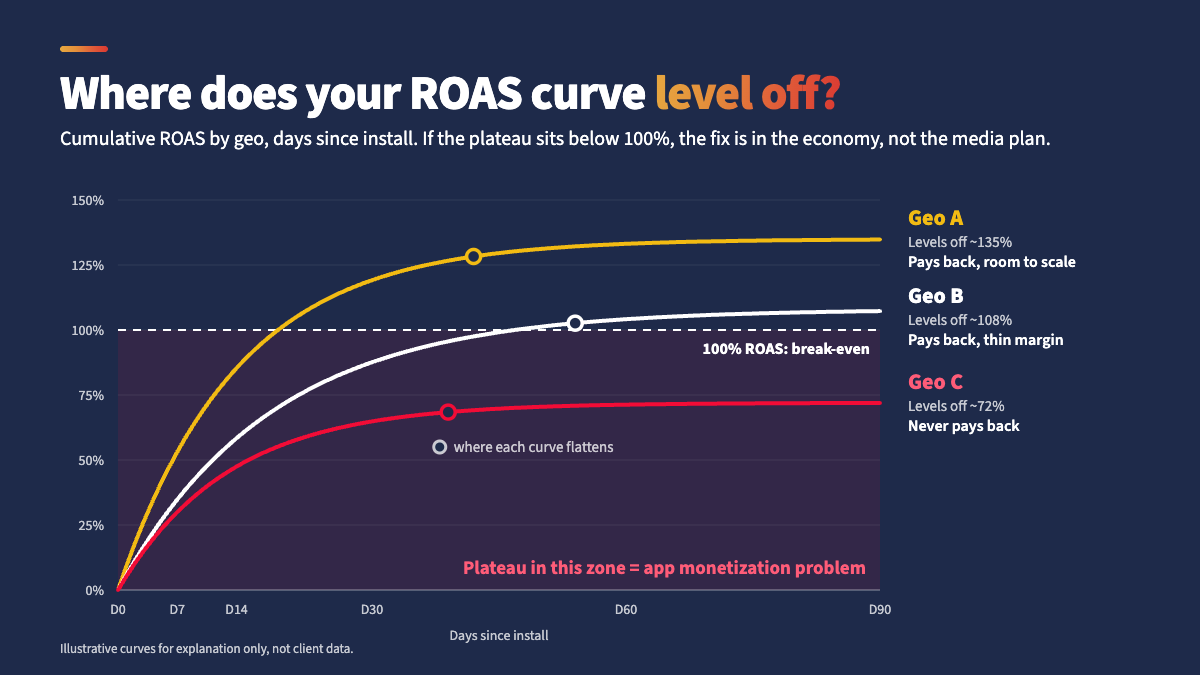
When a studio brings me a mobile UA problem, I start with two questions that have nothing to do with media buying. What's the highest CPI you can afford in each geo? And does your ROAS curve cross 100% before it flattens?
Pull your D30 ROAS curve by geo and look at where it levels off. If that point sits below 100%, you have an app monetization problem. More creative testing, better lookalikes, or shifting budget between channels won't fix it, because the problem sits in your game's economy.
If you want a quick place to start, look at your first-purchase offer, and specifically at when it fires. Most of what shows up in D30 ROAS comes from a player's first week. If your starter pack or paywall triggers on a fixed day, you miss every player who was ready to buy earlier. Trigger it off behavior instead: when a player hits a resource wall, fails a level twice, or finishes onboarding. Purchase intent peaks in those moments, so that's where the offer belongs.
Blended CPI, not paid CPI, is the number that matters
Another pattern I see a lot: studios treat paid CPI as if it moves on its own, separate from organic. It doesn't. Paid campaigns create visibility, and a real share of the installs that show up as "free" organic actually come from that visibility.
You can check this in your own data. Go back to the last time you paused or cut a paid campaign, and pull organic installs for the two weeks after. In my experience, organic usually drops 20-30% within a few days of the paid slowdown/shutdown.
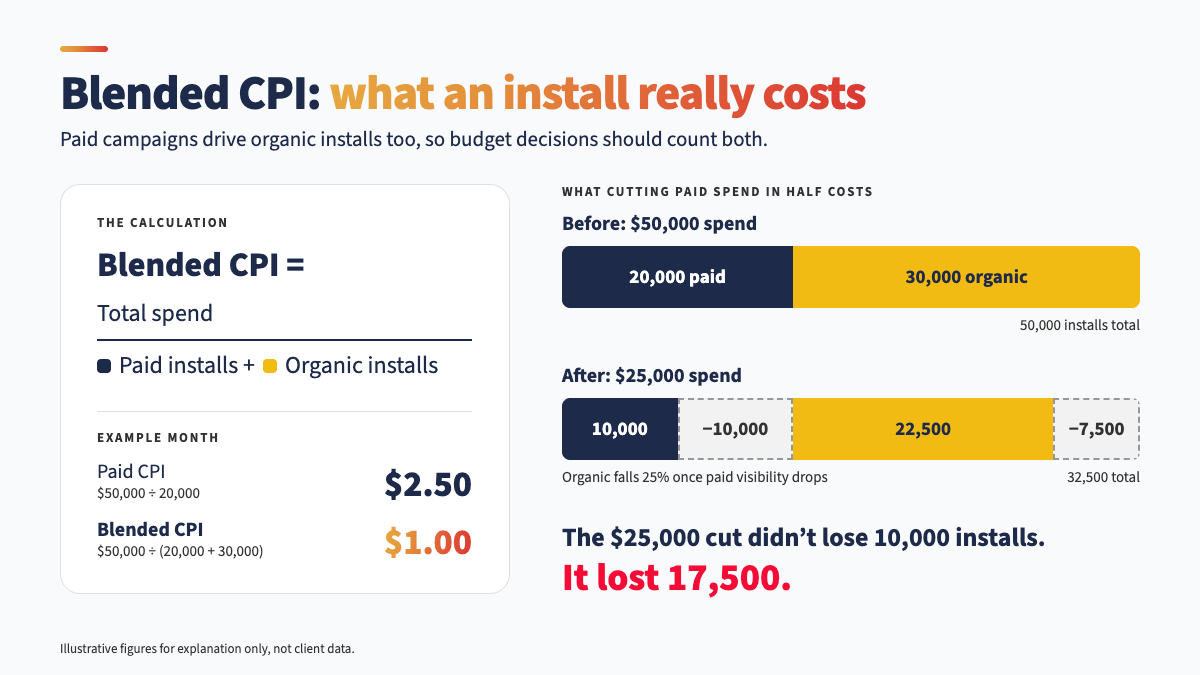
That's why I'd run budget decisions against blended CPI. That’s the total spend divided by total installs, paid and organic together. It shows what an install really costs you, and it makes clear that cutting paid also costs you organic.
Budget organic like a channel
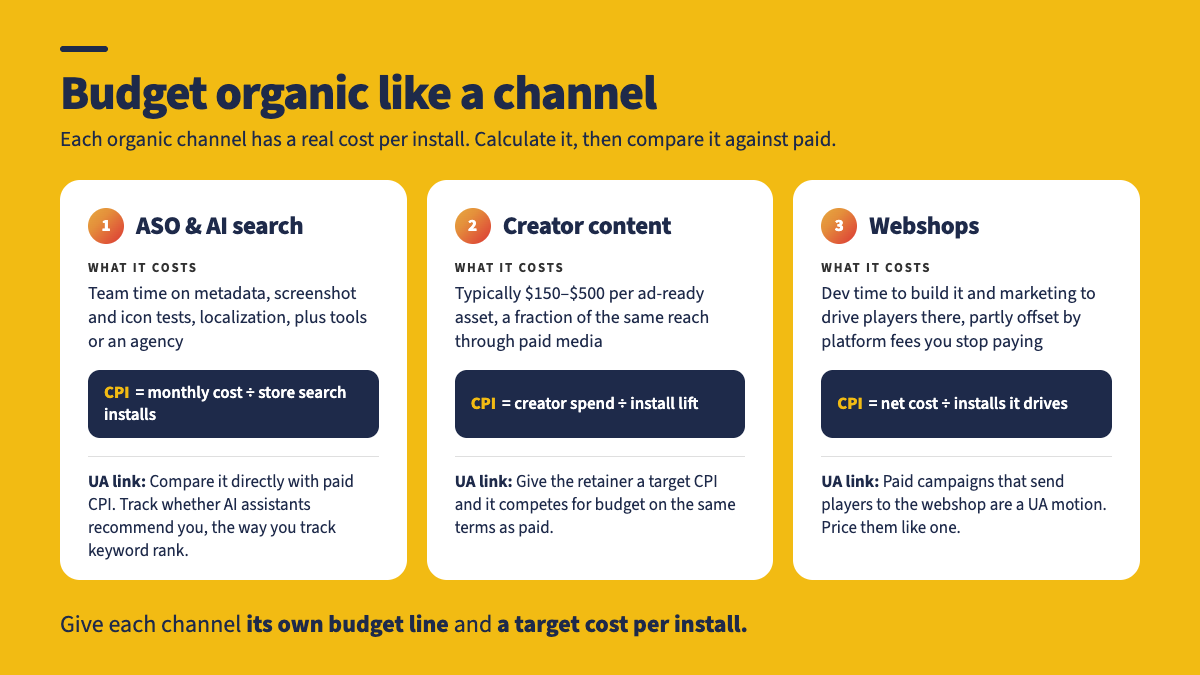
This is the blind spot I see in most studios. ASO, AI search visibility, creators, and webshops each have a real cost per install, and it’s often never calculated.
ASO and AI search
ASO is the channel studios are least likely to put a number on, because the cost is spread across people's time: metadata updates, screenshot and icon tests, localization, maybe a tool subscription or an agency. Add those up and you have a monthly cost. Divide it by the store search installs it drives, and you have a CPI you can compare against paid.
That number matters more now because discovery is changing. Both app stores are building generative AI into search, and apps are already being recommended inside ChatGPT, Gemini, and Perplexity. If a model can't read your listing and web presence and clearly say what your game is and who it's for, it'll recommend a game it can describe. Attribution from AI assistants is still messy, but tracking whether you show up in AI recommendations, the same way you track keyword rank, at least tells you whether that spend is working.
Creator content
Gaming UGC creators typically charge $150-$500 per ad-ready asset, which is a fraction of what the same reach costs through paid media. But it only pays off if you measure install lift against that spend as carefully as you'd measure a Meta campaign. Give a creator retainer a target cost per install, and it can compete for budget on the same terms as paid.
Webshops
A webshop isn't a UA channel in the way paid media or creators are, but it still has a cost per install. You're paying for the dev time to build it and the marketing to get players there, and part of that is offset by the platform fees you stop paying Apple or Google. If your paid campaigns send players to your webshop instead of a store listing, that's a UA motion with its own CPI, and it should be priced like one.
Give each of these its own budget line and a target cost per install. If you can't put a number on all four right now, organic isn't really being managed, and that makes it very hard to prove how you plan to offset rising CPI.
Raise your LTV
The first section was about finding your CPI ceiling, and the next two were about what an install actually costs you. The next step is raising that ceiling. Two levers do it directly: your first-purchase offer and a webshop.
I briefly covered first-purchase timing earlier, and it's worth mentioning again as a design priority because the first purchase shapes the rest of a player's monetization curve.
The webshop is less obvious, but it's often the bigger lever. When players buy through a webshop, the purchase goes through web payments instead of in-app billing, so most of the stores’ 15-30% commission stays with you. You still pay for payment processing, but the difference is significant. And webshops aren't an experiment anymore: the top 100 titles grew direct-to-consumer earnings by 38% in 2025.
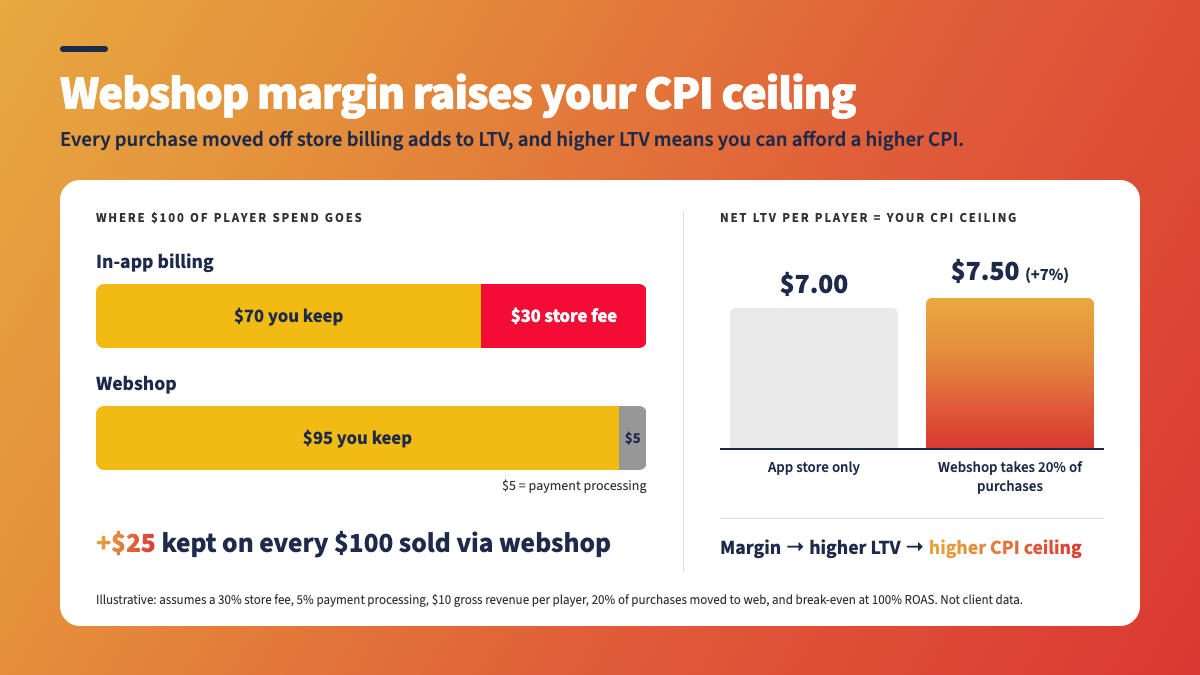
That margin goes straight to the LTV side of your LTV:CAC ratio. Higher LTV means you can afford a higher CPI, which brings us back to the number we started with.
Before you decide whether a webshop is worth the engineering work, run the math twice:
Once on your current store-only revenue
Another time assuming a webshop captures even 15-20% of purchases at web margins.
For most studios I've modeled this with, the difference between those two numbers is bigger than anything that better bidding would get back.
Run UA as a portfolio, not a bid
None of the four studios I spoke with this week has a UA crisis. They have a product and channel-mix problem that shows up on the UA line first, because that's the line everyone watches when margins get tight.
The pressure isn't easing anytime soon. Global gaming UA spend hit $25B in 2025, and paid installs kept growing as a share of the total even as each one got more expensive. More studios are competing for the same players at higher prices. Better bidding helps at the edges, but the bigger opportunity is managing product, organic, and paid together.
So here's what I'd do this week: put a target CPI on each of the four channels, ASO, AI search, creators, and your webshop. If you can't, that's the real problem to solve first. It's also where I'd start if we worked together. Reach out if you’re interested to hear more.