Microdramas Won the Download War. They Haven't Won the Game Yet
Microdrama apps are winning on downloads, but they're leaving billions on the table in revenue. Discover how F2P gaming monetization mechanics can fill the gap.
Microdrama has an acquisition machine nobody else in mobile can match, and a retention curve nobody would want.
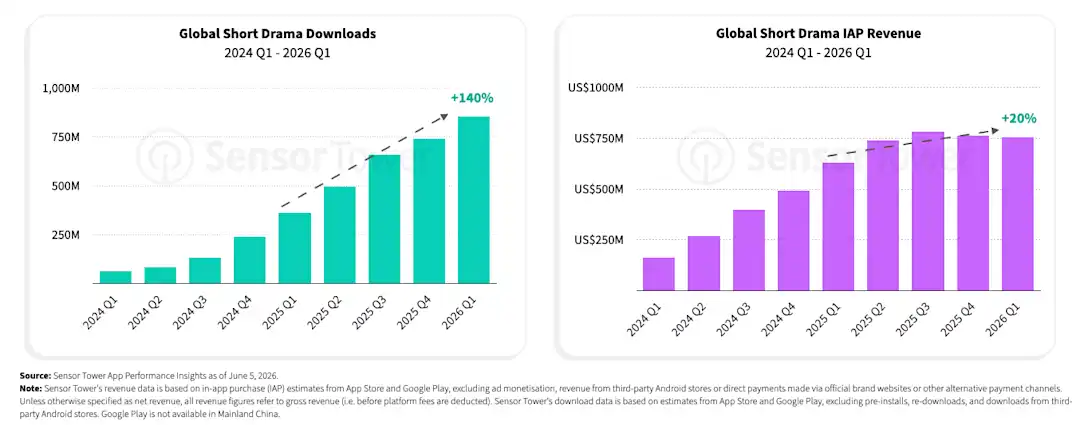
Start with the machine: short-drama apps pulled in 850M downloads in a single quarter, up 140% YoY - and the money is starting to catch up. Media Partners Asia projects ReelShort will hit $1.05B in revenue in 2026 and turn its first real profit. Meanwhile, DramaBox already got there earlier, posting $323M in revenue and $10M in net profit back in 2024.
We've watched this movie before. Not literally (the enemies-to-lovers billionaire romance isn't exactly our department), but in the shape of the curve. Hypercasual gaming did this. So did the first wave of match-3 titles, and battle royale before that.
Every one of them hit a point where acquisition stopped being the hard part and retention became the whole game. Microdrama is standing at that exact inflection point right now, and the numbers make it clear: downloads grew 140% YoY, while category in-app purchase revenue reached roughly $750M in Q1 2026. User acquisition is scaling far faster than monetized value, and that gap is the story. Everything else is commentary.
sensortower.com/blog/state-of-short-drama-apps-2026-report
The category proved something real
How far has this gone? Six short-drama apps now sit in the global download Top 40. That’s an entire category muscling its way into charts that have long been dominated by games and social apps. NetShort alone grew downloads 196% QoQ, and the pace shows no sign of slowing.
But the number that should actually stop you is engagement, not downloads:
US ReelShort users spend an average of 35.7 minutes a day in the app
Amazon Prime Video users: 26.9 minutes
Netflix mobile: 24.8 minutes
Disney+: 23.0 minutes
App | Avg. daily minutes per user |
ReelShort (US) | 35.7 |
Amazon Prime Video | 26.9 |
Netflix mobile | 24.8 |
Disney+ | 23.0 |
A five-year-old app category is out-engaging the biggest streaming platforms in the world on their own turf. That's a sign the format itself works. And the numbers back it up: the market (excluding China) is expected to triple from $3.6B this year to $9.5B by 2031.
F2P gaming monetization meets streaming apps
The mechanism behind that growth is a free-to-play monetization mechanic wearing a different costume:
Free episodes create the hook
A cliffhanger arrives right before the emotional payoff
A coin paywall sits between the viewer and the resolution
ReelShort's coin-based episode unlocks range from roughly $1.99 to $49.99 per bundle, putting a full binge well past the price of a month of any single streaming subscription.
Looking at their weekly VIP subscription, it costs $14.99 to $19.99, compared with $199.99 for the annual plan. The weekly price functions as a psychological anchor that makes the annual plan look like relief rather than a commitment. This is F2P scarcity psychology and energy-gate pacing, applied to narrative resolution rather than randomized rewards.
Timing the paywall just right
Scarcity alone doesn't explain it. Trigger timing does: the payment request arrives at peak emotional investment. F2P economists have used the same principle for years across energy systems, premium currencies, and progression gates. Microdrama applies it to narrative resolution.
The category didn't invent a new monetization playbook. It borrowed the acquisition and first-conversion layers of an old one, then ran them better than almost anyone expected. What's missing is the payoff side. Paying at peak emotional investment works - but pay, watch, and you're done feels hollow fast if nothing else happens. In gaming, a purchase usually buys a win, an achievement, something that means something to the player and pulls future spend behind it. Microdrama's coin economy hasn't built that second half yet.
Where the leak actually is
Here are the retention numbers across the top 200 microdrama apps that should stop any game economist mid-scroll:
D1 retention: 26.9%
D7: 8.6%
D14: 5.6%
Even DramaBox, one of the category's strongest performers, shows a similar shape: 27.5% D1, dropping to 7.8% by D7 and 5.0% by D14.
Run that against published mobile-retention benchmarks by category and the gap is stark. A 5-6% D14 rate sits below even hyper-casual games' reported D7 benchmarks (10-20%), and far below mid-core and social/messaging apps, which typically hold 20%+ users at D7.
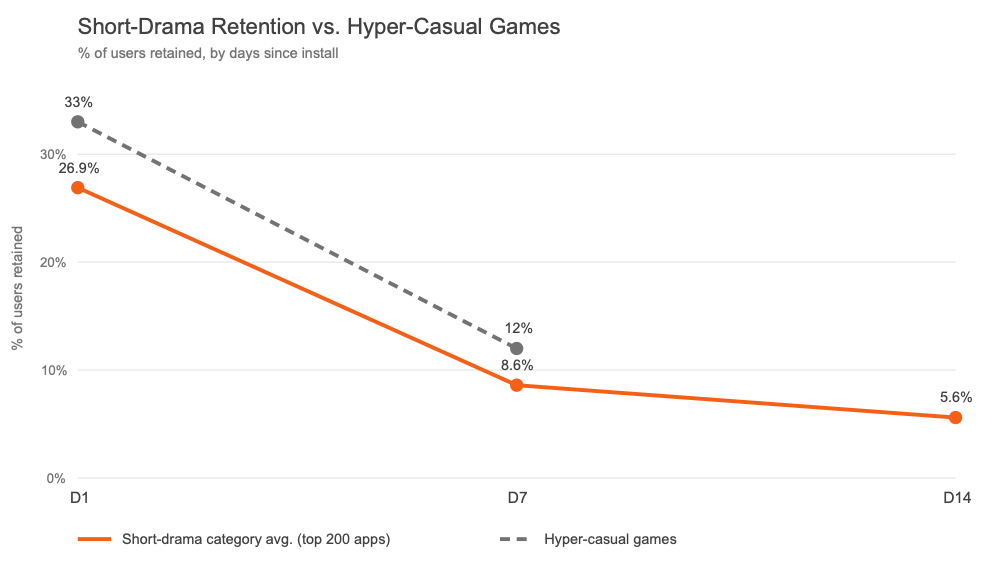
Microdrama's short-term retention curve is already collapsing faster than some of the leakiest categories in mobile. Yet they’re in a category (streaming) that’s simultaneously producing some of mobile entertainment's deepest daily engagement.
That's not primarily a taste problem. ReelShort users spending 35.7 minutes a day in the app isn't what a rejected product looks like. The more plausible diagnosis is structural: this is a classic leaky-bucket dynamic, where acquisition keeps filling the top of the funnel while users rapidly churn out the bottom.
There's a more precise way to put it: in gaming, D30 retention is driven mainly by two things: core loop satisfaction and meta. Microdrama's core loop is genuinely satisfying, which is exactly why the engagement numbers hold up. What it doesn't have is a meta layer, and the core loop itself has a built-in exit ramp. Finish a show, and there's no nudge into what comes next, so you leave. Games rarely let a session end without pointing somewhere.
3 things F2P built that microdrama hasn't (yet)
Three missing product layers separate a durable free-to-play economy from a one-shot conversion funnel, and none of them requires a larger content budget. They require a product system built around content that already exists.
LiveOps
Durable games give users a reason to return tomorrow that isn't just waiting for the next content drop. This includes LiveOps content, like:
Time-limited events
Returning-user bonuses
Seasonal content beats
Reactivation campaigns
All of these create a calendar around the core product, with different interventions for active, lapsing, and lapsed cohorts. Microdrama already has the content treadmill because major platforms release new titles every week. What it lacks is the event layer that turns that supply into scheduled reasons to return.
Segmentation
A first-time viewer and a five-title-deep whale can still hit the same paywall, priced the same way, at the same emotional beat. No mature F2P economy treats those users as interchangeable.
A new installer probably needs a low-friction first purchase; a series-completer might respond to a bundle; a high-value viewer might want early access, premium passes, or a subscription upgrade. Segmented offers with different prices, pacing, and hooks for different user states are the most immediate lever available to microdrama apps - and they don't require a single new minute of footage.
Social and participation layers
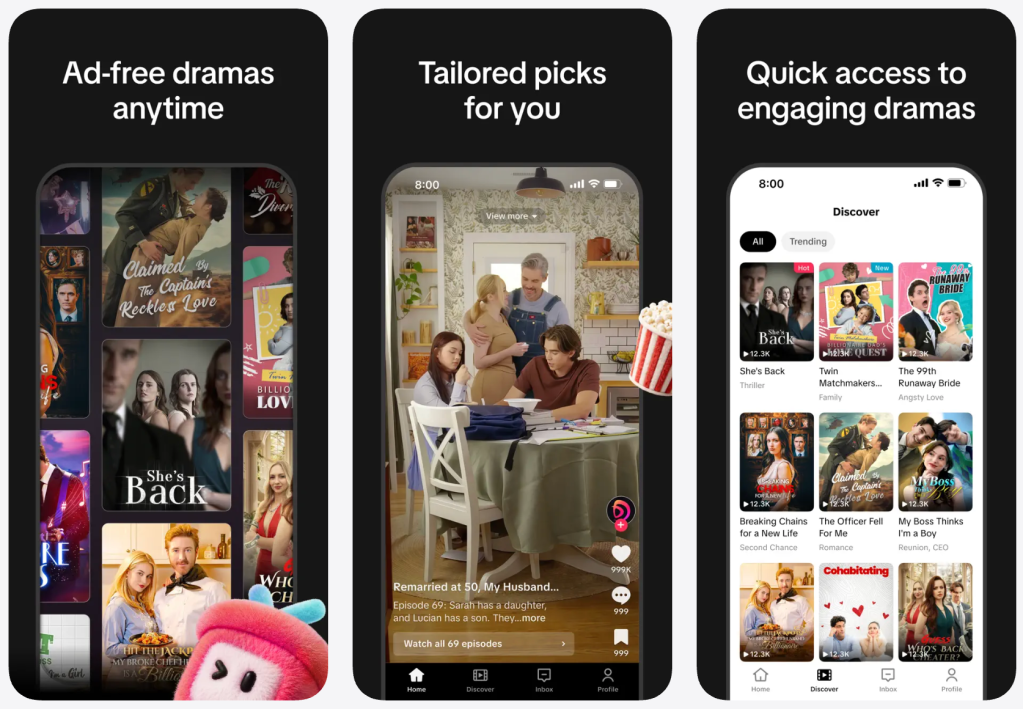
TikTok's PineDrama launched on January 16, 2026 with a Watch History section, a Favorites list, and comment threads. These are basic tools to resume, save, and discuss a series - and represent the early infrastructure for the kind of social graph that keeps F2P titles alive well past their content's shelf life.
Those features aren't a mature social economy yet - the app launched free and ad-free, with no monetization model disclosed. But they point at the missing layer: a viewer needs somewhere to return besides the next unlocked episode.
techcrunch.com/2026/01/16/tiktok-quietly-launches-a-micro-drama-app-called-pinedrama
Platforms such as Dorian are testing a more participatory model, with creators building interactive stories and fans spending around UGC experiences. Dorian says its breakout title SlashFic generated more than $3M in its first year on the platform, using a near-zero-upfront-cost production model.
In the strongest F2P products, content starts the relationship, then community and participation sustain it. Microdrama has already proved it can produce content at scale. The next question is whether platforms can turn that supply into a relationship that survives between episodes, series, and purchases.
Four ways this plays out
Strip away the branding and there are four strategic postures available. Each maps to a pattern mobile gaming has already tested.
Path | Model | Mobile-game analogue | Advantage | Main risk |
Premium Subscription | Pay before viewing | Premium title in a free-to-play market | Predictable Revenue per subscriber | Slower Acquisition and weak impulse conversion |
Freemium optimization | Improve coins, passes, and pricing | Economy tuning | Fastest, lowest-risk improvement | May not fix weak long-term retention |
Participation-led | Free viewing plus ads, community, and creator monetization | Social or UGC game | Strong potential in lower-IAP markets | Requires dense participation and creator supply |
Hybrid | Free entry, subscriptions, coins, ads, and social features | Battle pass plus guild system | Highest potential lifetime value | Hardest to design and balance |
Quibi is the cautionary reference for the subscription model. With this approach, the app couldn't overcome free alternatives, weak habit formation, and an unproven premium-short-form proposition. A hard wall may work as a premium tier for an already-established platform, but it's a poor default for a category still dependent on rapid acquisition.
On the third path, PineDrama is an early experiment: it launched with free, ad-free access and no clearly disclosed monetization model yet. That’s the honest read on where participation-led microdrama actually stands today: it’s not a proven playbook.
Why hybrid wins
We'd bet on the hybrid monetization plan. Not because stacking every monetization layer automatically improves the economics, but because different cohorts want different forms of value. A single-mechanism economy depends on one spending pattern staying stable. A well-designed layered economy is more resilient: it lets the platform monetize a casual viewer, a binge-watcher, and a high-value fan without forcing all three through the same transaction.
That bet needs a complication, though. Ads and IAP aren't neutral toward each other: the moment an ad can substitute for a purchase, that purchase becomes less likely, and every ad slot chips at the premium feel the conversion moment depends on. Hybrid should win on ROAS, but pure freemium with no ad layer diluting the purchase decision probably has the higher ceiling.
The sequencing matters too, and it's worth building differently than a straight freemium-first rollout. Rather than fixing pricing friction and only later layering in an event calendar, subscription and live ops should be built together from the start, framed as a single system, closer to a battle pass than two separate initiatives.
A hybrid built as a stack of unrelated tactics creates confusion. A hybrid built around one coherent system, with reactivation layered on at the end, is closer to what could produce the category's durable winners.
The consolidation question
Revenue concentration tells you where this is headed, and the shape is already changing. In Q1 2025, the category was effectively a duopoly: ReelShort and DramaBox each pulled in roughly $130-140M in quarterly IAP revenue, together accounting for about 70% of the entire global short-drama market.
A year later, that duopoly is already cracking open. Media Partners Asia's latest count puts ReelShort at 29% share and DramaBox at 21%. They’re still the two biggest players, but no longer 70% of the pie, with DramaWave (13%), NetShort (10%), and GoodShort (6%) carving out real positions - and roughly 300 smaller apps splitting what's left.
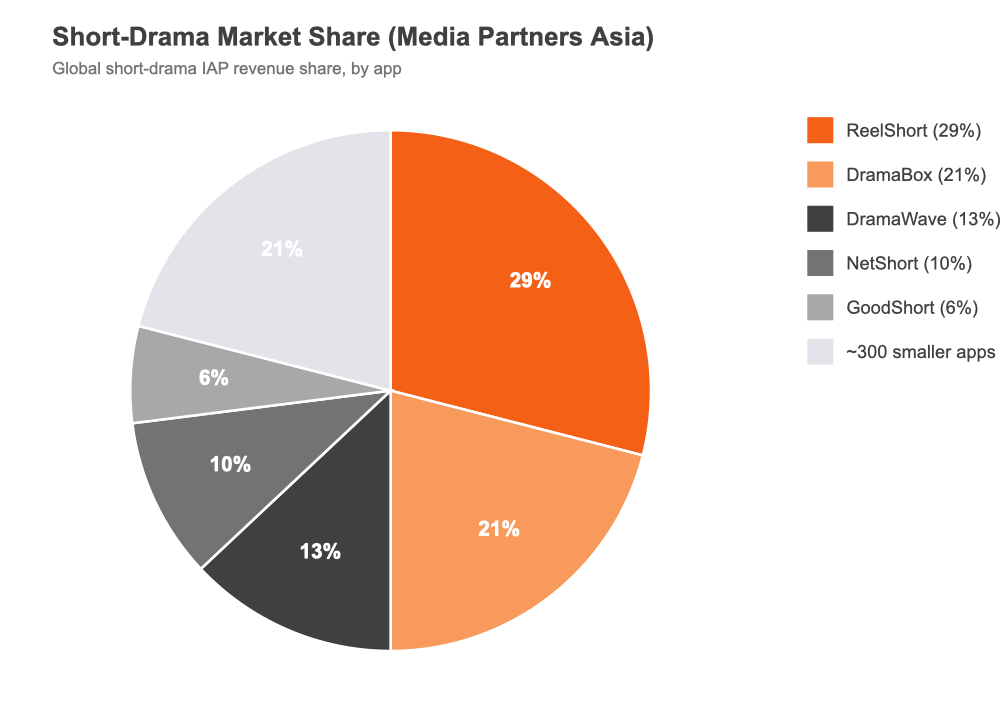
Those two snapshots come from slightly different points in the market's evolution, but the direction they both point in is unmistakable: this is the same shape hypercasual gaming took on its way from hundreds of competing studios to a handful of scaled winners. It’s also the same shape that match-3 settled into as an effective two-title rivalry (King vs. Dream Games).
In both cases, acquisition was only the first filter. The winners combined distribution, monetization discipline, content supply, and retention systems that smaller competitors couldn't replicate.
A more specific shape than a simple field-to-handful narrowing is likely, because hybrid economics reward platforms that can execute live ops, segmentation, and social layers simultaneously. The apps that build that product layer first won't just win more downloads. They'll be the ones that finally convert this category's extraordinary engagement numbers into the kind of durable, compounding revenue that F2P gaming spent a decade learning to build.
Want to discuss how to improve your own app’s product layer and boost growth? Talk to us.