How Plunge Grew Playgem's Net Revenue by 160% in Less Than 6 months
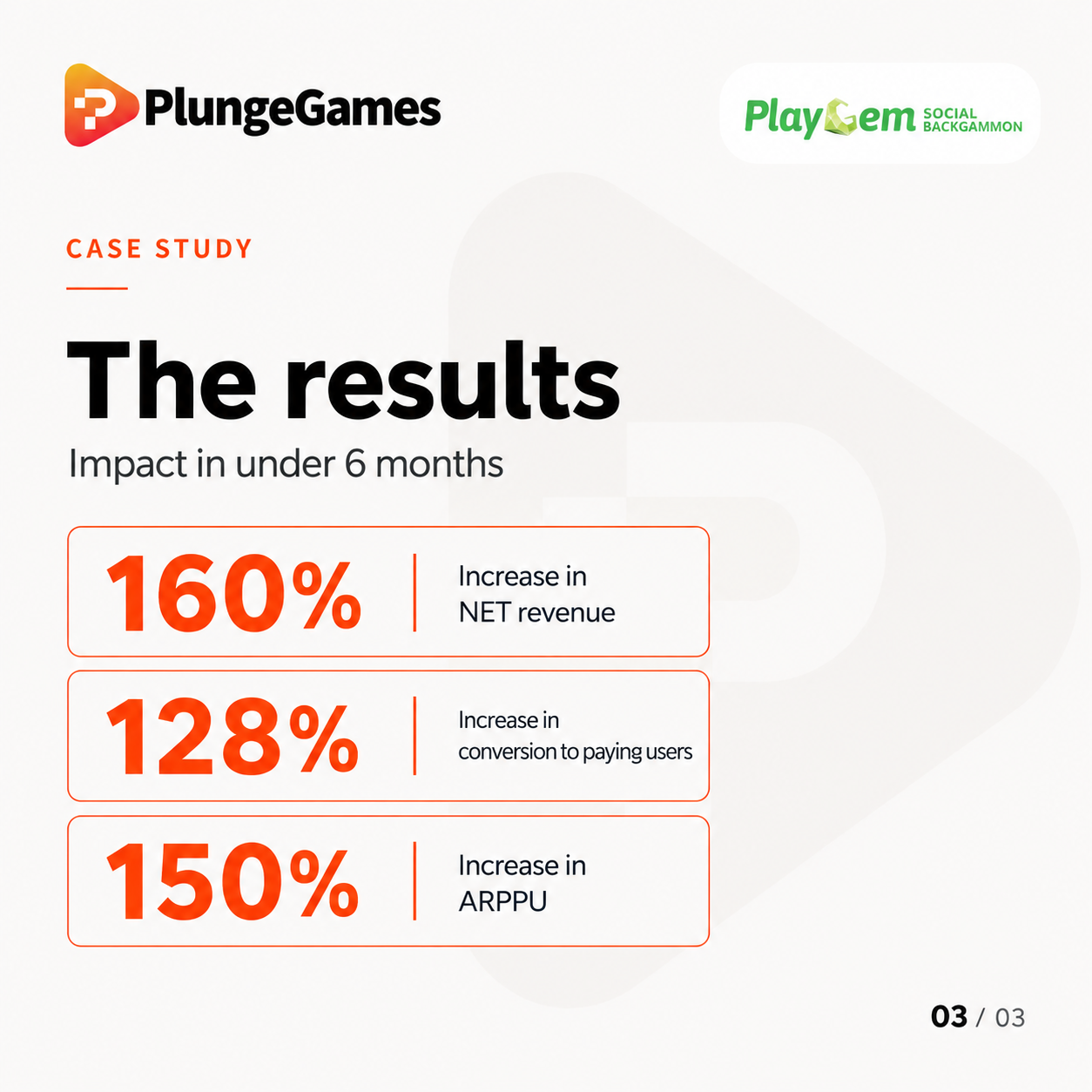
160% Net revenue increase | 128% Higher CVR from install to paying users | 150% Increase in ARPPU |
Playgem is a mobile game studio that's been operating for over 13 years. Their flagship game, PlayGem Backgammon, had everything a studio wants to see: authentic gameplay, 24/7 tournaments, and a loyal global community across iOS, Android, and desktop. What they still had yet to achieve was scale. The user base was real and sticky, but growth beyond it had always been out of reach.
By January 2025, the challenge of scale still remained. The potential was sitting inside the product, and it just needed the right team to unlock it. So Playgem brought Plunge in with a full mandate that went beyond the usual consultant scope of sharing a few decks and advising on a high-level. They gave the Plunge team the authority to plan and execute across monetization, product, ad revenue, and design simultaneously.
Within less than 6 months, net revenue was up 160%, the conversion rate of installs to paying users increased by 128%, and ARPPU experienced a 150% jump.
A strong game with stalled growth
Playgem had built something real with PlayGem Backgammon: an established player base and proven game loop was driving deep retention and dependable revenue.
But by late 2024, growth had flattened. Revenue wasn't declining, but it was stuck - and the gap between the players Playgem had and the revenue those players could generate was widening.
The root causes were visible across every layer of the business:
New users were arriving without a structured onboarding experience to convert early engagement into habit
The monetization architecture was thin. It was just a basic shop with undifferentiated offers that left significant IAP revenue on the table, regardless of where a player was in their lifecycle
The team was underutilizing liveops as a revenue driver, with limited pricing strategy and no segmentation to match offers to player value
The game was running almost entirely on IAP, with no hybrid monetization model in place to capture the ad revenue opportunity sitting alongside it
Playgem needed an operator team that could take full ownership by diagnosing the gaps, designing the solutions, and executing across all of them at once. That's the mandate they gave Plunge.
Four workstreams powering game growth
Plunge came in with a full operational mandate from Playgem that enabled them to work efficiently and quickly across four parallel aspects of the game from day one. Each was owned by a dedicated consultant, and all four were designed to compound overall growth.
Rebuilding the new user experience
The Plunge team led a ground-up redesign of the new user journey. The existing onboarding was functional but passive: players arrived, started a game, and were largely left to figure out the rest. We closed the gap between install and investment by:
Introducing a Welcome bonus to give new users an immediate reason to engage
Layering in push notification flows to bring lapsing early-stage players back before they churned
Restructuring the onboarding flow to guide players toward the moments in the game most likely to convert them into habitual, paying users
Live ops pricing strategy and shop segmentation
Playgem’s approach to their in-game shop was treating all players the same. They had a single set of offers and one pricing structure, regardless of where a player was in their lifecycle or how much they'd already spent.
The Plunge team explored new opportunities for conversion by introducing a segmented pricing strategy that matched offer type and price point to player value tier. We also rebuilt the live ops calendar to use pricing as an active revenue lever rather than a static backdrop.Players at different stages of their journey started seeing offers that were relevant to them, and conversion quickly followed.
Alongside this, our team implemented new minigames designed to balance coin inflation and extend session length. As a result, players engaged longer and there were more natural monetization opportunities.
Sales structure and FTD journey optimization
The Plunge team also led a full restructuring of Playgem's sales architecture in three critical ways:
Replacing single offers with triple offer structures. This gave players more choice and more surface area to find a purchase that felt right for them
Optimizing the first-time depositor (FTD) journey end-to-end, designing each touchpoint to lower the barrier to that critical first transaction
Introducing minigames as a monetization mechanic. These were lightweight, rewarding interactions that created new moments of willingness to spend outside the core game loop.
Hybrid monetization model
Playgem never fully activated their ad revenue layer. The game was running almost entirely on IAP - a single-channel model that left meaningful revenue unrealized.
When the Plunge team came in, they designed and implemented a hybrid monetization model that integrated ad revenue alongside IAP without undermining the player experience or cannibalizing existing purchase behavior. The result was a second revenue engine running in parallel with the first.
Driving +160% net revenue in under 6 months
The four workstreams weren't designed in isolation - they were built to compound. And the results reflect that.
Within less than a year of Plunge taking on the full mandate:
Net revenue grew by 160%
Conversions from non-paying to paying users increased by 128%, meaning significantly more of Playgem's existing player base was crossing the threshold into spending for the first time
ARPPU grew by 150%, reflecting that the players who were already paying were now spending considerably more
These results trace back to Plunge’s full-service approach, which tackled challenges and exposed growth opportunities in each part of the studio’s operations. The new user journey and onboarding overhaul drove more players to the moments most likely to trigger a first purchase. The shop segmentation and live ops pricing strategy ensured that when players were ready to spend, the right offer was in front of them. The restructured sales architecture and FTD journey optimization lowered the barrier to that first transaction and increased the ceiling on subsequent ones. And the hybrid monetization model added a revenue layer that hadn't existed before, widening the overall monetization base without touching the core player experience.
Close your growth gaps
Most studios know where their growth gaps are. The harder problem is having the operator expertise - and the bandwidth - to close all of them at once.
Playgem needed a team that could take full ownership across monetization, product, design, and ad revenue simultaneously, and execute without the overhead of building that team in-house. That's the Plunge model: embedded operators who work inside your business, move at the speed your roadmap demands, and are accountable to outcomes.
The 160% revenue growth and other KPIs that Playgem achieved weren't the results of a single insight. They’re what happens when the right team has the expertise and mandate to act on all of them.
If you're ready to close your game’s growth gap, let’s talk.