What Is Hybrid Monetization? A Working Model for Mobile Game Studios
Free-to-play payer conversion has stayed in the low single digits for a decade. Swrve and Unity data from across the last ten years consistently lands between 1.5% and 2.3%. That means an IAP-only game is running its entire business on roughly one in fifty players. It can work, but it’s a fragile foundation - and as user acquisition costs have climbed, the fragility has become harder to ignore.
Ads-only models have the opposite problem: these games monetize a much broader audience but cap out too low to fund profitable UA. It’s a ceiling that has only gotten harder to clear as privacy changes have made targeting more expensive.
Hybrid monetization is the answer to both problems at once. It gives non-payers a way to generate value through ads, gives payers more than one way to spend and progress, and produces a wider revenue base that depends less on any single segment.
The harder question is what this monetization model actually looks like in practice. Which combination fits your genre, what each layer is meant to do, and how they can fail each other if the implementation is careless. Let’s dive in.
What is hybrid monetization?
Hybrid monetization is the combination of in-app purchases (IAP), in-app advertising (IAA), and recurring commitment tools like subscriptions or battle passes into one coordinated revenue system. It’s not three separate revenue lines sitting next to each other.
By 2026, this isn't a niche strategy or a "let's test this later" idea. For most mobile games, it's the default revenue architecture, including genres that would have been treated as IAP-only or ads-only a few years ago.
The real question studios are asking now is less "should we add ads to our IAP game?" and more "which part of our hybrid mix is underperforming, and why?"
The origins of hybrid monetization
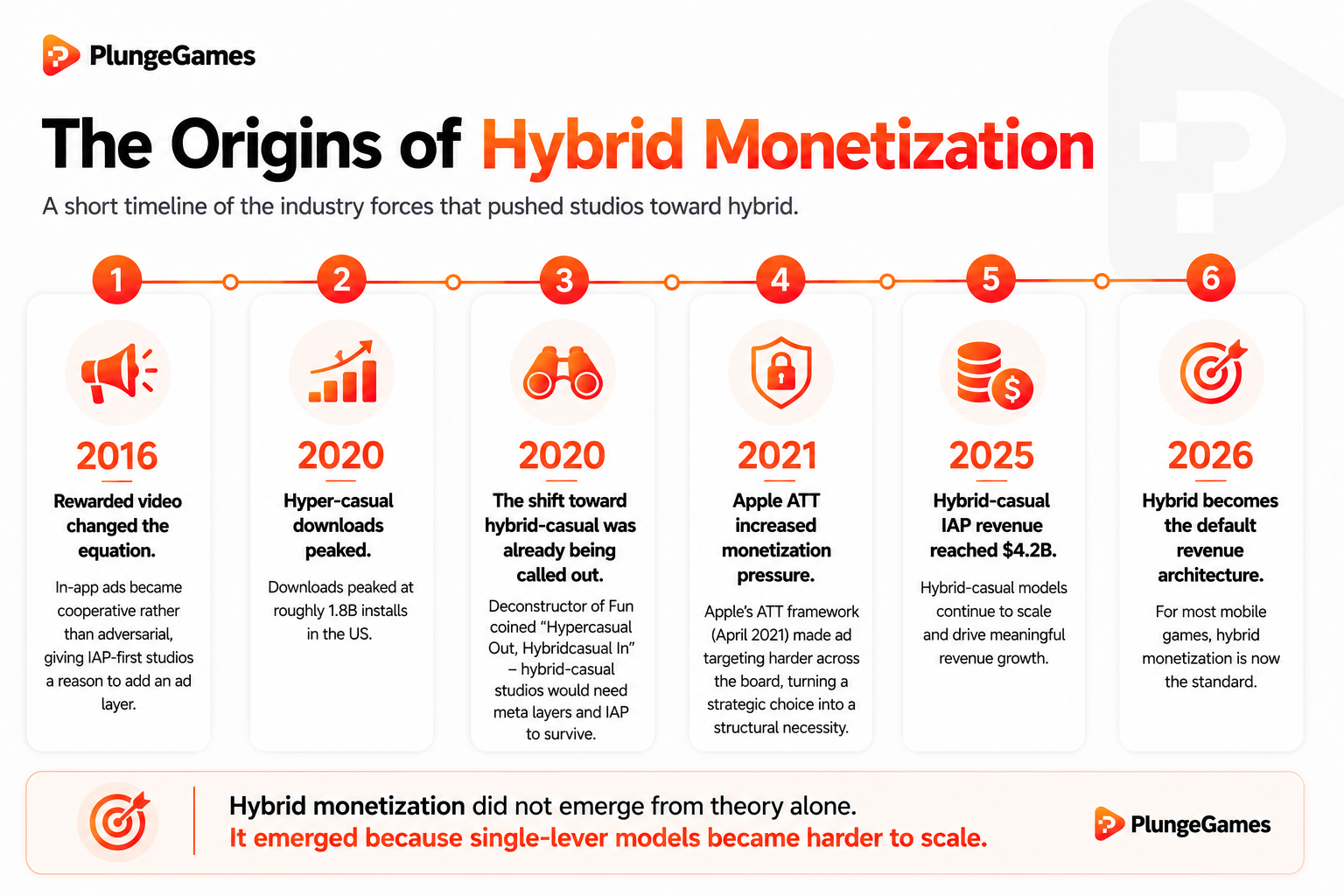
Hybrid monetization emerged from two separate pressures converging on the same problem at roughly the same time.
On one side: Rewarded video changed the equation around 2016. That’s when in-app ads became cooperative rather than adversarial, and it gave IAP-first studios a reason to add an ad layer without worrying it would poison the player experience. Candy Crush Saga is the clearest example of this. King was insistent on using just in-app purchases for years before adding ads back in. Now, ad revenue is estimated at 10-15% of the game’s total revenue.
On the other side: Hyper-casual games hit a ceiling. Downloads peaked at roughly 1.8B installs in the US in 2020, but growth was already decelerating as UA costs rose and CPMs softened. By January 2020, Deconstructor of Fun was already calling the shift, "Hypercasual Out, Hybridcasual In". Hyper-casual studios would need to add meta layers and IAP to survive. Then Apple's ATT framework landed in April 2021, made ad targeting harder across the board, and turned what had been a strategic choice into a structural necessity.
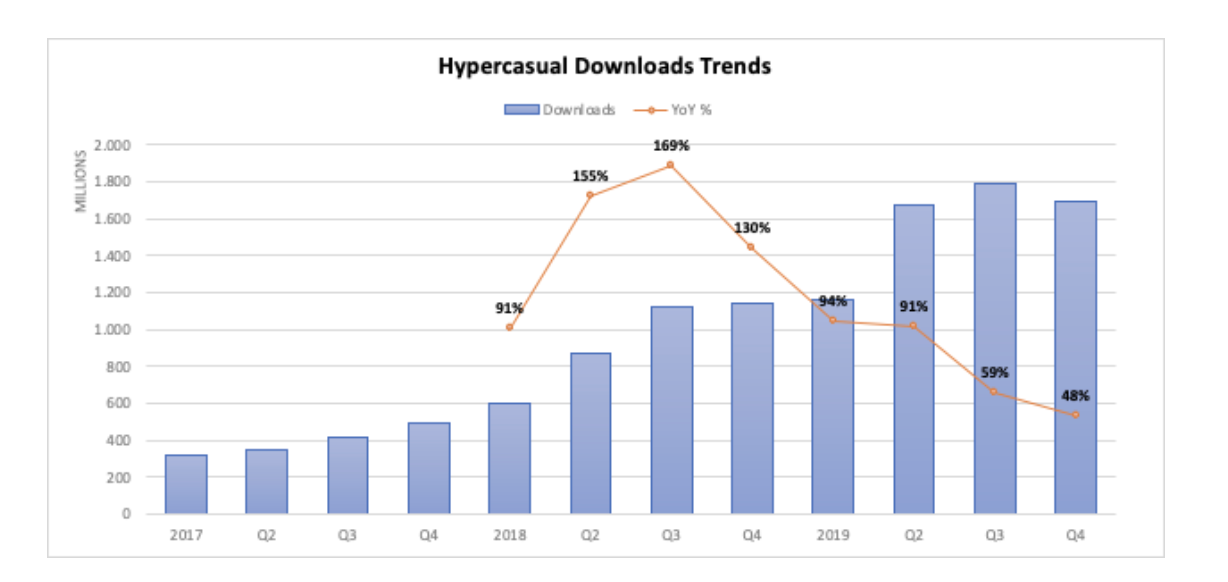
Source: https://www.deconstructoroffun.com/blog/2020-2-what-happens-when-the-hypercasual-party-ends
Both directions - IAP games adding ads once the format became player-friendly, ad games adding IAP once the economics forced it - ended up in the same place: an economy that couldn't depend on a single revenue lever. Hybrid monetization is a response to the economics of free-to-play at scale.
Comparing monetization models: IAP vs. IAA vs. subscription vs. hybrid
One term worth defining before reading the comparison table below: ARPDAU, or average revenue per daily active user. It’s the standard yardstick for comparing how much a model earns per player, regardless of total player count.
Model | How it works | Typical ARPDAU | Best genre fit | Main risk |
IAP-only | Revenue from currency, boosters, and cosmetics; free content is a loss leader for conversion | Low volume, high ceiling on payers | Mid-core RPG, strategy, simulation | Whale dependency: a handful of players can carry the whole P&L |
IAA-only (ads) | Revenue from rewarded video, interstitials, and offerwalls across nearly the whole player base | Low, capped ceiling | Hyper-casual | ARPDAU too thin to fund UA once CPMs soften |
Subscription / battle pass | Recurring commitment for a defined content or convenience window | Moderate, but concentrated in engaged users | Puzzle, brain-training, live-service titles with strong content cadence | Churn if content pipeline slows; needs LiveOps maturity to sustain |
Hybrid | IAP, ads, and subscriptions layered so each catches a different player segment | Broadest and most stable | Hybrid-casual, mid-core, most live-service genres | Layers competing instead of complementing. Ads devaluing IAP, or currency systems that don't reconcile |
The three layers of a hybrid monetization model
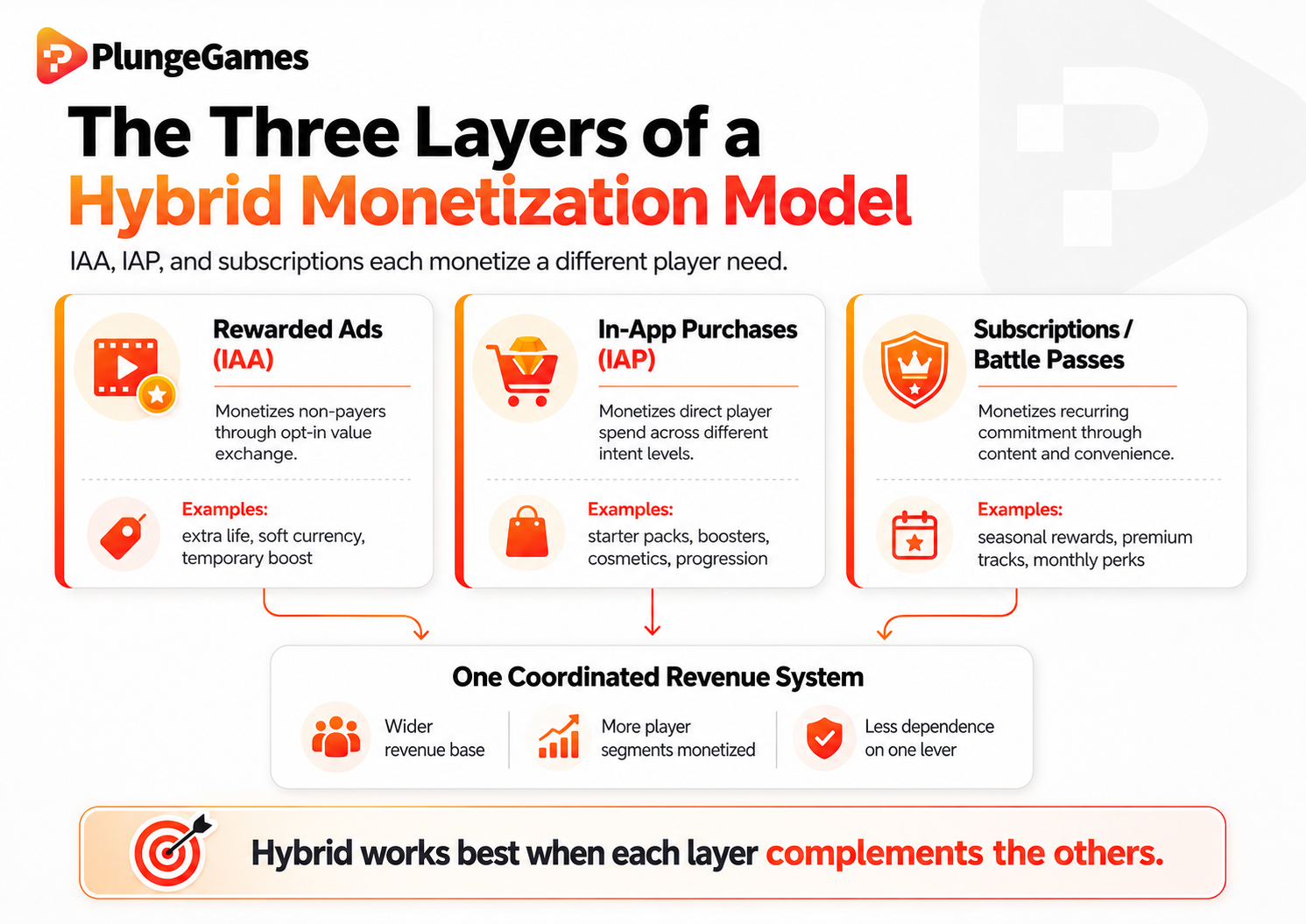
Each layer in a hybrid model is designed to reach a different type of player.
Rewarded ads (IAA)
Rewarded ads are the entry point for players who aren’t ready to pay. A player opts in - usually for extra currency, an extra life, or a temporary boost - and watches a short video ad in exchange.
That opt-in is what makes the format work. Interstitials that interrupt play without being requested can hurt retention. But players actively choose to engage with rewarded ads because they’re earning something at the end that they want. The difference between an ad being a choice and an ad being a disruption is the difference between a lever that works and one that erodes the game.
In-app purchases (IAP)
In-app purchases cover more than most studios design for. Hard currency, boosters, cosmetics, progression shortcuts - these are all examples of IAPs you’re probably familiar with and already using. But the mistake we often see studios make is that they treat IAP as one bucket instead of a ladder. A $0.99 starter pack, a $4.99 mid-tier bundle, and a $49.99 high-value offer aren't the same purchase in different sizes. Each solves a different problem: impatience, identity, catching up. The best purchases solve a real friction point or make a player feel meaningfully ahead, without ever feeling like a tax on progress.
Subscriptions
Subscriptions and battle passes come last, deliberately. They ask for a recurring commitment in exchange for steady content or convenience. This layer only works if there's already a LiveOps cadence behind it. A battle pass without a content engine doesn't read as a value proposition - it reads as a charge. Players notice quickly, and renewal rates show it within a season.
How genre determines your monetization mix
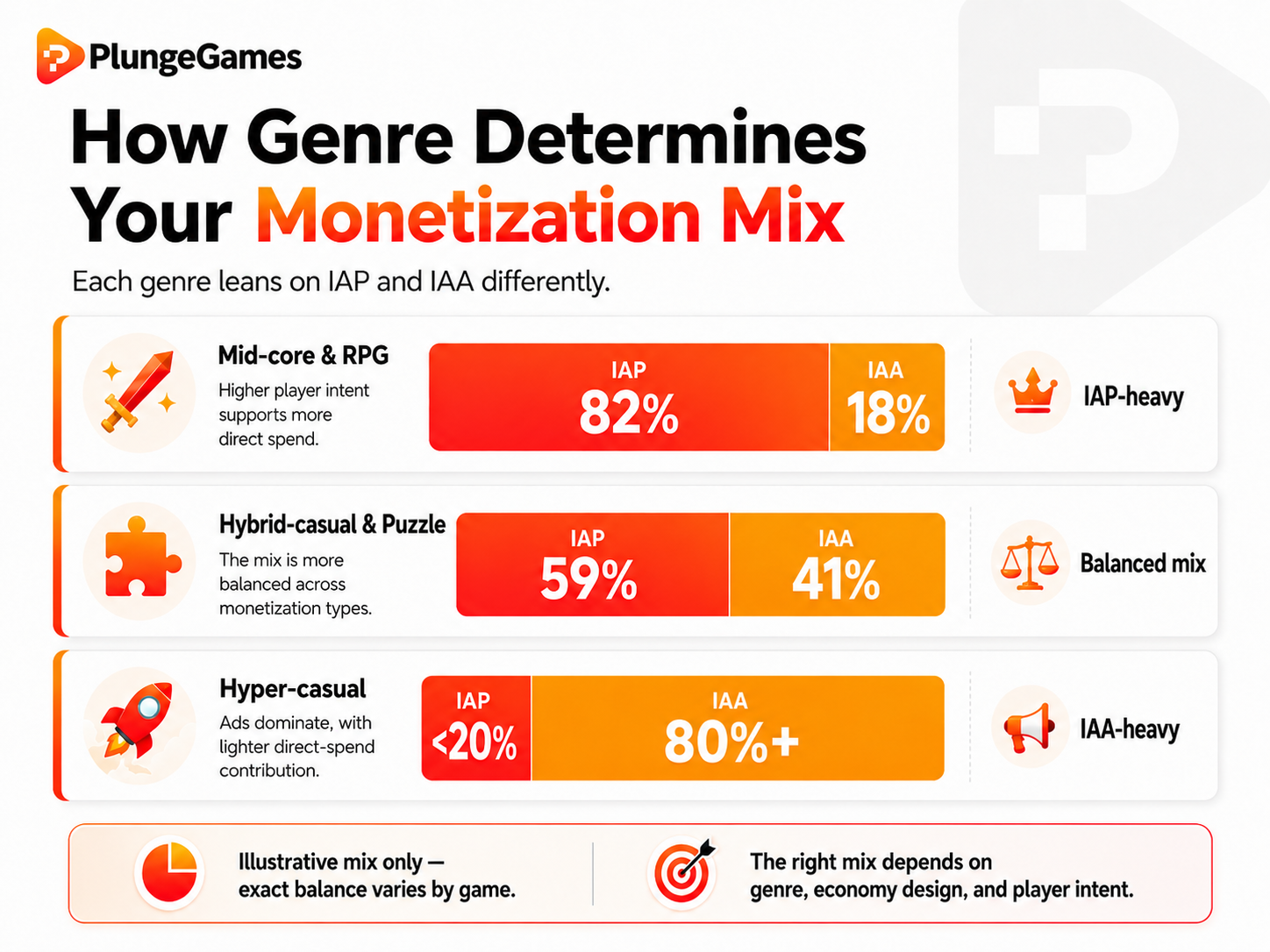
There isn’t a single ratio of IAP:IAA:subscription that fits every game. The right hybrid ratio depends heavily on your genre:
Mid-core & RPG
Mid-core RPGs and strategy titles lean IAP-heavy, roughly 82% IAP, 18% ads, based on industry revenue data. Their players are fewer but more invested, and the depth of progression systems supports higher-ticket purchases without feeling exploitative. Ads are a secondary layer at most, especially for core games, where the risk of losing a high-value player to an intrusive placement outweighs the ad revenue they would generate. Supercell’s Clash of Clans is a good example: built primarily around gems and bundles, it’s still one of the highest-grossing strategy games on mobile.
Hybrid-casual & puzzle
Hybrid-casual and puzzle titles sit closer to the middle - roughly 59% IAP, 41% IAA. This is also where growth has been most visible: according to Sensor Tower's State of Mobile 2026 report, hybrid-casual IAP revenue hit $4.2 billion in 2025, up 20% year over year, while the broader mobile market grew only modestly. Puzzle games alone accounted for 53% of all mobile game ad revenue from February to April 2026, per Sensor Tower - the category is running real ad scale alongside IAP. Subway Surfers is a clear reference point: rewarded ads, IAP, and meta-progression exist inside one casual loop.
Hyper-casual
Hyper-casual remains ads-dominant - typically 80%+ ad revenue - though even that's shifting. Most games now add some form of meta layer, which is often the first step toward hybrid monetization rather than a full jump into it. Appodeal's 2025 Mobile Casual Benchmarks report backs that up from the numbers side: hybrid-casual titles significantly outperform pure hyper-casual on both retention and ad monetization, while hyper-casual's average ARPU trails behind genres like Party and Match that carry heavier meta layers.
If you strip the genre labels away, the real question isn't whether a game uses hybrid monetization — by 2026, many do in some form. It's how much of its economy can support ads before it starts needing real spend. A hyper-casual loop can absorb a lot of ad frequency before players push back; a $50 mid-core purchase can't sit next to constant interruptions without the offer feeling cheap. That's less a design category than an economic one, and it's the actual decision studios are making when they pick a genre and a core loop.
How to implement a hybrid monetization strategy
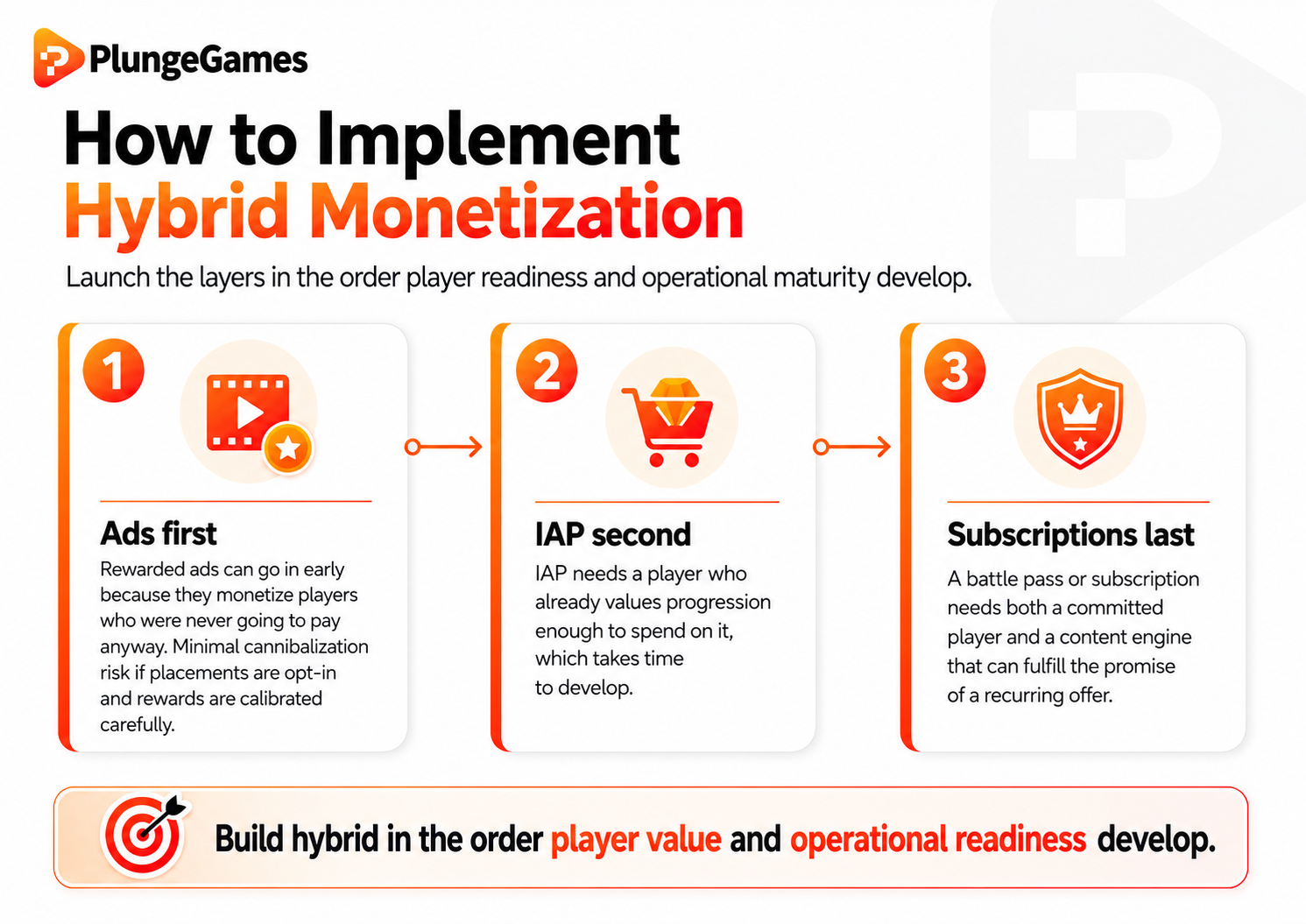
The sequencing matters as much as the mix. A battle pass launched before there's a LiveOps cadence to support it, or rewarded ads placed before players have formed an attachment to the game, will underperform.
The general logic: Ads first, IAP second, subscriptions last.
Ads first: Rewarded ads can go in early because they monetize players who were never going to pay anyway. There's minimal cannibalization risk if placements are opt-in and rewards are calibrated carefully
IAP second: IAP needs a player who already values progression enough to spend on it, which takes time to develop
Subscriptions last: A battle pass or subscription needs both a player who's committed and a content engine that can fulfill the promise of a recurring offer
The interaction between layers is where we see most implementations go wrong. If a 30-second rewarded ad delivers the same reward as a $0.99 purchase, you've essentially set the market price of that purchase to zero. The ad should let a player sample the value of an item.
Currency systems need coherence across layers, too: f IAP currency, ad rewards, and battle pass content all feel interchangeable without a clear hierarchy, players stop trusting the economy's logic. As a result, spend intent drops even among payers who were comfortable before.
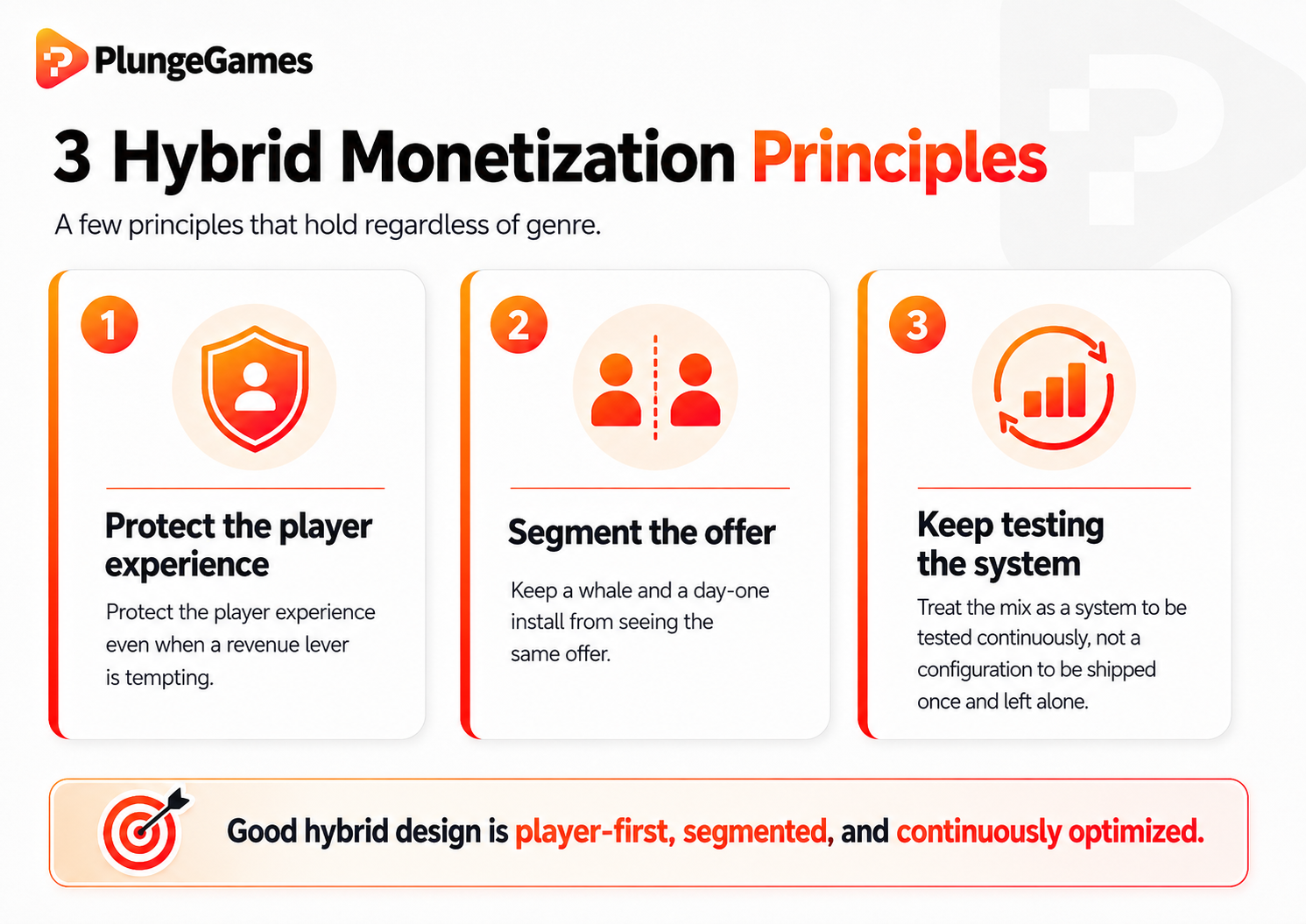
A few principles that hold regardless of genre:
Protect the player experience even when a revenue lever is tempting
Keep a whale and a day-one install from seeing the same offer
Treat the mix as a system to be tested continuously, not a configuration to be shipped once and left alone.
What’s next for
This article covers the foundations: what each layer is, where it came from, and how genre should shape the mix. If you're past those questions and already running a hybrid model that isn't performing the way it should, the diagnosis is different.
Omri Nygate, Plunge's Game Economy and Monetization expert, wrote an advanced, operator-level take on exactly that: Hybrid Monetization Is Now the Default. Most Studios Are Still Getting It Wrong. It covers the ROAS tradeoffs between hybrid and pure IAP, how to sequence a retrofit on a live game, and why the studios getting it wrong are usually making the same two or three mistakes.
And if you want to speak with Omri and the Plunge team directly about your game's monetization mix, talk to us.
FAQ
What is hybrid monetization in mobile games?
Hybrid monetization is a revenue model that combines in-app purchases, in-app advertising, and recurring tools like subscriptions or battle passes into one coordinated system. By 2026 it's the default approach for most mobile games rather than a niche strategy.
What is the difference between IAP and IAA?
IAP (in-app purchases) is direct spend from players in-game, like currency, boosters, cosmetics, or progression items. IAA (in-app advertising) is revenue generated by showing ads, typically rewarded video, interstitials, or offerwalls. IAPs monetize the players who will never make a purchase.
What games use hybrid monetization?
Most top-grossing mobile games across genres — from mid-core strategy titles to hybrid-casual puzzle games — now run some combination of IAP, ads, and often a seasonal pass. Clash of Clans is a good example on the IAP-heavy strategy end, while Candy Crush Saga shows the hybrid-casual puzzle end, running rewarded ads alongside its IAP shop. The specific ratio depends heavily on genre; a strategy RPG and a hybrid-casual puzzle game will weight these layers very differently.
When should a game introduce a battle pass or subscription?
Only once there's a reliable LiveOps cadence in place to support it, typically this looks like a consistent content pipeline filling several weeks of seasonal progression. A pass launched without that operational backbone tends to see weak renewal rates within a season or two.
Can you add hybrid monetization to a live game after launch?
Yes, and it's common. Candy Crush Saga is a good example, having run on IAP alone for years before adding ads, which reportedly now make up 10-15% of its revenue. The main risk in doing this late is currency and pricing conflicts with systems that are already live, which is why it needs careful sequencing rather than a simple bolt-on.
What is hybrid-casual, and how does it relate to hybrid monetization?
Hybrid-casual is a genre category, and it includes games with simple, hypercasual-style core mechanics enriched with meta-progression, cosmetics, and light IAP economies. It's one of the clearest examples of hybrid monetization in action, and one of the fastest-growing segments of the market, with IAP revenue up 20% YoY in 2025, according to Sensor Tower.