Why Studios Hire Plunge (Even When Their Teams Are Strong)
Every studio we work with has a capable core team. We’re not hired to replace what's already there. We're hired because there is an underlying gap: deep capability in most places, and a specific blind spot or bandwidth ceiling that's quietly limiting what the studio can build.
Plunge sits inside that gap, across UA, monetization, economy, ASO, creative, and product. We operate as the growth layer your team doesn't have to build from scratch, all under a single contract. Think of us as an embedded team, where every discipline talks to each other before they talk to you.
Here's what that looks like across five situations it's built for.
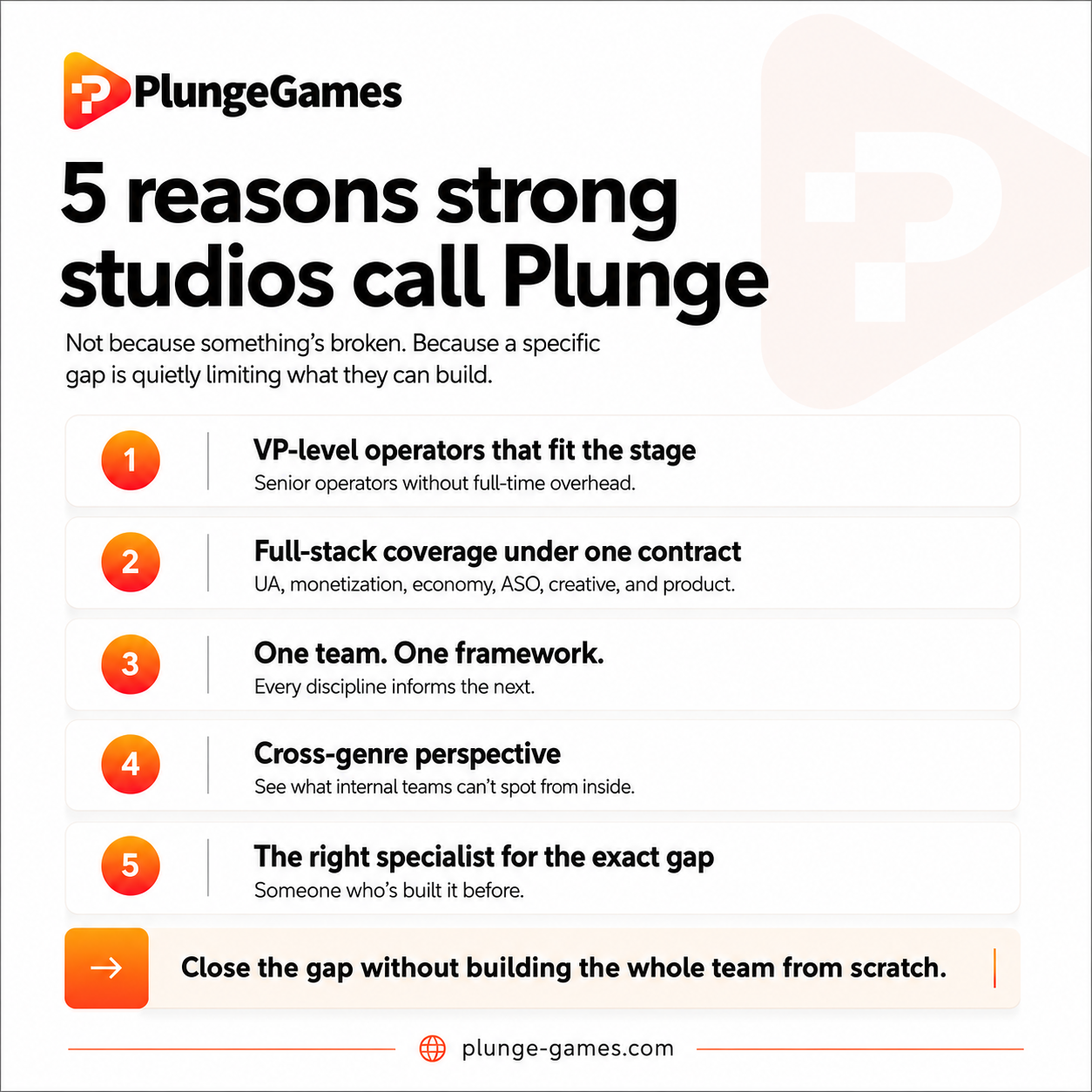
1. Early-stage studios that need senior leadership before they can afford it full-time
If you’re a seed or Series A studio, you probably don’t lack the capital to invest in expertise. What you do lack is the headcount capacity - or the workload - to justify a full-time VP of Monetization or Director of UA on payroll.
You can either hire early and pay a senior salary for a role that's 30% utilized (the other 70% is deadweight on the runway). Or you don’t hire and you're building the wrong foundation and retrofitting later. The UA structure you build in month four, the monetization model you wire into the economy in month six - those decisions compound.
This is the gap that Plunge was built for.
The decisions you make at seed stage are the cheapest ones you'll ever make. With Plunge, you get a fractional director- or VP-level operator - at the exact caliber you'd hire full-time at scale - that can help you build the right infrastructure at the most efficient cost.
2. Lean founding teams with expertise blind spots
There’s an honest pattern that emerges in early teams: founders over-invest in the areas they know and under-invest in the ones they don't. When KPIs stall, the instinct is to go deeper into familiar territory and iterate more on the parts you can see, rather than look hard at the areas you can't.
At Plunge, we bring expertise across every part of studio operations - UA, monetization, economy, ASO, creative, product, etc. When a KPI is stuck, we can tell you whether the issue is upstream, downstream, or somewhere you wouldn't have thought to look. That diagnosis is almost impossible to make from inside your own game.
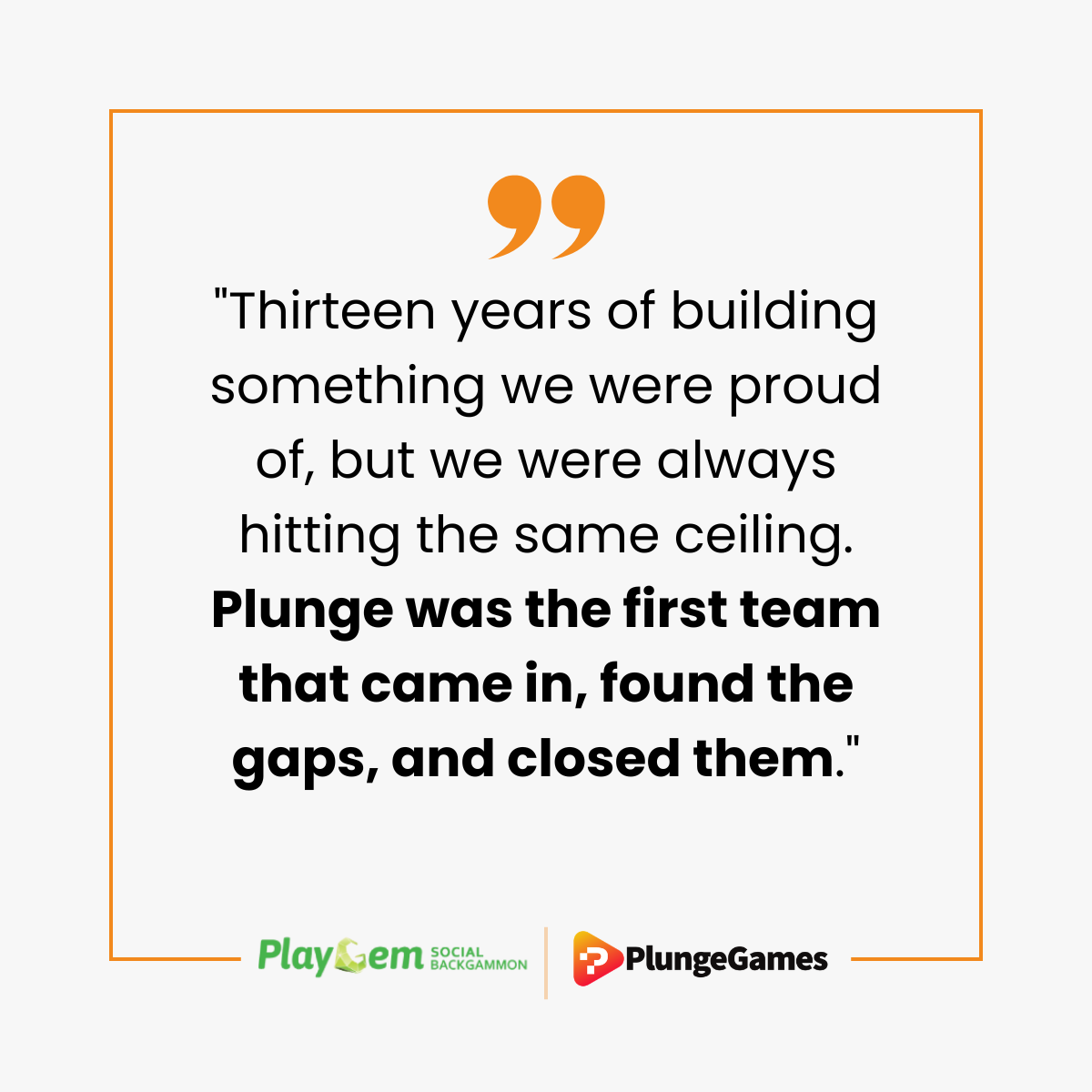
For example, Playgem had been working on scaling their flagship title, PlayGem Backgammon, for over 13 years. It was a good game with real players that was generating dependable revenue. And still, the team couldn't see where the money was being left on the table. That's not a criticism - it's just what happens when you're too close. Within six months of bringing Plunge in, Playgem’s net revenue was up 160%.
3. Siloed vendors with no shared framework
The alternative to Plunge is vendor sprawl: an agency for UA, a freelancer for monetization, a shop for creative, and another consultant for ASO. Five contracts, five invoices, five different frameworks. Meanwhile, nobody in the room is checking whether any of the recommendations line up.
Our model is a single engagement covering the full stack. UA, monetization, economy, ASO, creative production, business review - all of these services live under one contract, with each strategy informing the next. Nothing slips between disciplines because there are no cracks between vendors to slip through.
When Plunge came into Playgem, there wasn't a single problem to fix - there were four:
Onboarding
Live ops
Sales architecture
Monetisation model
A vendor-by-discipline setup would have meant four separate conversations, four separate reports, and nobody checking whether any of it added up. Instead, the Plunge team ran all four at once, with each workstream feeding into the next.
4. Scaled studios in need of fresh perspective
"You don't notice the water getting warmer. Until it's boiling."
That's what happens to studios running the same game for years. They build a deep expertise in that game, but somewhere along the way, a blind spot emerges - often gradually. A mechanic that worked in year one becomes the way things are done. A monetization call that made sense at 100K DAU never gets revisited at 1M. When you've lived inside something long enough, you stop seeing it and start seeing through it.
At Plunge, our operators have shipped across genres, from midcore and casual to social casino, hyper-casual, sweepstakes, and sports. When we look at a mature title, we bring references from outside its own vertical.
Ruby Seven, for example, had a welcome offer in FoxPlay Casino that had just always been there: seven days of rewards, dripped out over a week. It made sense when someone set it up, but nobody on the team had revisited it since. Plunge looked at it fresh, ran a test against a single-day pack, and achieved:
60% increase in day-zero purchases
33% boost in revenue
5. A working model that could use a specific addition
Sometimes the call isn't "something's broken." It's "this is working, and we want to add something we saw in another game."
A battle pass layered onto an existing economy. A new ad placement strategy. A retention mechanic borrowed from a different genre.
Studios in this situation need a specialist who’s actually built the specific thing they want to add - plug in for a defined scope, get it right the first time.
Because of the breadth of our bench, we can almost always put the right person on the exact problem.
Ruby Seven had just launched a web title - Choctaw Slots - but players weren’t finding it. Plunge went in, audited the site, restructured the pages, fixed how Google was reading it, and added the keywords players were actually searching. Ninety days later, organic visits were up 310% and Choctaw Slots was sitting at #4 in Google search.
Comparing Solution to Close the Growth Gap
Most studios choose between three options when they need help closing the growth gap:
The Single Hire | The Niche Agency | Plunge | |
Coverage | One function, deep | One function, specialist | Full stack: UA, monetization, economy, ASO, creative, product |
Cross-discipline thinking | Limited to their lane | Hands off at the edge of their scope | Built in. Every discipline informs every other |
What you're actually buying | One great person in one seat | Expertise plus a coordination problem | Unified strategy across every discipline |
The thread running through all five
None of this is about our clients' teams being wrong. It's about the realities of running a gaming business.
You can't afford everyone full-time early, you can't master every discipline personally, you don't want to manage five vendors, you can't see your own game with fresh eyes, and you can't staff a specialist for every new capability you want to add.
The studios that solve all five of these at once do it through one thing: a single partner with a full-stack bench who operates like an extension of the team, not an addition to the vendor list.
That's what Plunge is: One contract. Every discipline. No gaps.