Mobile Gaming Trends 2026: 7 Shifts Every Studio Needs to Know
From AI-native studios to hybrid monetization and retention-led growth, check out the 7 mobile gaming trends reshaping studio strategy in 2026.
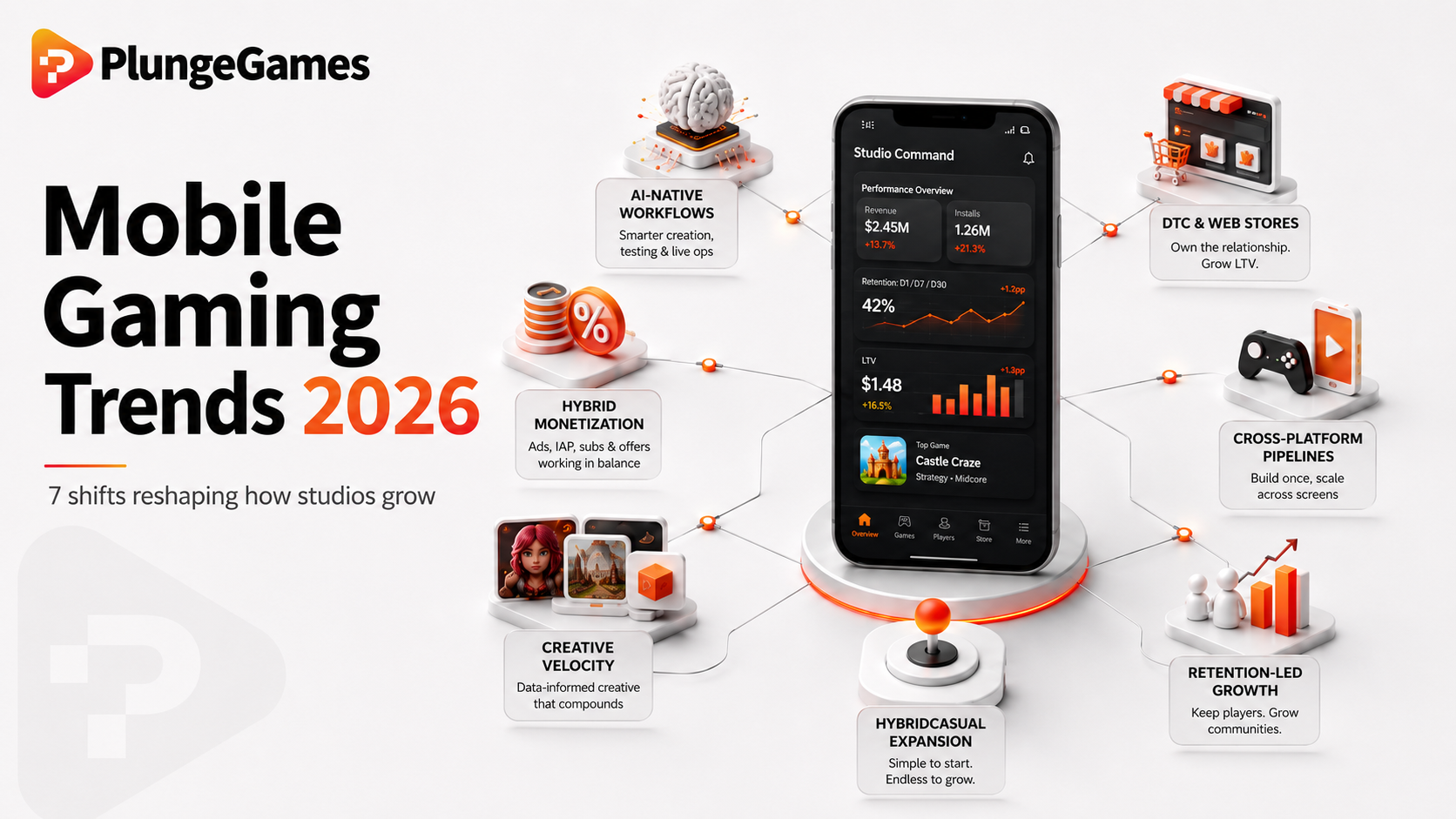
The mobile gaming trends 2026 conversation isn’t really about trends. It’s about a market reorganizing around retention, monetization depth, and faster operating loops. If you’re still reading the market as “more installs, more ads, more content,” you’re already a step behind.
What’s changing is the operating model. Here’s what we’re diving into in this article:
AI is changing how studios produce
Hybrid monetization mobile games are becoming the default instead of a niche strategy
Mobile game user acquisition 2026 is a battleground of creative volume - so differentiation matters most
Distribution is being rebuilt around DTC, web stores, and cross-platform pipelines that let studios own more of the relationship
PC/Steam IP is crossing over to mobile as cross-save and cross-progression systems mature
Growth is shifting from install volume to retention, LiveOps, and payer value
Hybridcasual is still the genre to watch
1. AI-Native Studios Are Here
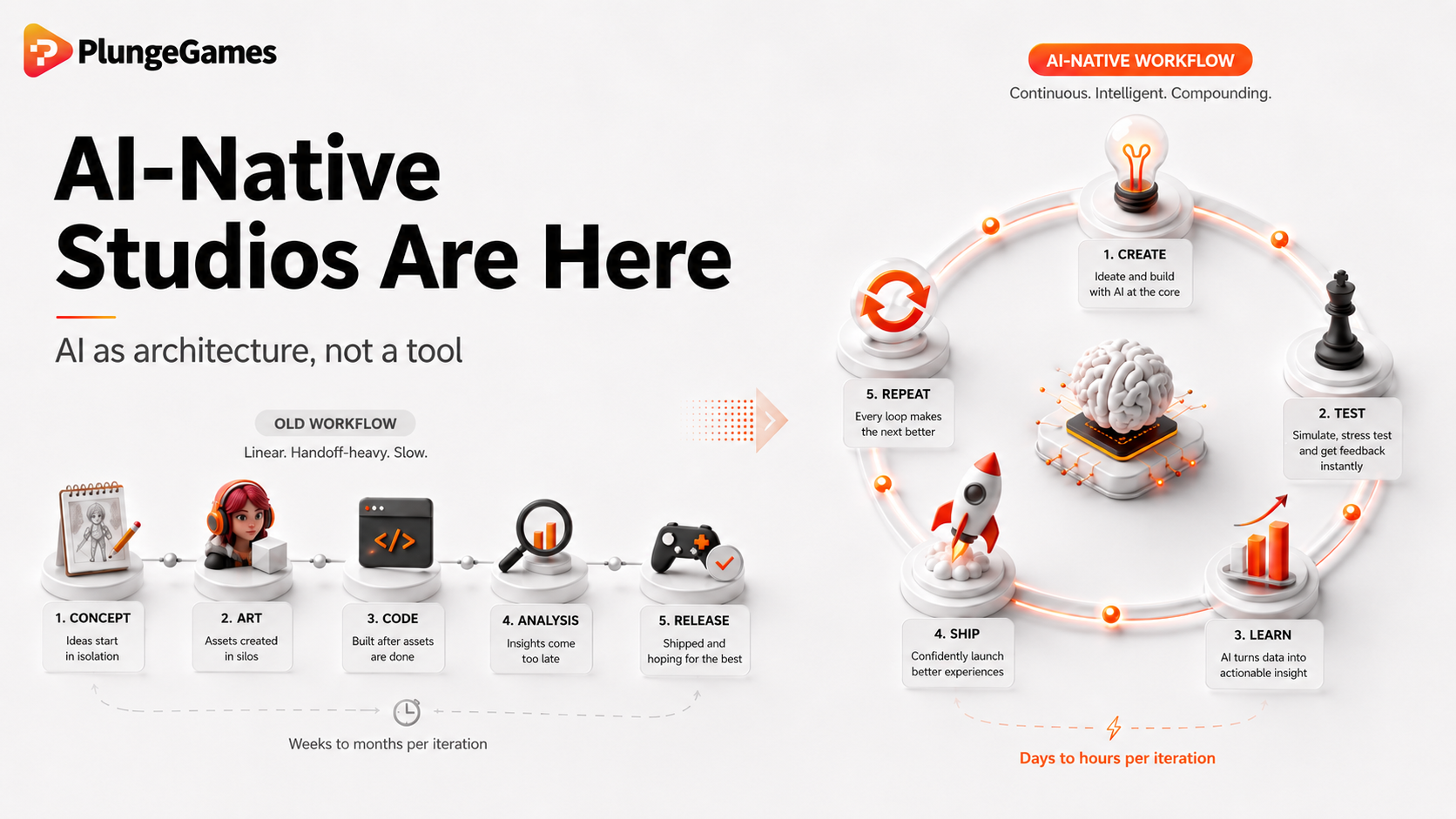
The useful distinction at this point in 2026 isn’t whether a studio uses AI. Most do now, at least somewhere in the workflow. The real divide is between teams that are adding AI as a tool and teams that are rebuilding around it.
In a tool-adoption setup: AI helps with one task at a time - a concept pass, a dialogue draft, a code snippet, a quick internal summary
In an AI-native setup: The workflow changes. Creative gets iterated faster. Analysis gets closer to the people making decisions. Production stops being a long chain of handoffs and becomes something much closer to a live system.
Krafton is a good example of that direction. It has publicly framed itself as AI-first, which tells you where the company thinks the leverage sits.
Ubisoft is another useful signal: Ghostwriter pushed AI directly into the production of NPC dialogue, which is exactly the kind of workflow shift that changes what a team can realistically ship.
AppLovin shows the same logic on the distribution side. Since Axon 2, it has scaled ad spend for gaming clients to roughly a $10 billion annual run rate, up about 4x in two years, which is what AI embedded as architecture looks like at scale.
That matters because mobile is still a fast business. If a studio can test creative faster, shorten the distance between insight and release, and remove friction from analysis and production, it becomes both more efficient and harder to compete against.
2. Hybrid Monetization Becomes the Default
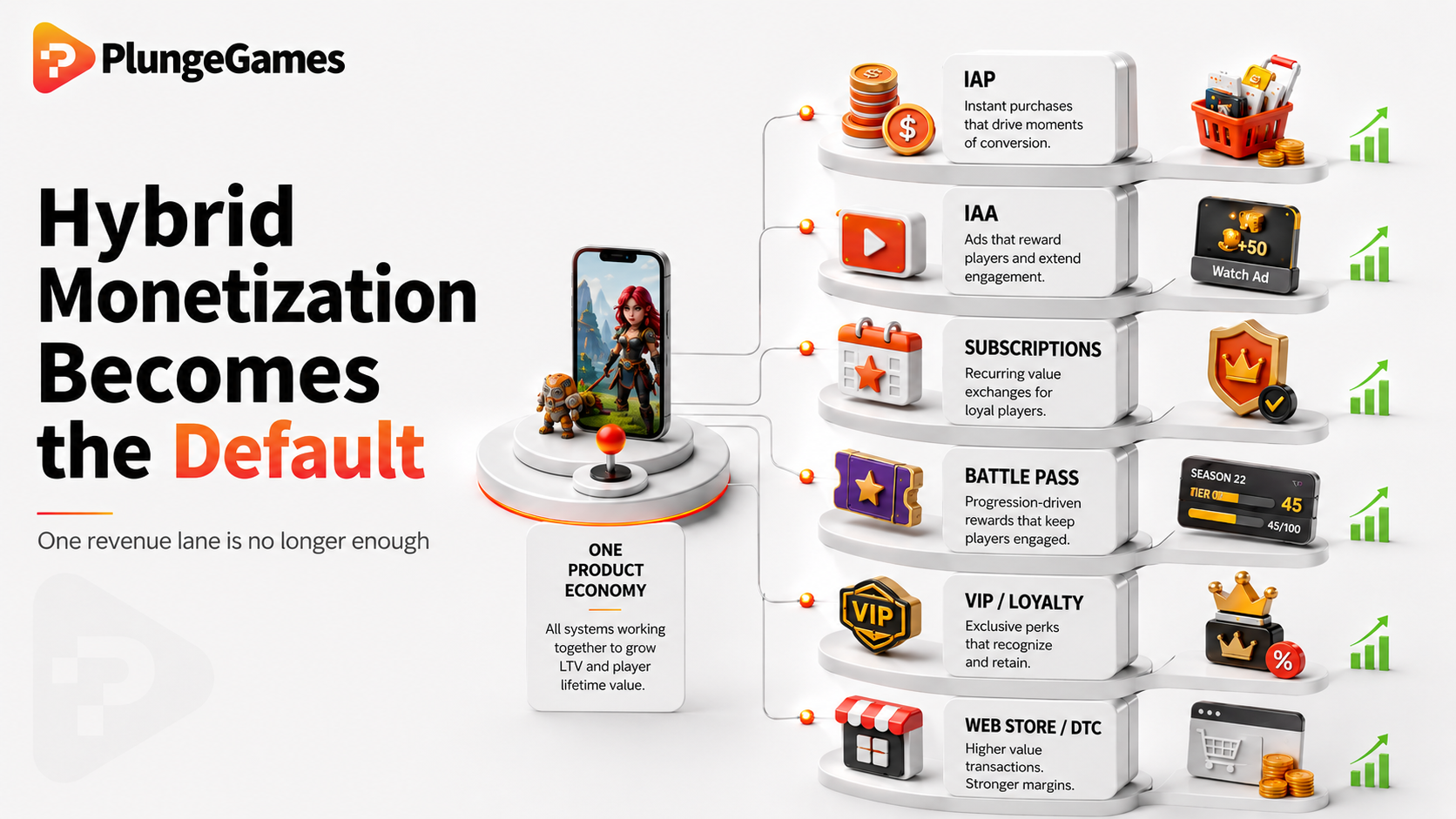
The single-model studio is getting harder to defend. The market is instead moving toward layering: IAP, IAA, subscriptions, battle passes, VIP programs, and DTC/web offers all living inside the same product. That’s the reality behind mobile game monetization strategies in 2026.
What’s interesting is that the convergence is happening from both directions. Some studios are moving from ad-heavy models toward deeper IAP economies, while others are layering ads into IAP-led games to widen the revenue base. Vietnamese publishers are a clear example of the first shift: the Vietnamese mobile game market is moving from IAA toward more sustainable IAP-led monetization.
There’s also a real shift in design. Hybrid monetization mobile games work best when the economy, offer timing, and ad placements are built in early. If the product wasn’t designed for layering, it often results in friction. The studios that understand that are designing for compounding value, not just multiple revenue lines.
3. Creative Volume Is the New UA Battleground
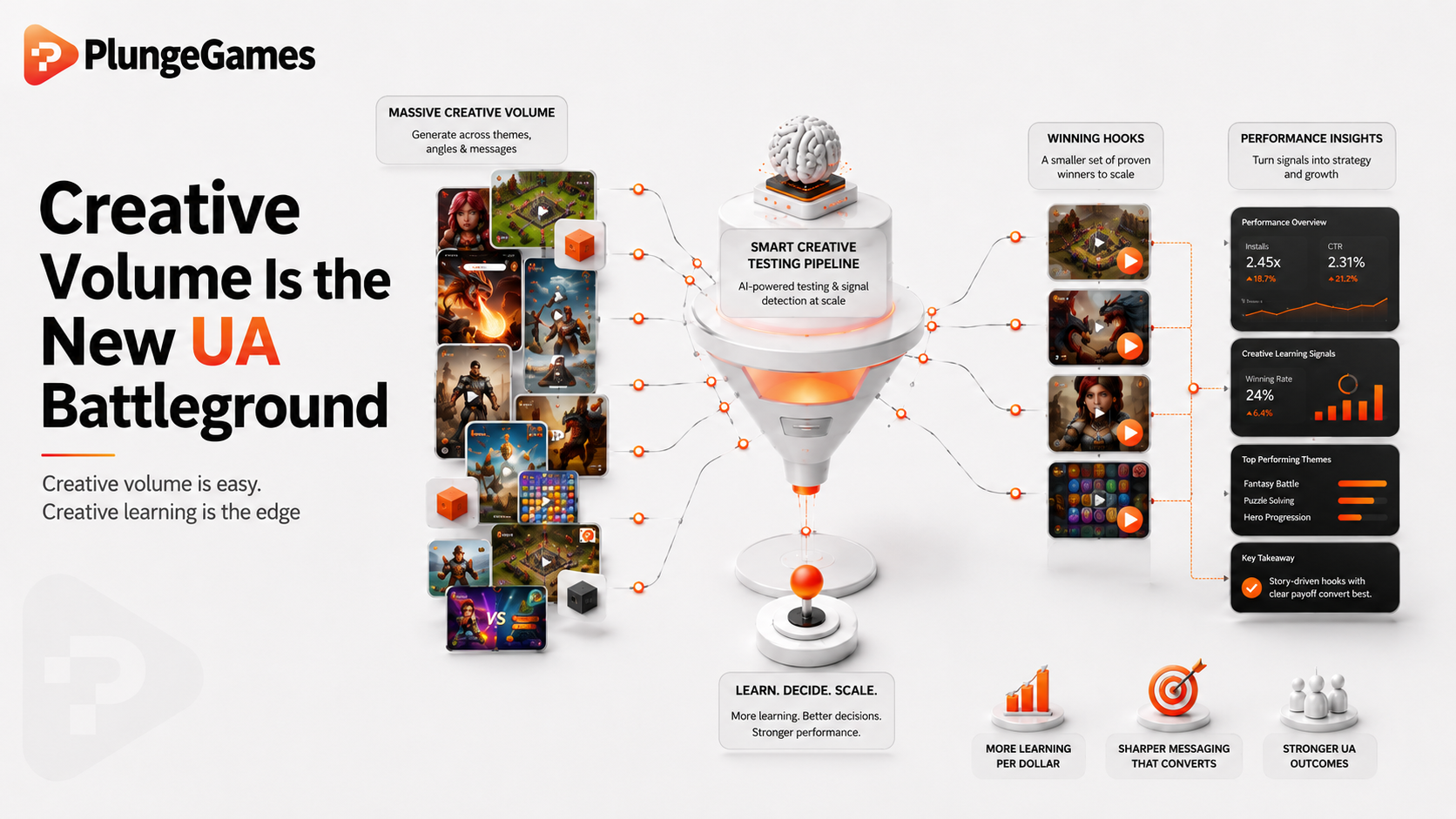
Creative got cheaper to produce before it got easier to win with.
That’s the paradox in mobile game user acquisition in 2026. AI has made it faster to generate variants, iterate hooks, and push more output through the pipeline. But the reason creative matters more now isn’t just because teams can make more of it. It’s because everyone else can too.
AppsFlyer’s latest gaming marketing report puts hard numbers on this mobile gaming trend of 2026: top advertisers produced 2,400 to 2,600 creative variations per quarter in 2025, up 25% to 30% year over year. Smaller spenders increased output, too, which tells you the floor has moved across the market. If you’re still thinking about creative as an occasional production task, you’re late - it’s now the rhythm of the channel.
The tools behind that shift are getting more automated, too. AppLovin has been building toward automated playable ad creation and expanded AI-generated interactive ads, while its broader ad engine keeps leaning into automated decisioning at scale. On the production side, tools like Playturbo and Segwise are making playable and video ad generation more self-serve, and AI-heavy workflows built around ComfyUI are being used to compress image-to-video and creative iteration loops.
What matters now is not whether a studio can produce 50 creatives. It’s whether it understands what the best ones are actually saying about the player. When everyone can generate volume, differentiation becomes the moat.
4. DTC and Web Stores Are a Core Monetization Layer
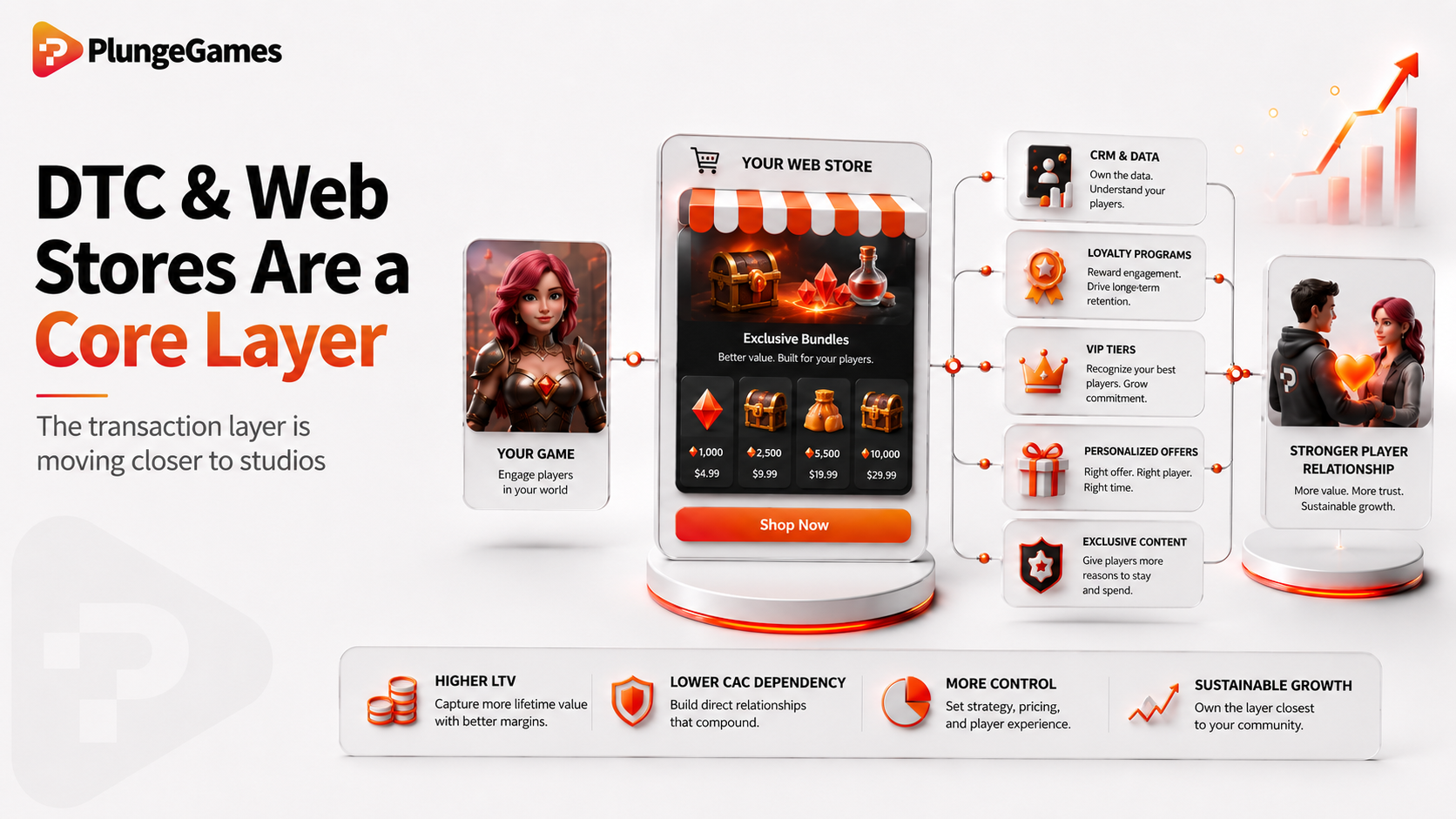
Stillfront’s Q1 2026 numbers make it clear that one of the top mobile gaming trends of 2026 is the rise of DTC monetization: 44% of bookings came through DTC, and gross margin reached 84%. At that level, DTC is part of the operating model.
Huuuge has shown how quickly DTC can scale: direct revenue reached 27% of total revenue in Q3 2025, climbed to 34% in October after Huuuge Pay rolled out, and hit 37% in Q4. Supercell’s ecosystem is different, but its Supercell ID layer points in the same direction: one account connecting all games, turning the direct relationship with players into a permanent part of the product architecture.
Different companies, same conclusion: once a game has enough player depth, owning more of the transaction layer starts to make real sense.
The reason for adopting mobile game monetization strategies like DTC is broader than fee reduction. Web stores give studios more control over pricing, bundles, CRM, loyalty, and VIP treatment, while also reducing dependency on platform rules. The Apple vs. Epic trial (it’s not over yet!) has kept that discussion alive, but the direction is still toward more room for off-app payments and linking.
The cutoff is practical, not ideological. For mature games with strong spenders and the team to support offers and CRM, DTC is worth building now. For earlier-stage titles, it’s usually better to wait until the product has enough payer depth to justify the lift.
5. Steam-to-Mobile Is Getting Real

This mobile gaming trend feels more real in 2026 because the pieces are finally in place: stronger IP, better cross-save systems, and more confidence that players will move across screens when the experience holds together.
You can see that in the titles making the jump. Wuthering Waves has built a clear PC-mobile cross-platform path, Delta Force has been pushing cross-progression between PC and mobile, and Rust Mobile is being positioned as a meaningful extension of the broader Rust experience rather than a disconnected spinoff. Those examples all show the same pattern: mobile works better when it’s not asking the player to start from zero.
The fact that 2.5 Gamers is tracking Steam-to-mobile and adjacent cross-platform developments regularly is a signal in itself that this is one of the top mobile gaming trends of 2026. It tells you this is no longer a fringe conversation. More of the market is now paying attention to where PC/Steam audience equity can be translated into mobile reach.
That connects to a broader shift in platform boundaries. A CTA survey found that 61% of U.S. gamers already play across multiple devices — mobile is increasingly the more convenient screen for players who already know the IP, which changes acquisition economics because trust carries over.
6. Retention-Led Growth Replaces Install Volume
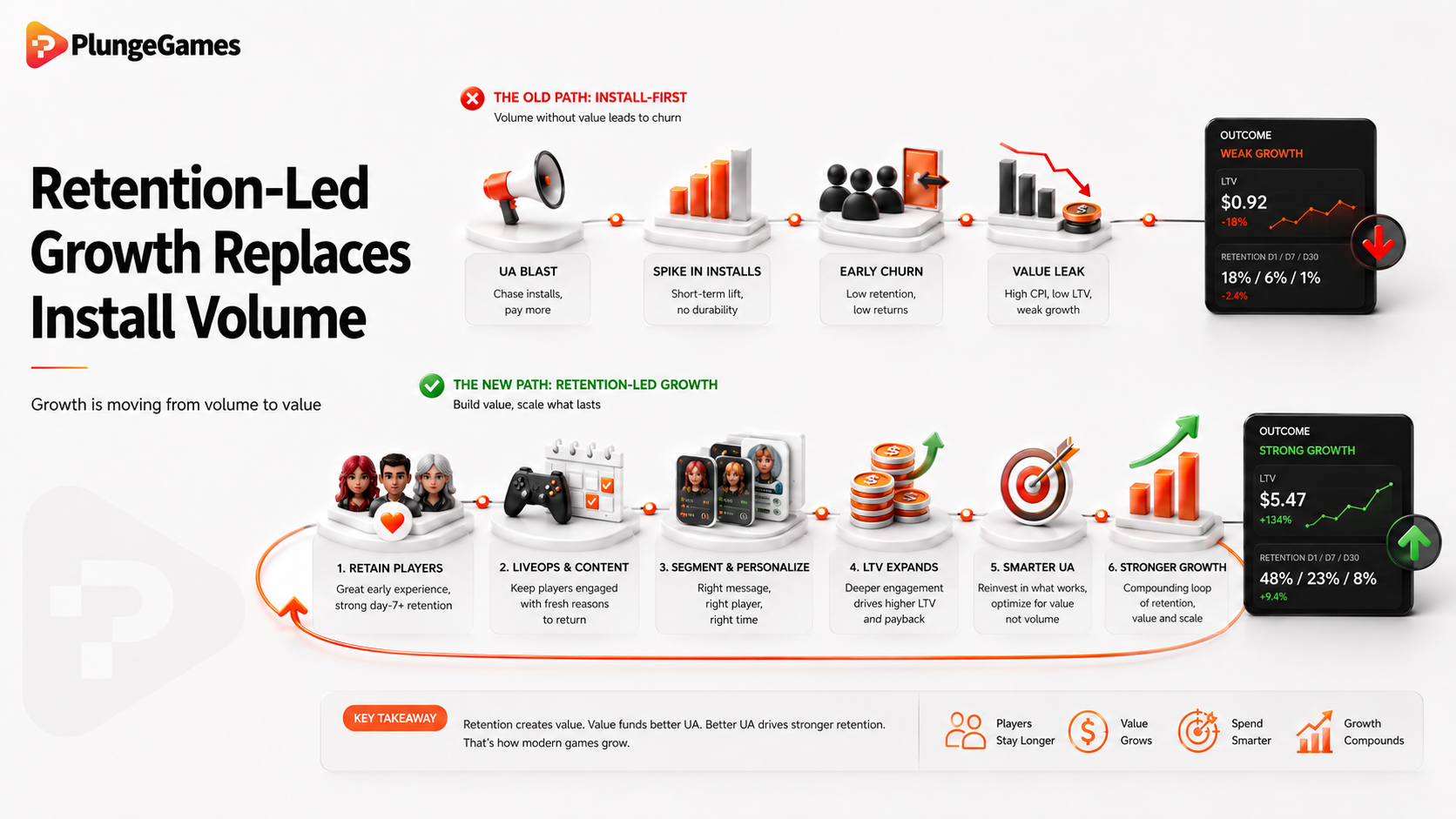
One of the clearest signals in Sensor Tower’s 2026 reporting is that the market is moving from growth-through-volume to growth-through-value. Mobile game downloads fell about 7% in 2025 while IAP revenue still held up, which is a very different operating environment than the old install-first era.
That’s why retention-led growth matters more now. The question has shifted from “how many users can we buy?” to “how much value can we extract from the users we already have?” If that sounds obvious, it’s still where a lot of studios are underinvesting.
In practice, retention-led growth means:
Tighter LiveOps cadence
Stronger progression design
Better payer segmentation
More disciplined reactivation
It also means smarter mobile game user acquisition in 2026, because buying users who behave like your best players is a better business than buying the broadest possible audience. The studios that succeed this year are the ones already treating retention as a revenue system, not a product metric.
7. Hybridcasual Is Still the Genre to Watch
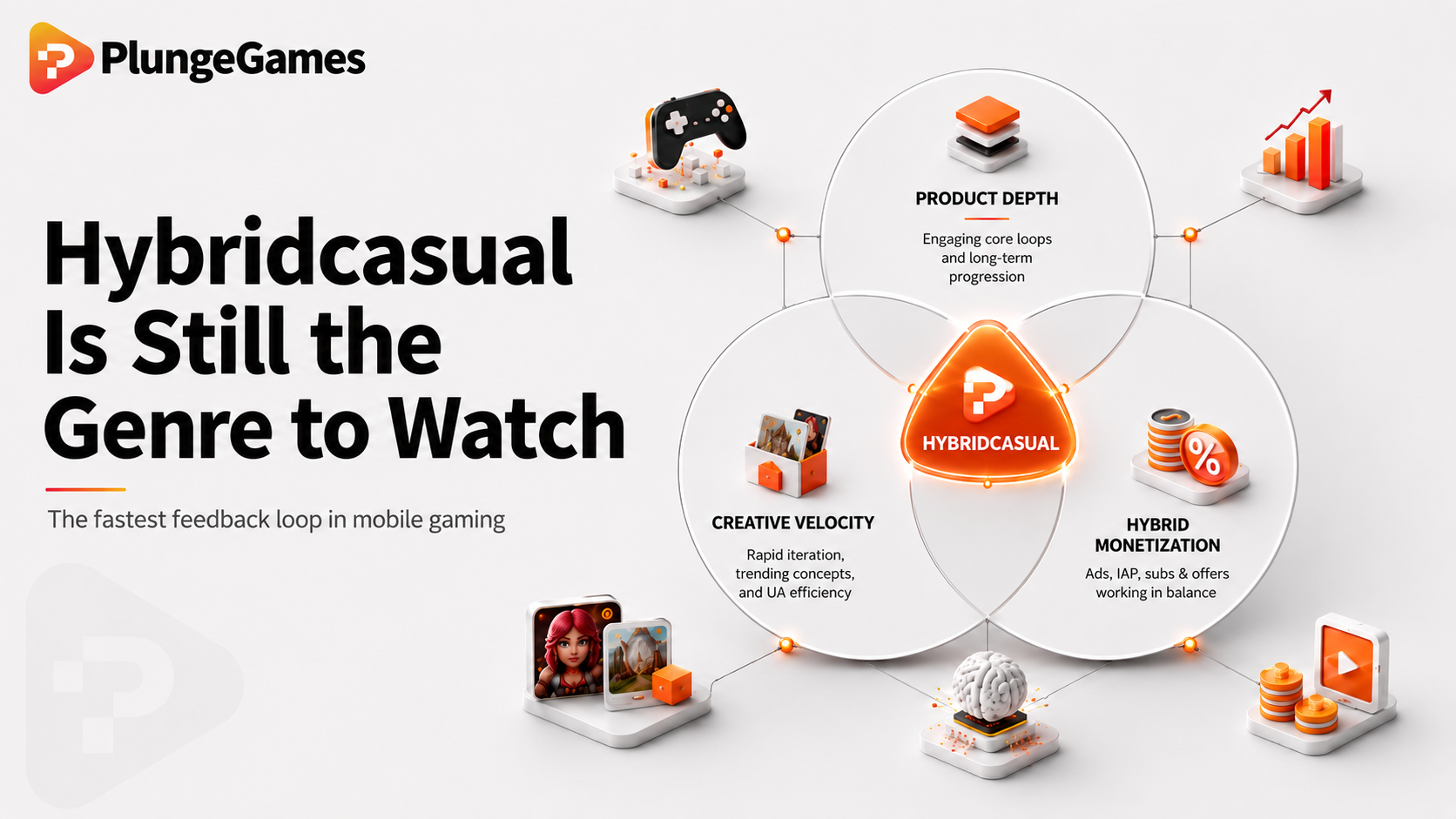
If you want to understand where the market is heading, hybridcasual is still the best place to look. It’s where AI-assisted creative, hybrid monetization mobile games, and retention design show up first because the feedback loop is faster than in most other genres.
Sensor Tower’s 2026 reporting points to hybridcasual as one of the few segments with meaningful IAP growth, while the category continues to split into two business models:
1. On one side are lifestyle and puzzle games, where ad monetization still carries a lot of the load
2. On the other are action and strategy hybrids where IAP depth is stronger and the LTV ceiling is much higher
That’s why games like Last War: Survival, Whiteout Survival, and other strategy-forward hybrid monetization mobile games matter so much. They show how the category has moved beyond “casual with a bit of monetization” into deeper economy design. The next wave will likely come from games that combine high creative velocity with more durable retention hooks and cleaner economy layering.
For studios of all sizes, mobile gaming trends in 2026 like the rise of hybridcasual remain the clearest test of whether your product, UA, and monetization teams are actually working as one system.
How Mobile Gaming Trends 2026 Compound
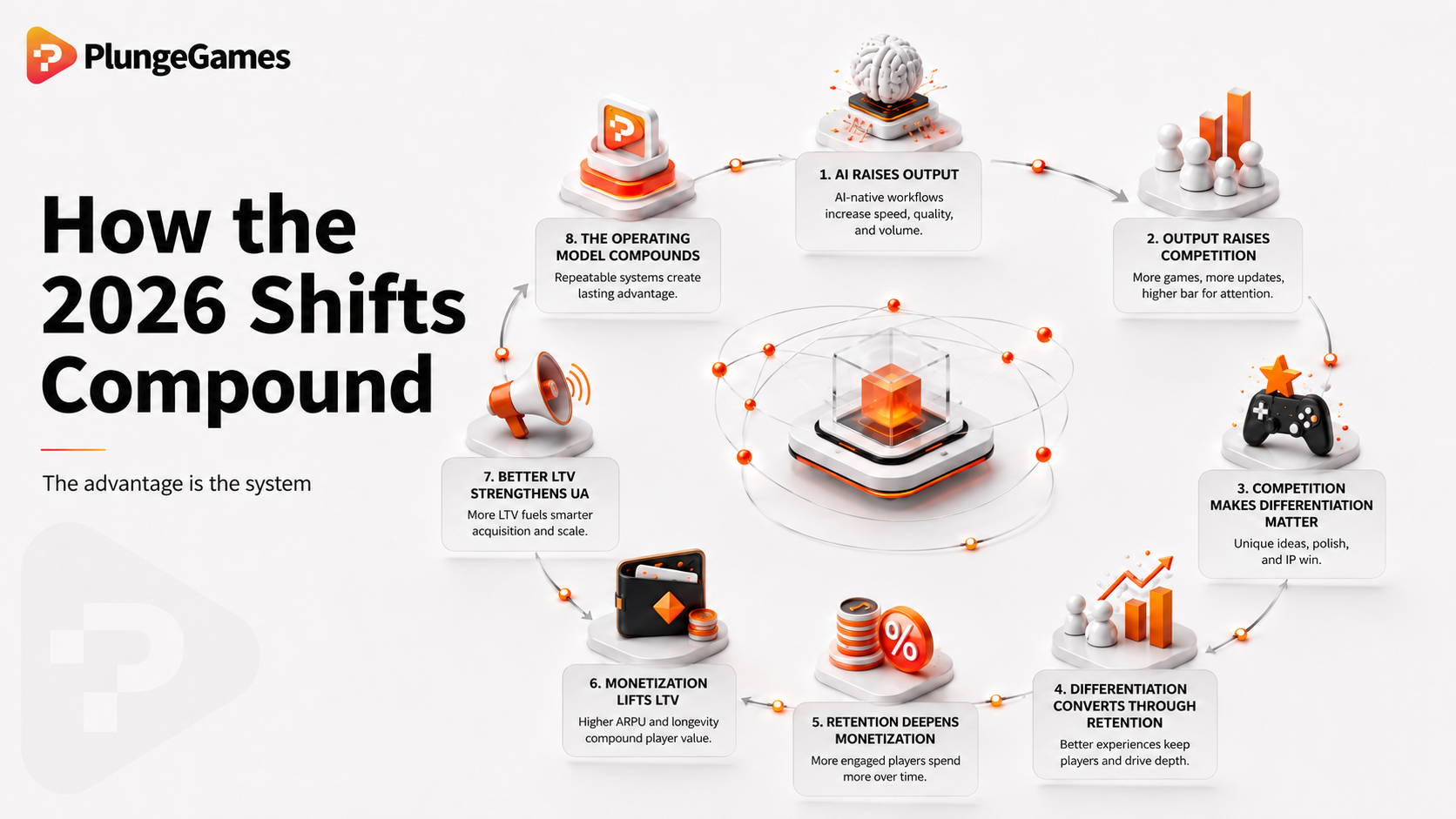
These aren’t seven separate trends. They’re one system rearranging itself.
Each trend in this list creates the conditions for the next. The studios that understand how each piece connects are the ones building a compounding advantage, not just optimizing one function at a time.
That’s the real mobile gaming trends 2026 story: the whole stack is getting tighter.
FAQ
What are the biggest mobile gaming trends in 2026?
The biggest mobile gaming trends 2026 are AI-native studio workflows, hybrid monetization, creative volume as a UA battleground, DTC/web store growth, Steam-to-mobile pipelines, retention-led growth, and hybridcasual’s continued strength. The common thread is that the market is shifting from volume-based growth to value-based growth.
What is hybrid monetization in mobile gaming?
Hybrid monetization means a game uses multiple revenue layers instead of relying on just one. That usually includes IAP, IAA, subscriptions, battle passes, DTC/web stores, and VIP systems. It’s becoming the default because a single model is often too shallow for today’s player economics.
How is AI changing mobile game development?
AI is changing mobile game development by reshaping workflow, not just adding tools. In AI-native studios, creative production, coding, analysis, and iteration all move faster because the process itself is built around AI. AppsFlyer’s 2026 report shows how quickly creative production scaled once AI entered the loop.
What is retention-led growth in mobile gaming?
Retention-led growth is the shift from optimizing install volume to optimizing lifetime value. In practice, that means better LiveOps, stronger progression, sharper segmentation, and more disciplined reactivation. It’s the operating model that fits a market where downloads are weaker but monetization still matters.
Are DTC and web stores worth it for mobile game studios?
For studios with enough scale and payer depth, yes. Stillfront’s Q1 2026 report showed DTC at 44% of bookings and gross margin at 84%, which is strong evidence that the model can materially improve economics. The trade-off is operational complexity, so the answer is usually strongest for mature games with an established spend base.
What are the hottest mobile game genres in 2026?
Hybridcasual is still the most important genre to watch because it’s where the market’s biggest operating shifts show up first. Strategy-forward hybrids and deeper economy games are especially important because they’re showing stronger monetization and retention signals.