Hybrid Monetization Is Now the Default. Most Studios Are Still Getting It Wrong.
By Omri Nygate — Monetization Consultant, Plunge Games
Let me start with something that should give every studio founder pause: once you put ads in your game, you almost certainly can’t take them out.
Ad campaigns get trained on your ad-monetizing users, so if you pull the ads the revenue tanks immediately. Run an A/B test to see if IAP catches up and it takes 2–3 months for IAP revenue to recover enough to tell a clean story. You could theoretically segment the ad-free experience for new players only, but you’re still left managing two monetization stacks indefinitely. In practice, once ads are in, they’re structural.
However, hybrid monetization is table stakes in 2026. Sensor Tower data shows hybrid-casual IAP revenue hit $4.2B in 2025, up 20% year-on-year, while pure casual and mid-core were essentially flat. Single-model games - pure IAP or pure ads - are increasingly structurally disadvantaged.
So how can you actually “go hybrid” in a way that won’t tank your game? You need to understand what you’re actually committing to.
The real questions you should be asking are harder: which combination works for your genre, what does implementation actually look like for a live game vs one still in development, and what are the tradeoffs nobody puts in the deck.
I’ve tuned these systems firsthand. Here’s the operator-level view on implementing a hybrid monetization strategy.
What the Right Model Actually Looks Like, By Genre
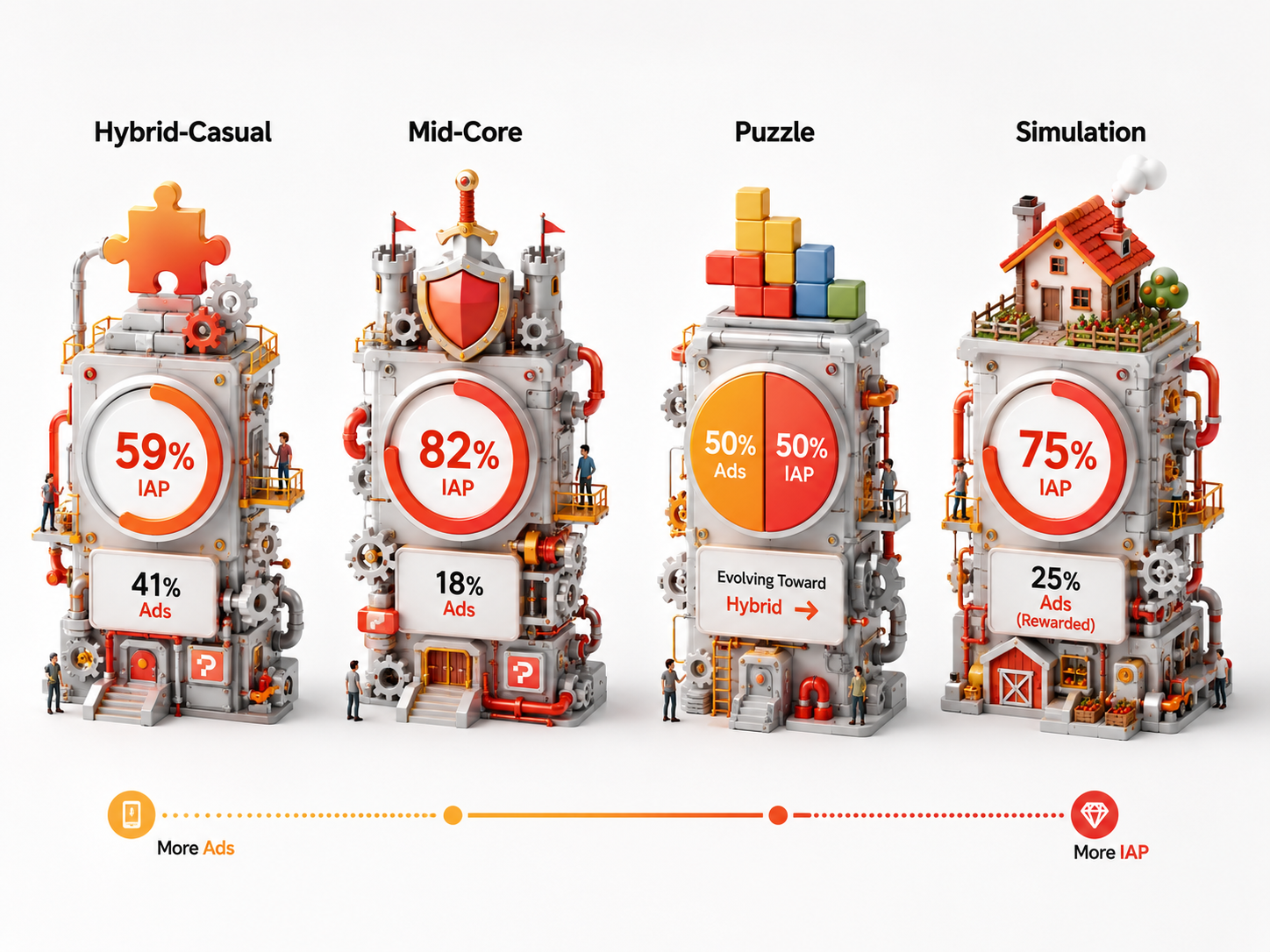
IAA + IAP + subscription/battle pass is the emerging standard for top performers. But the ratio matters enormously by genre, and the industry’s data is now specific enough to be actionable.
Hybrid-casual (lifestyle and puzzle titles) runs roughly 59% IAP, 41% ad share. Mid-core and action/strategy sits closer to 82% IAP, 18% ads.
Hybrid-casual: the clearest success story
Pixel Flow! (Loom Games, acquired by Scopely at a reported $1B+ valuation in February 2026) hit 10M+ players and top-20 US grossing within months of launch in October 2025. The model: IAP and rewarded ads layered into a puzzle core loop with genuine depth.
The hybrid-casual IAP revenue figure for the top titles reached over $345M in H1 2025 alone. The ad layer broadens the addressable market because players who would never pay can still engage and monetize through rewarded placements. Meanwhile, IAP captures high-value players who want to move faster.
Mid-core RPG and strategy: the ad layer shrinks
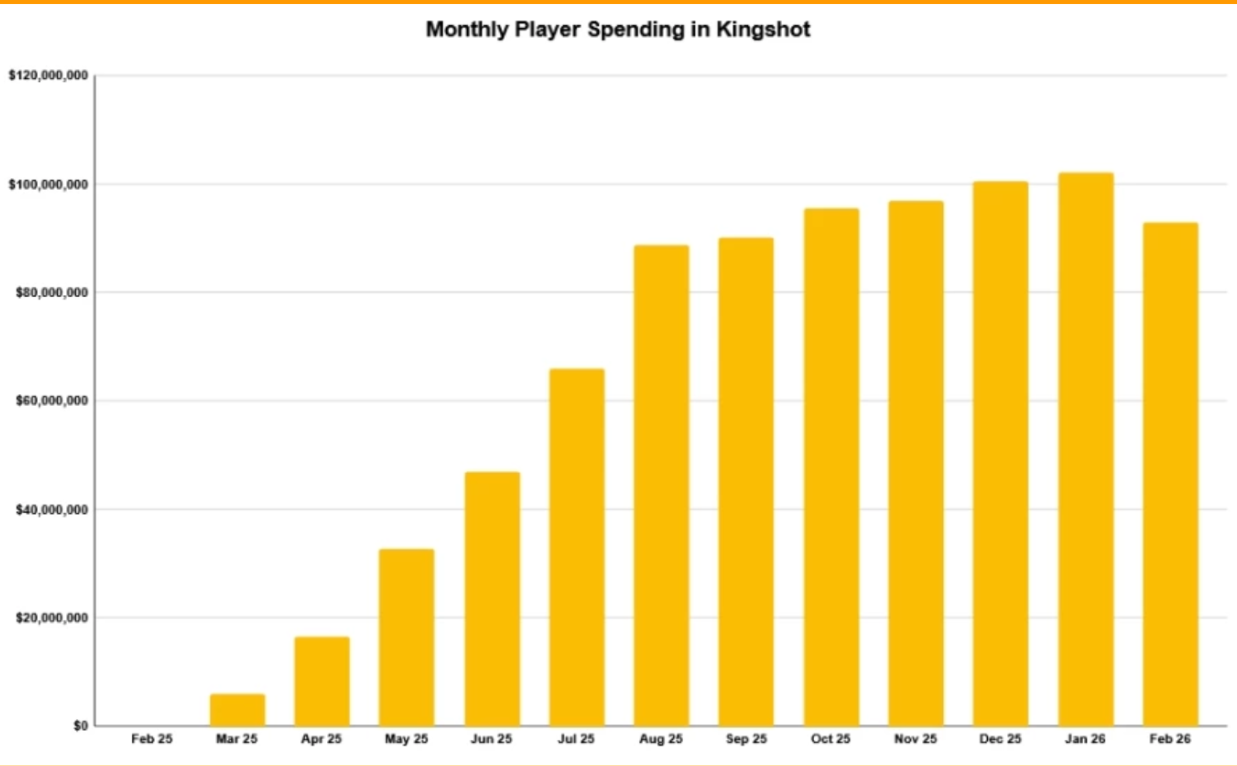
Kingshot (Century Games) achieved $811M+ in first-year revenue running an estimated 85–90% IAP, 10–15% ads model. The game applied the Whiteout Survival playbook at compressed speed: aggressive LiveOps, event-driven monetization, constant purchasable moments. The revenue story is remarkable. The sustainability question is real — Deconstructor of Fun flagged its “near-predatory level of monetization” and notable player backlash emerged in February 2026.
Mid-core players tolerate aggressive monetization when the gameplay loop earns it; when it doesn’t, the backlash compounds fast.
Puzzle: the category is bifurcating
Block Blast! runs on pure ad monetization, and it has 70M DAU, 300M MAU, and was #1 most downloaded game of 2025. It’s a case study in how far ad-only can scale.
But the block puzzle category is now rapidly evolving toward hybrid (Color Block Jam, Screwdom) as studios push for higher revenue per download. Even Royal Match, long a poster child for pure IAP premium puzzle, has started testing ads. The category migration is happening in real time.
Simulation: the ad layer is light but effective
Tends toward IAP-heavy models with light rewarded ad integration. The emotional investment players make in simulation progression creates strong IAP intent. Ads are most effective as optional boosters that don’t feel coercive against a game world that the player cares about.
The ROAS Question: Why “Which Model?” Is Really About Time Horizon
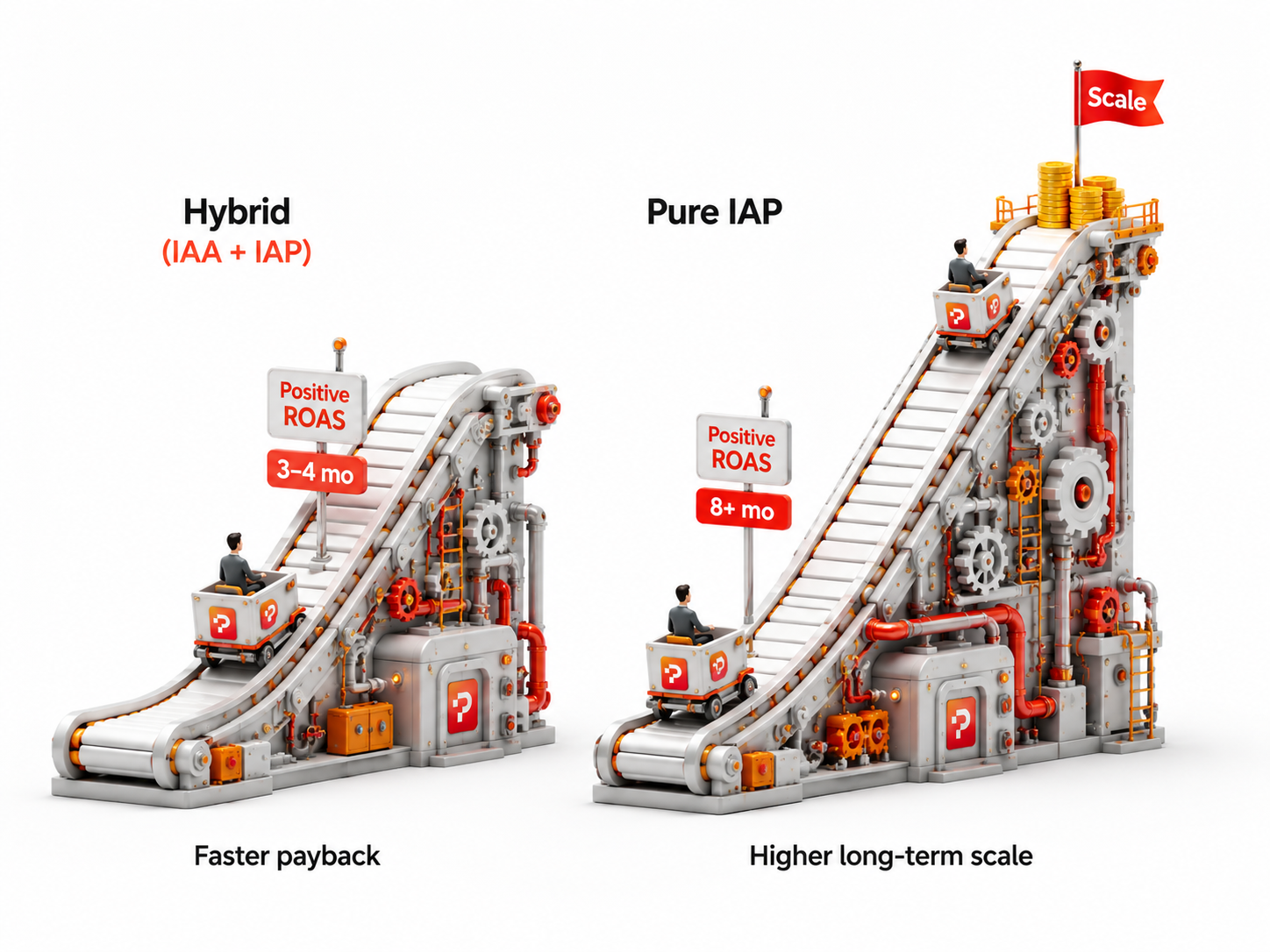
The choice between hybrid and pure IAP should be based on your ROAS window and ambitions for scale.
Hybrid monetization typically achieves positive ROAS in 3–4 months. Compare that to pure IAP, which usually takes 8+ months. If you’re a studio with limited runway, constrained marketing budget, or you need to prove unit economics quickly to investors, the faster payback window of a hybrid model is compelling.
But here’s what’s almost never said in the same breath: pure IAP tends to scale larger over time. Why? Because your margins are fundamentally better. When you’re not giving away progression for free through rewarded ads, every incremental dollar of UA spend produces higher LTV. The LTV curve keeps climbing as live ops compounding takes effect, which means you can keep scaling UA spend profitably at sizes that would make a hybrid game bleed.
Example: Monopoly GO!
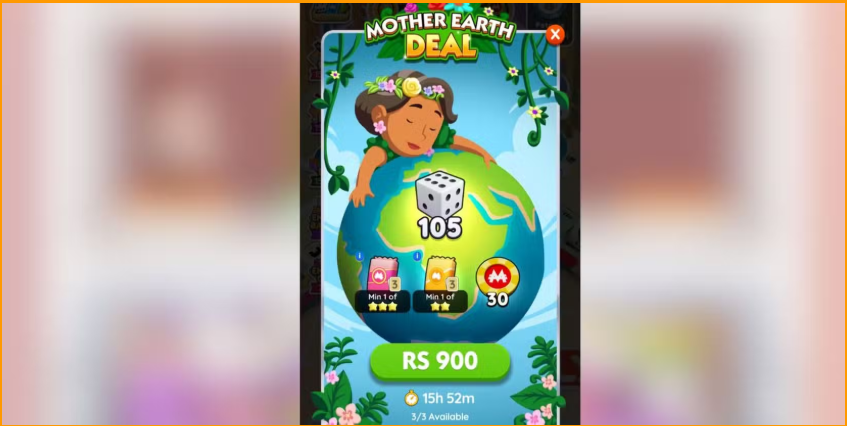
Monopoly GO! is the clearest recent proof of this. Despite the industry’s hybrid consensus, Scopely went all-in on IAP with zero ads and generated approximately $1.46B in revenue in 2025. The energy-based progression system is a masterclass in demand generation because players are always one purchase away from the next satisfying moment. LiveOps-driven event stacking creates constant purchasable contexts without any ad layer. The result is a game that can sustain aggressive UA investment because LTV keeps growing.
The practical implication:
If you have strong LiveOps infrastructure and a game with depth that rewards long-term player investment: pure IAP is a legitimate path and possibly the more lucrative one long-term
If you have a strong growth engine but less certainty about long-term retention depth: hybrid gets you to positive ROAS faster and de-risks the early stage
One more thing: for early-stage startups, starting pure IAP is extremely difficult. The combination of a long ROAS window, limited marketing budget, and no established brand makes the economics brutal. For most new studios, hybrid is a survival mechanism, rather than a preference.
Pre-Launch vs. Post-Launch And How to Sequence Either Way
The conventional wisdom to “design monetization from day one” is right, but incomplete.
Plenty of live games have successfully retrofitted hybrid monetization. Rewarded ads into IAP-first games is the most common and most forgiving retrofit - it adds value for players who weren’t buying anyway and doesn’t disrupt the existing payer experience if implemented carefully. Battle passes into ad-first games is harder: you’re asking players who have never paid to consider a recurring commitment, which requires a deeper relationship with the game than ads alone typically build.
What’s realistically achievable post-launch:
Adding rewarded ad placements to an IAP-first game: Achievable with moderate effort. The risk is cannibalization of IAP intent. Players who would have purchased now watch an ad instead. To mitigate this, you need to use careful placement that rewards non-payer behaviors without substituting for payer moments
Introducing a battle pass into an existing game: Achievable, but requires a content engine to support it. A battle pass with thin rewards in a mature game feels like a cash grab. It works when you already have LiveOps infrastructure generating rotating content
Restructuring your core progression around a hybrid model: This approaches a near-rebuild. If your progression system was designed around a single monetization layer, adding a second layer that feels intentional often requires touching core loops. That’s a major undertaking on a live game
Whether you’re building from scratch or retrofitting, the sequencing logic is the same. Hybrid monetization works best when it’s phased. Players need to form an emotional attachment before monetization pressure lands. Front-loading kills retention before that attachment forms.
Example: Survivor.io
Survivor.io is the best recent example of getting this right. The game doesn’t overwhelm players at Level 1. Instead, it unlocks monetization elements one by one alongside new game loops.
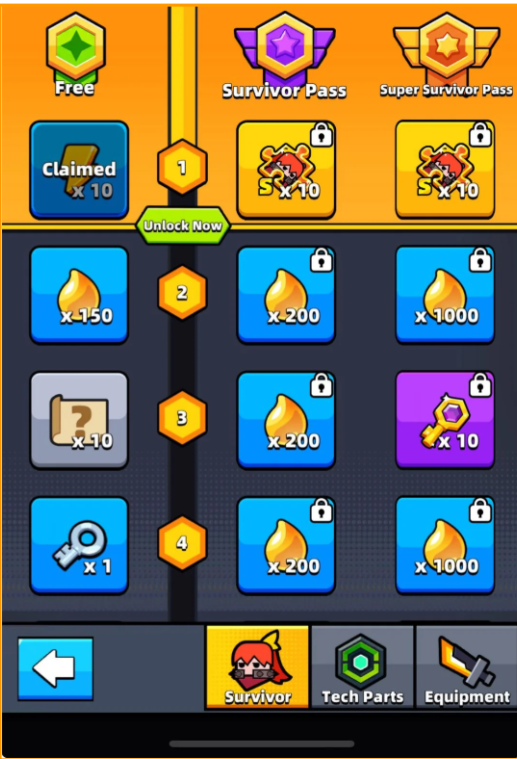
Players encounter rewarded ads first, which builds tolerance and conditions the expectation of optional value exchange. IAP surfaces come later, once the player understands what they’re buying into. The battle pass arrives last, when the player has developed enough loyalty to consider a recurring commitment.
The recommended sequencing:
Rewarded ads first: Establishes the value exchange, builds ad tolerance, monetizes non-payers without pressure
IAP surfaces second: Introduced once the player understands what they’re paying for and has demonstrated engagement
Subscription or battle pass layer last: Only works once LiveOps infrastructure is running. The pass needs rotating content to feel worth renewing
And remember what I said at the top: once ads are in, they’re almost impossible to remove. Before retrofitting an ad layer, be certain about the long-term strategic direction. This is not a reversible test.
The LiveOps Dependency
Hybrid monetization without LiveOps is just multiple revenue streams competing with each other.
Events, seasons, and rotating content are what give the monetization layers their coherence. They create the purchasable moments and the ad-viewing contexts that make each layer feel intentional rather than stacked. Over 60% of revenue in top games now comes from post-launch live events and seasonal content. The monetization system is only as good as the content engine feeding it.
If you don’t have LiveOps infrastructure - the team, the tooling, the cadence - a battle pass or subscription layer will feel thin and fail to retain subscribers. This is a meaningful pre-condition that studios frequently underestimate when planning hybrid systems.
The Risks Nobody Puts in the Deck
Every hybrid monetization pitch emphasizes the upside. Here’s what usually doesn’t make the slide.
Ad frequency cannibalizing IAP intent
When ads are too available, they become the default path for players who should be purchasing. You’ve essentially trained your higher-intent players to wait for the free option. This is particularly acute in mid-session moments: if a rewarded ad placement competes directly with an IAP prompt, you’re cannibalizing yourself.
Currency system incoherence
Bolting a second monetization layer onto an existing currency system creates confusion. If players can’t immediately understand the value of what they’re buying or watching ads to earn, conversion collapses. Every hybrid game needs a coherent currency architecture that explains itself without a tutorial.
Here’s what incoherent looks like in practice: multiple currencies where one booster costs currency A, another costs currency B, you can exchange between them at certain rates, and it’s never quite clear what each currency is actually for
And what a simple, legible structure looks like: coins for boosters, lives for entering levels, gems for buildings. Each currency maps cleanly to one purpose
The convoluted version means players can’t evaluate whether an offer is good at all, so they don’t buy. The simple version is what lets a player look at an offer and immediately think “yes, this is a good deal, I want that.”
Overloaded hybrid models
IAA + IAP + battle pass + premium currency + season pass + limited-time offers simultaneously is a monetization interface that confuses players. Each layer you add requires the player to track more. The best hybrid models layer cleanly without creating decision fatigue.
Regulatory exposure
Gacha and loot box restrictions in Belgium and the Netherlands are established; the regulatory perimeter is expanding. Any hybrid model with probabilistic reward elements needs legal review that accounts for the jurisdictions your game actually operates in.
Player trust erosion
Kingshot is the cautionary tale. The game achieved extraordinary revenue metrics and simultaneously generated significant player backlash around its monetization approach. In mid-core, player trust is load-bearing, meaning word of mouth drives discovery and community drives retention. When monetization feels extractive, the community notices and says so loudly. Hybrid monetization with restraint means understanding when you’re past the point where you’re serving players and starting to extract from them.
What to Actually Measure
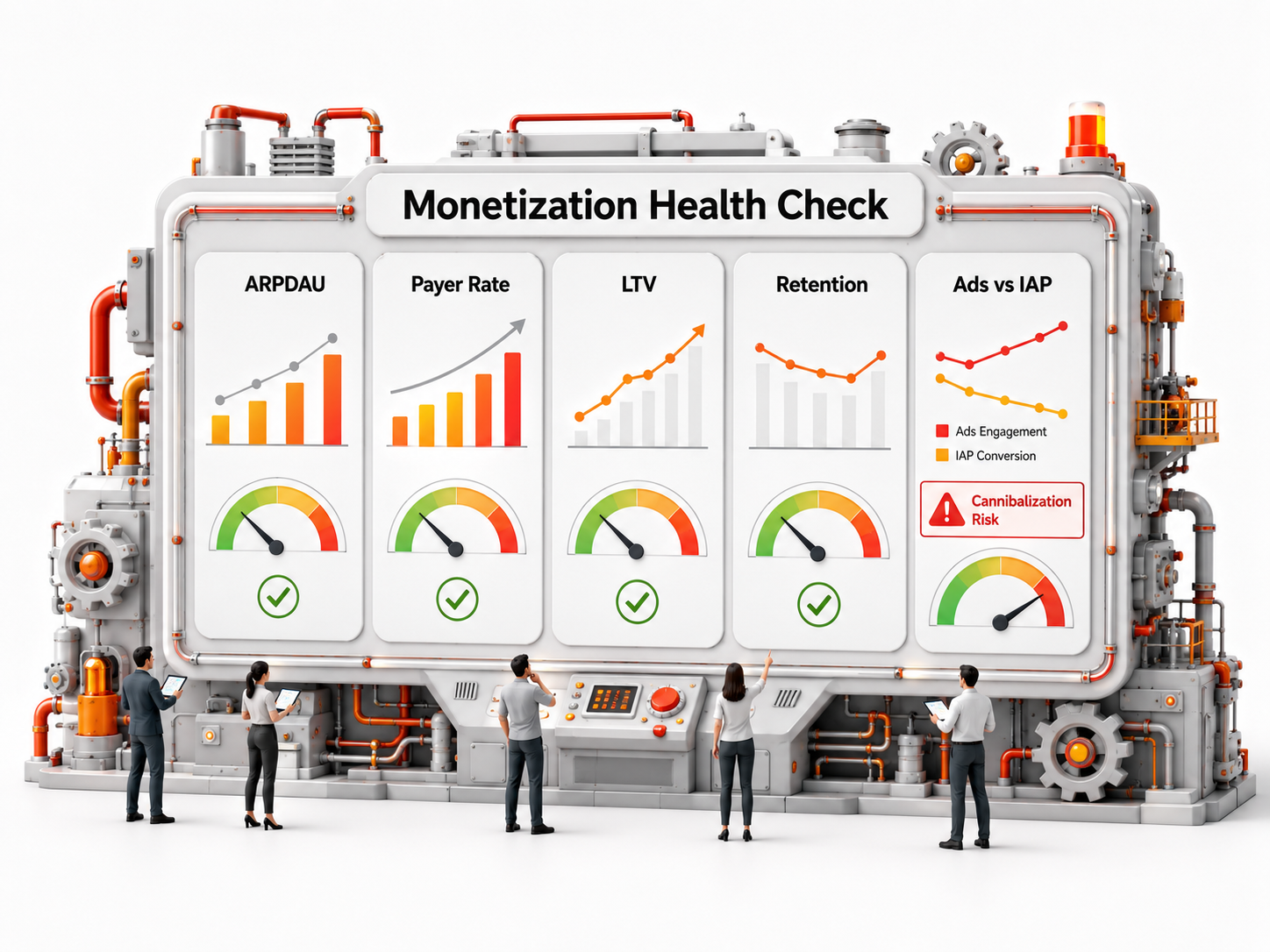
A hybrid system is healthy when the layers amplify each other. It’s eroding when they compete. Here’s the measurement framework that tells you which you’re in.
ARPDAU by monetization cohort: Not just overall ARPDAU. Break it by payers, non-payers who engage with ads, and players who do neither. The shape of this distribution tells you whether your non-payer segment is monetizing productively or dragging averages down
Payer rate: Track this separately for each IAP surface. If payer rate is declining while ad engagement is increasing, you have a cannibalization problem
LTV by segment: Your payers and your engaged non-payers have fundamentally different LTV curves. Model them separately. If LTV for the payer segment is declining, the ad layer may be pulling high-intent players toward the free path
Retention curves by monetization cohort: Day-7 and Day-30 retention for payers vs. ad-engagers vs. neither. Healthy hybrid systems show retained players across all three groups. Deteriorating hybrid systems show the non-monetizing cohort churning while payers stay
Ad session frequency vs. IAP conversion rate: Track these on the same timeline. If ad sessions are rising and IAP conversion is falling, you’ve trained your players to watch ads instead of buy
Metric | How to Break It Down | Warning Sign |
ARPDAU by monetization cohort | Split by payers / ad-engagers / neither | Non-payer segment dragging overall averages down |
Payer rate | Track separately per IAP surface | Payer rate falling while ad engagement rises = cannibalization |
LTV by segment | Model payers and engaged non-payers separately | Payer LTV declining = ad layer pulling high-intent players to free path |
Retention curves | D7 + D30 by payer / ad-engager / neither | Non-monetizing cohort churning while payers retain |
Ad session frequency vs. IAP conversion | Track both on the same timeline | Ad sessions rising + IAP conversion falling = players trained to watch, not buy |
The Decision Framework
Before deciding on your monetization model, answer these questions honestly:
What is your runway, and can you sustain an 8+ month ROAS window? If not, hybrid de-risks your early stage
How strong is your LiveOps infrastructure? If it’s underdeveloped, a battle pass will fail. Build the engine before you add the layer
Does your core loop have the depth to support long-term LTV growth? If yes, pure IAP at scale may be the more profitable path. If uncertain, hybrid is the safer early bet
Are you ready for the commitment? If you add ads, you are likely adding them permanently. Make sure that is a decision you can stand behind for the life of the game
Hybrid monetization done well is a growth engine. Hybrid monetization done carelessly is a slow erosion of player trust, IAP intent, and ultimately the game’s ceiling. For help in building and scaling your hybrid monetization strategy, reach out to us at Plunge Games.
Omri Nygate is a Monetization Consultant at Plunge Games.