Rewarded UA Isn't a Channel. It's an Architecture Problem Most Studios Haven't Solved.
Rewarded UA has a trust problem, but not the one people think.
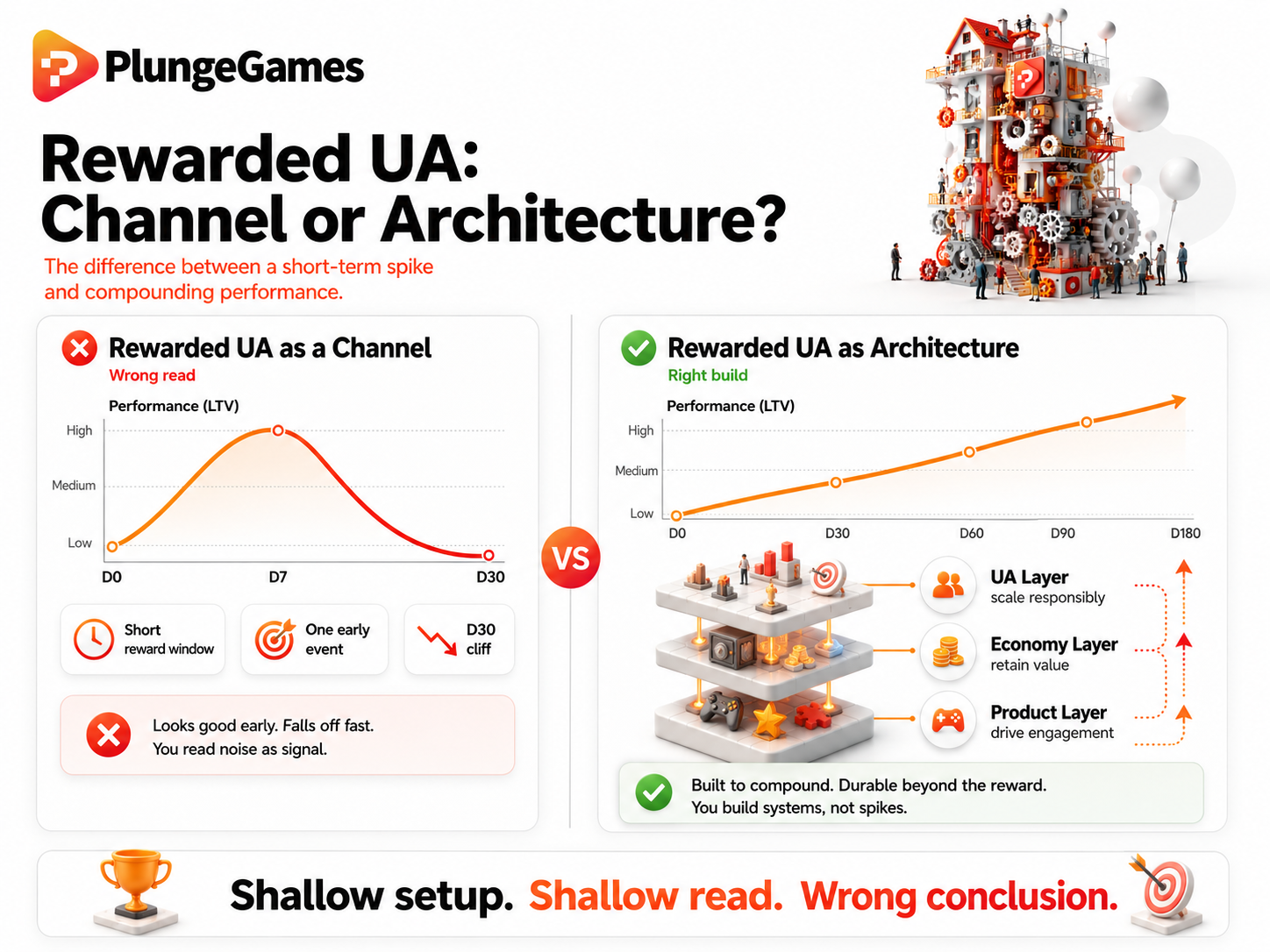
The standard story is familiar: a rewarded campaign drives a clean D7 spike, retention fades by D14, and the takeaway becomes "incentivised users don't stick." In practice, that outcome is usually self-inflicted: a reward window that ends too early, an event structure with nothing to optimize beyond the first sessions, and a game that doesn't give the channel enough runway to work. Shallow setup. Shallow read. Wrong conclusion.
That narrative is increasingly out of step with the market. Almedia's 2026 Rewarded UA Handbook shows that based on a survey of 912 mobile UA professionals across 10 tier-one markets, rewarded UA is now standard practice for 93% of mobile game advertisers - up from 77% a year earlier, with only 2% planning to reduce spend. Gamedev Reports' breakdown of the survey lays out those numbers alongside how deeply rewarded is now woven into most UA mixes.
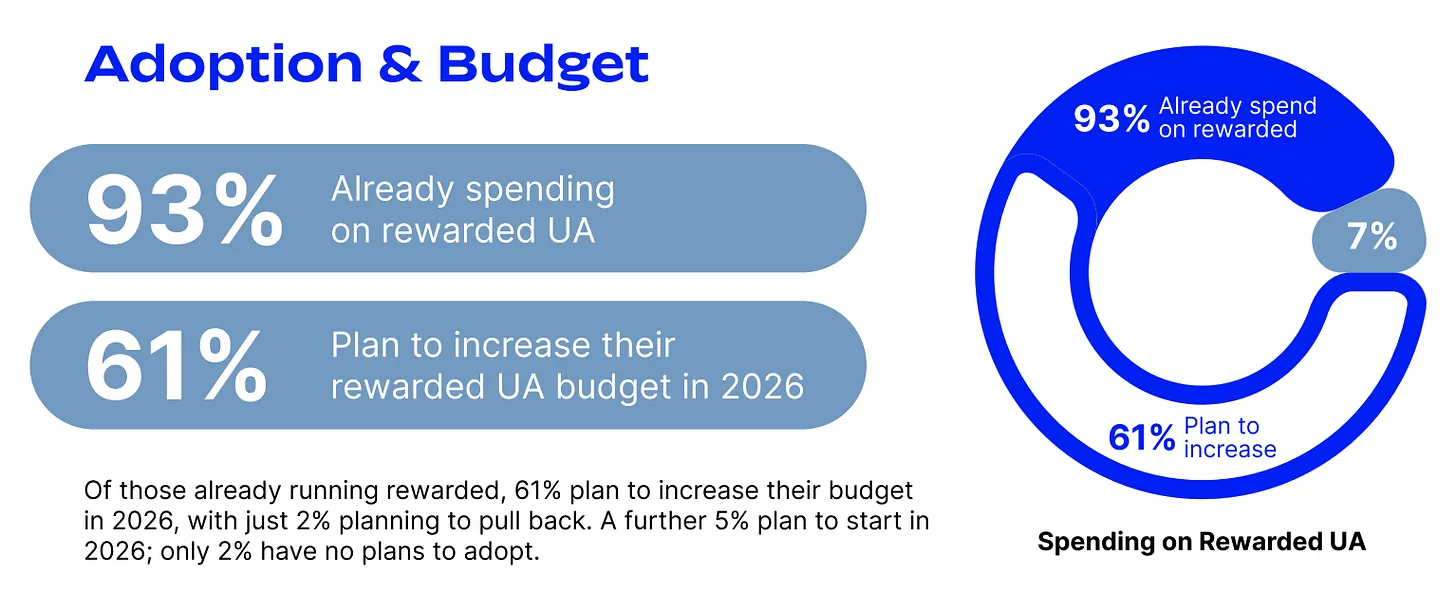
Source: https://gamedevreports.substack.com/p/almedia-rewarded-ua-in-2026-sponsored
It's worth noting the source: this is a vendor report from the company behind Freecash, and its case studies naturally skew toward its own platform. A more skeptical independent read of the same handbook from Matej Lancaric puts it well in stating that the benchmarks and playbook are solid, but read it for that, not for a neutral verdict on the market. The methodology itself is sound (a large, externally run survey via a certified research firm), and the directional findings line up with what other partners in the rewarded and offerwall space are reporting about adoption and budget share.
The studios pulling ahead aren't the ones who "tested rewarded." They're the ones who built for it by aligning product, economy, and UA around a reward system designed to compound over time. That shift from "channel" to "architecture" echoes what other operators have been saying about rewarded, including in Almedia COO Jan Sommerfeld's "Rewarded UA in 2026: The Growth Playbook" talk and Gamelight's guide to scaling rewarded UA without breaking your economy.
“You need to think of reward and your rewarded platform as a loyalty program that supports the gameplay that you have in parallel at key milestones…It's about optimally allocating the rewards that you have over the entire lifetime of a user, not shooting all the shots early.” - Jan Sommerfeld, COO at Almedia
What follows is a practical breakdown of what rewarded mobile UA actually is, where it fits in today's UA mix, and - most importantly - what separates campaigns that produce a short-term spike from the ones that compound retention and revenue over time.
What Is Rewarded UA?
Most of the confusion around rewarded UA starts with definition. Too many teams still talk about it like a creative format, such as "rewarded video", instead of a user acquisition system.
According to Almedia's explainer on what rewarded UA is and who it's for, rewarded UA means users actively opt in to complete specific in-app tasks, like clearing levels, maintaining daily streaks, making IAPs, reaching VIP tiers. In exchange, they earn external rewards such as cash, gift cards, or points. The core mechanism is voluntary participation: users pick offers that interest them and earn more as they progress. That's fundamentally different from passive ad formats like non-skippable video, where users have no choice but to sit through the spot.
This difference in intent explains the retention dynamic. Users who proactively accept a value exchange and follow a clear task list tend to act more like participants than impression-level viewers - a distinction offerwall and rewarded networks generally converge on, whatever their specific platform.
In the broader UA mix, rewarded sits alongside the usual heavyweights, like Meta, Google, AppLovin, and TikTok, as a smaller but fastest-growing slice of spend and volume. It's still underweighted in many decks, often relegated to "secondary channel" status long after the data says it deserves primary attention.
The Market Context
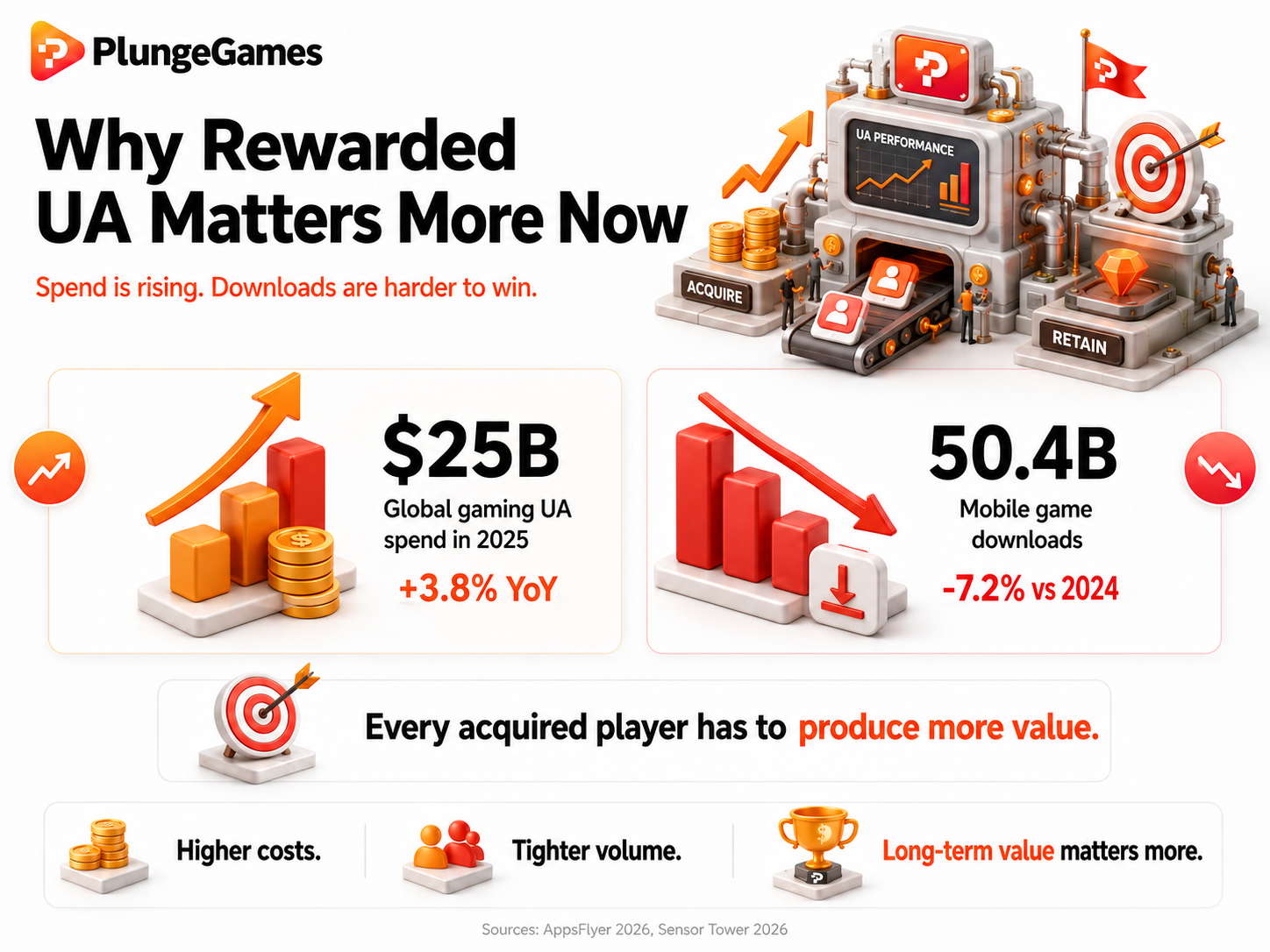
UA has become more expensive and less forgiving. AppsFlyer's "State of Gaming for Marketers 2026" puts global gaming app UA spend at around $25B in 2025, up 3.8% year-on-year, based on anonymised data from 9.6K apps and 24.8B installs. eMarketer's coverage of the report highlights the same figures, and notes that close to half of that spend flowed into the US market alone. Over the same period, Sensor Tower's State of Mobile 2026 report shows total mobile game downloads actually fell to 50.4B, down 7.2% from 2024. So spend is still climbing against a shrinking pool of users to acquire it from.
Spend up, volume down, and over 95% of new users still churning within 30 days across both iOS and Google Play, per Business of Apps' mobile game churn data. In that environment, channels that can reliably push engagement and value past D30 are no longer "nice to test" — they're where margin comes from.
A rewarded setup that's designed to keep users progressing and earning over 60, 90, or 180 days behaves less like a one-off campaign and more like a loyalty system layered onto your UA mix. That's the core thesis behind both the Almedia Rewarded UA Handbook and its Gamedev Reports synopsis: rewarded works best when you treat it as an ongoing system rather than a short-term test.
Designing the Game
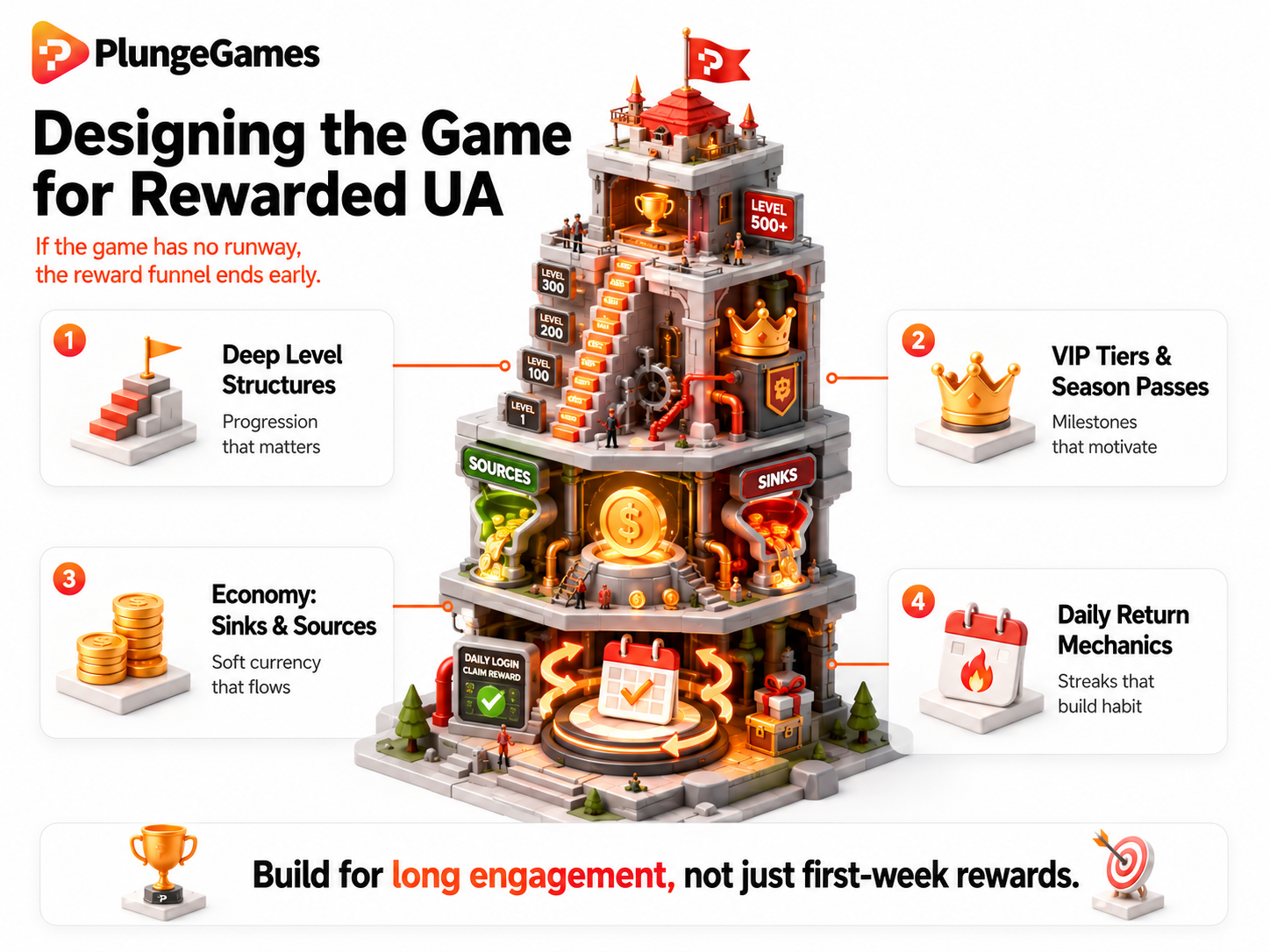
The single most common miss with rewarded UA is treating it purely as a media lever. In practice, a big part of performance is a product decision: the best rewarded campaigns sit on top of games built for long engagement funnels. Almedia's 2026 predictions piece frames this directly as designing games with rewarded flows in mind, and argues studios who do this will see the largest gains.
If your game caps out at 30 or 40 levels with a flat economy, your reward funnel caps out there, too. There's only so much a platform can do if there are no meaningful milestones to optimise toward beyond the early game. Gamelight's piece on scaling rewarded UA without killing your game economy hits the same note: deep progression, sinks and sources, and long-term goals are prerequisites.
In practice, "built for rewarded" usually means a few things working together:
Deep level structures: Hundreds or thousands of levels, not dozens, so campaigns have room to learn and optimize over time
Meaningful progressive milestones: VIP tiers, season passes, map unlocks, and late-game features that give platforms events that they can optimize toward and users reasons to come back
An economy that supports repeat purchases: Soft currencies, boosters, consumables, sinks, and sources so IAP and hybrid titles can target purchase events over months rather than days
Daily return mechanics: Streak bonuses, login rewards, and daily missions that give users a reason to open the app every day and give reward partners events they can optimize for
Those are the same structural priorities highlighted in Business of Apps' guide to scalable UA growth in mobile gaming, which frames rewarded not just as a numbers game but as a value exchange that needs a game built to sustain it.
Case study: Scaling D60 retention for a puzzle game and improving rewarded campaign performance
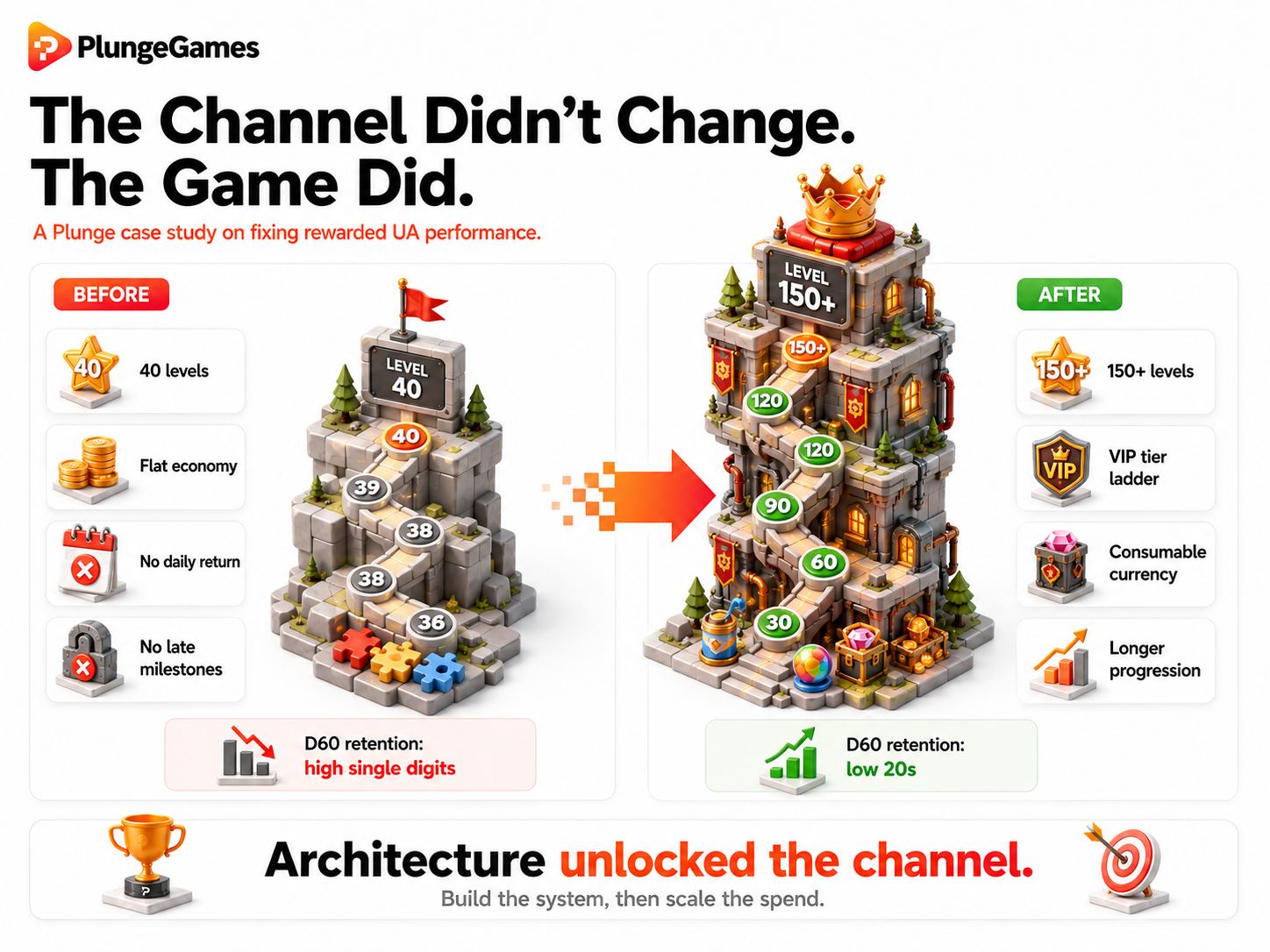
Our team at Plunge worked on this exact problem with a casual puzzle title. It was a 40-level match-3, flat economy, rewarded live in three markets. Campaigns spiked nicely into D7-D10, then flatlined hard. Internally, the read was "rewarded doesn't scale beyond the first couple of weeks," and we almost agreed with that read the first time we saw the dashboard.
But the real diagnosis we discovered wasn't the channel. It was the architecture. There were no meaningful progression milestones beyond level 40, no repeat purchase events to optimize against, and no daily return mechanic. Once the product team extended the level map past 150, added a simple VIP tier ladder, and layered in a consumable currency, the rewarded campaign suddenly had a real funnel to run on. Over the following quarter, D60 retention moved from the high single digits into the low twenties, and the campaign kept scaling instead of stalling out.
The underlying point is simple: if you want rewarded UA to behave like an always-on lever, your UA brief and your product brief have to be the same conversation. The channel can only amplify the structure you give it.
Structuring the Campaign
Once the game itself can support a longer funnel, the next question is what you're asking your rewarded partner to optimize against. This is where event structure becomes the single biggest performance lever most teams underuse.
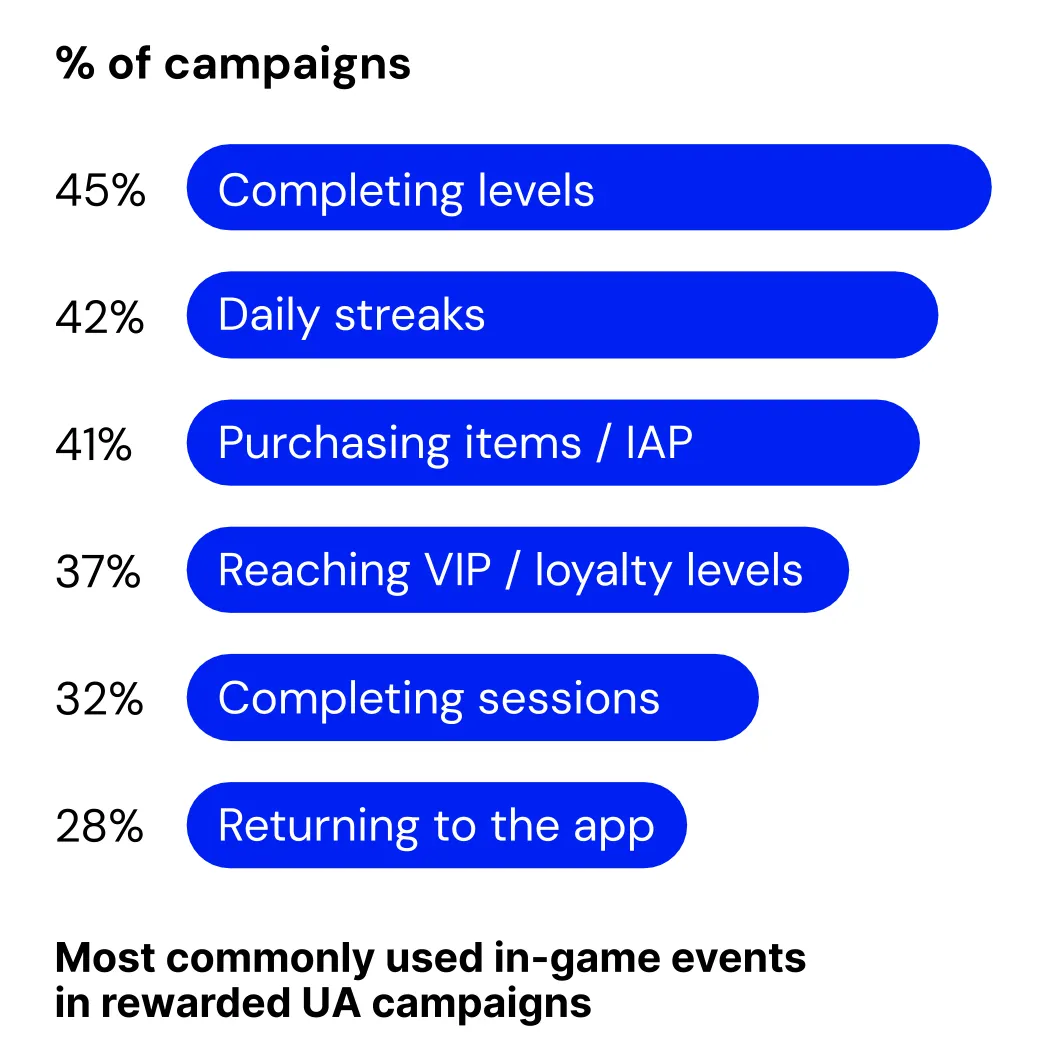
The Gamedev Reports breakdown of Almedia's survey lists the most common rewarded events:
completing levels (45%)
daily streaks (42%)
IAP purchases (41%)
loyalty program progression (37%)
sessions (32%)
app re-engagement (28%)
Source: https://gamedevreports.substack.com/p/almedia-rewarded-ua-in-2026-sponsored
It also notes that IAP and hybrid titles run an average of a bit over three distinct event types per campaign, while ad-only titles average just above two. That aligns with the broader recommendation in Almedia's own content: build a multi-tiered reward and event system that has early, mid, and late-game targets.
A practical way to think about it is as a three-layer structure:
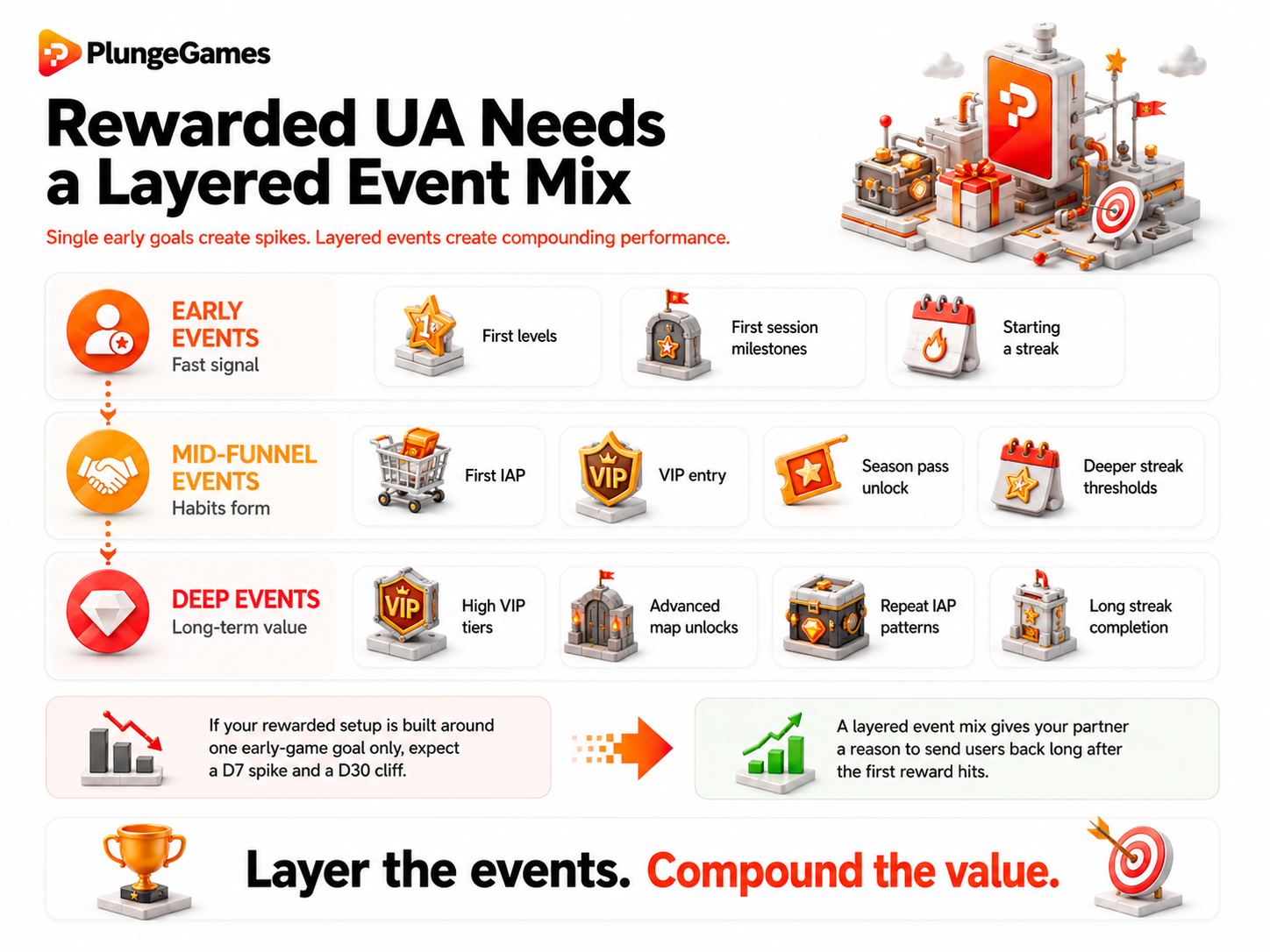
Early events (e.g., first levels, first session milestones, starting a streak) that give fast signal
Mid-funnel events (e.g., first IAP, VIP entry, season pass unlock, deeper streak thresholds) where habits form
Deep events (e.g., high VIP tiers, advanced map unlocks, repeat IAP patterns, long streak completion) that correlate strongly with long-term value
The studios that over-constrain their event setup - usually because they share minimal data or only feel comfortable exposing one or two events - are the ones who end up saying "rewarded doesn't scale." The survey data shows that the majority of studios using rewarded already expose multiple event types and often run several goals within a single campaign.
As a rule of thumb, if your rewarded campaigns are built around a single early-game goal and nothing else, expect a D7 spike and a D30 cliff. If you want compounding performance, you need a layered event mix that gives your partner a reason to send users back into your game long after the first reward hits.
Addressing the D30 Cliff
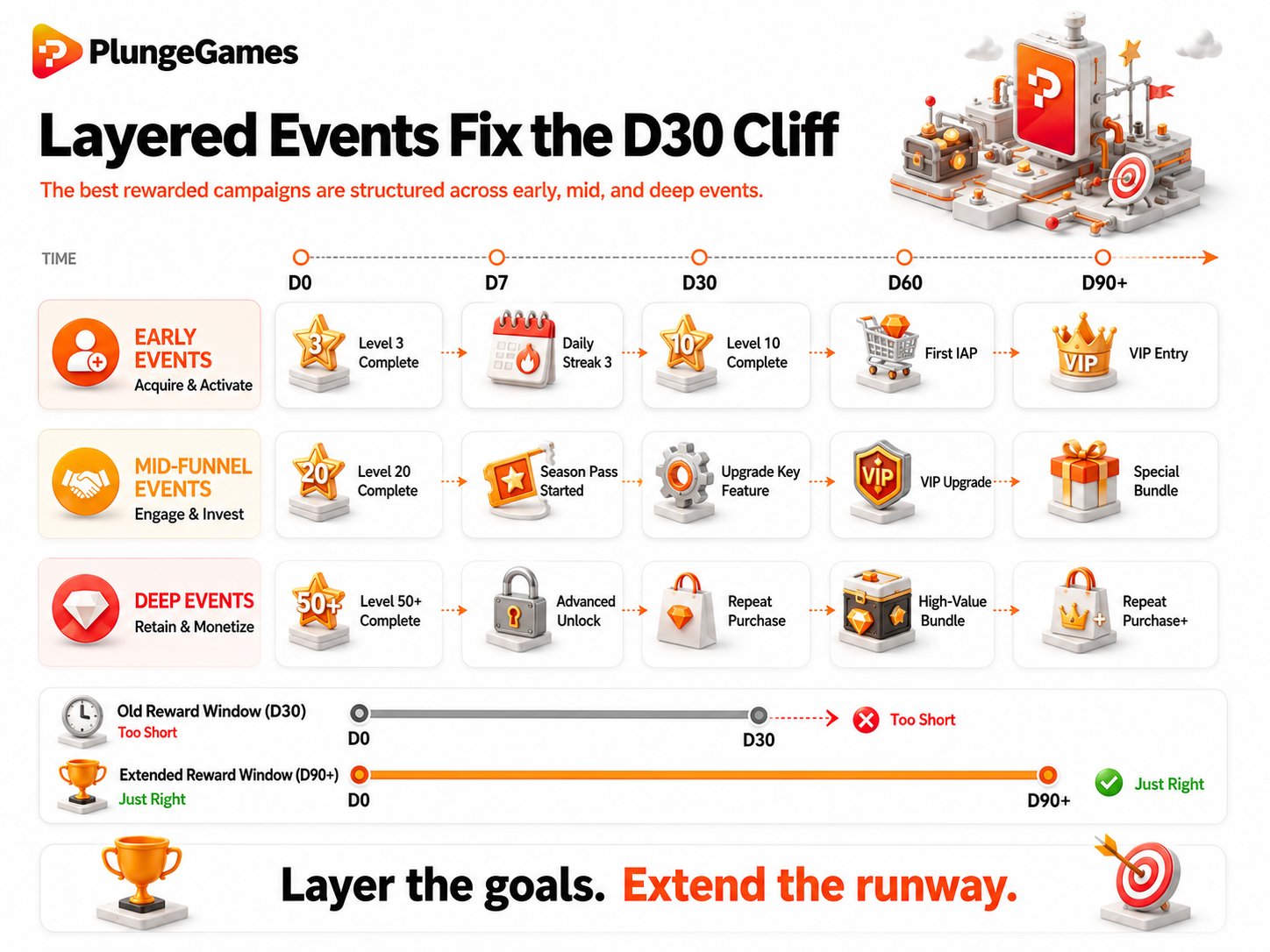
Layered events fix the optimization problem. They don't, on their own, fix the churn that studios worry about. One of the headline findings in the Almedia survey is that a major concern for studios is users churning once rewards run out. That fear appears repeatedly in other vendor and agency content - like in TyrAds' piece on rewarded UA's evolving retention challenge.
“Rewarded users are like party guests. When the drinks run out, everybody disappears.” - Zino Rost van Tonningen, CEO of TyrAds
Most setups treat D30 as the finish line: short windows, a couple of early-game goals, and a payout that assumes the relationship is over after week four. That naturally produces a D7 spike, some lingering activity into D30, and then a flatline.
The fix is structural: extend the reward window and give late-funnel users something to climb toward. In practice, that usually looks like starting with a D30 baseline, then expanding to D60 as data comes in, then D90 and beyond as you see stable late-funnel behavior. It’s a pattern that mirrors the early-to-mid-to-late event sequencing recommended in Almedia's rewarded optimization checklist.
In the Match Masters case study highlighted by Almedia, Candivore extended the Freecash reward window from 50 to 90 days and saw a significant improvement in ROAS. The precise numbers are naturally framed from the vendor's perspective, but the mechanism is clear: a longer window gave users more time to earn and gave the platform more time to identify and support high-value players.
Getting Setup Right
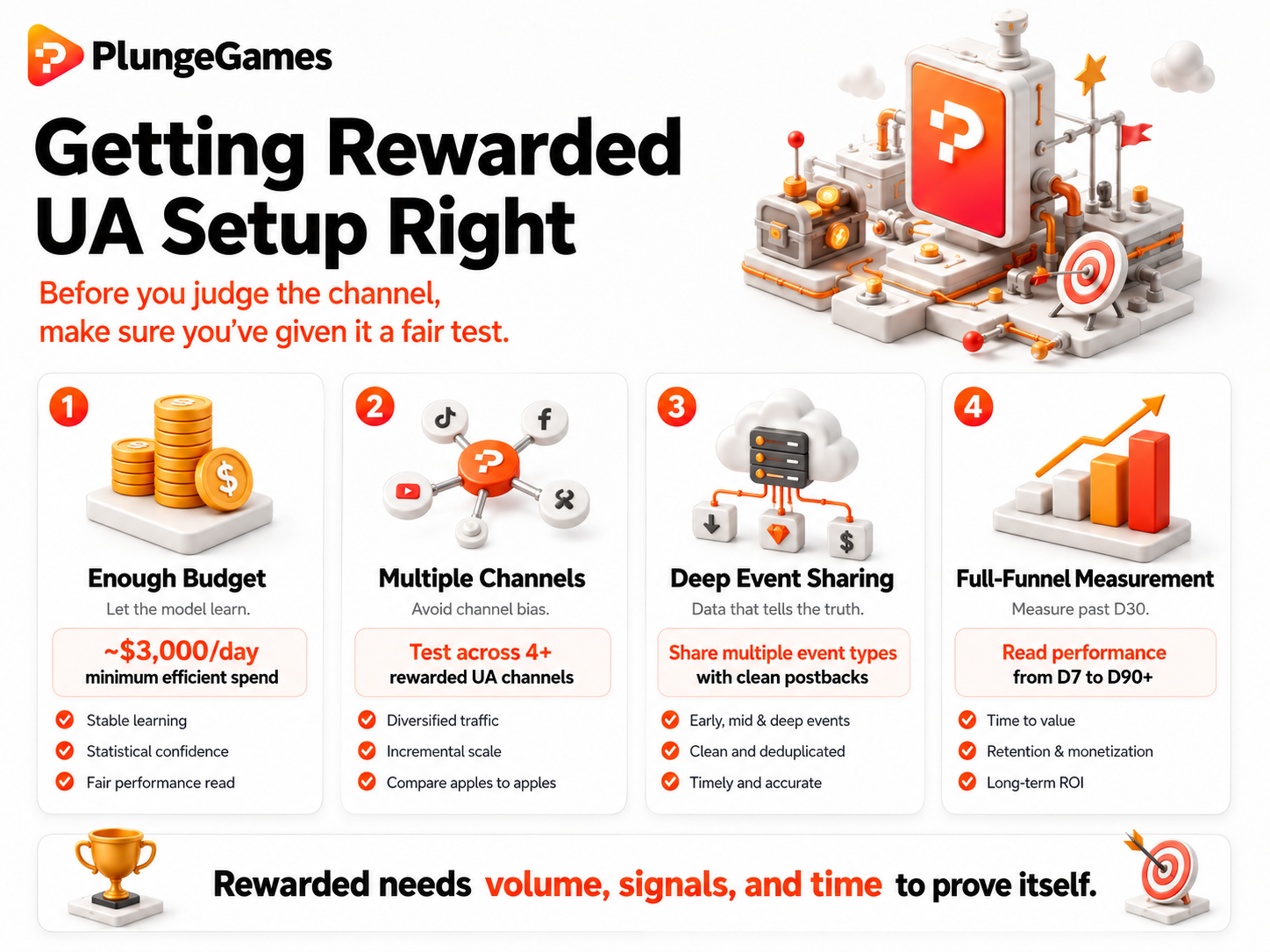
None of the above matters much if the campaign never gets a fair run in the first place. Before you judge rewarded UA, make sure you've actually given it one.
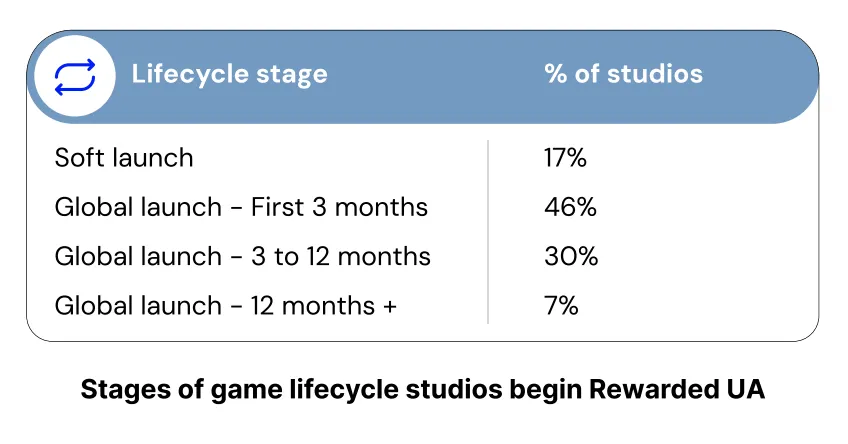
The survey breakdown on Gamedev Reports gives a good sense of when studios switch rewarded on:
17% of respondents start using rewarded UA as early as soft launch.
46% start within the first three months after launch.
30% start within 3-12 months.
Source: https://gamedevreports.substack.com/p/almedia-rewarded-ua-in-2026-sponsored
A strong majority of studios using rewarded bring it into the mix within the first year - and almost half do so within three months. Rewarded should be part of your go-to-market plan once you trust your core metrics, not something bolted on years later.
Budget is another make-or-break factor. In that same breakdown, the authors cite Almedia's recommendation that $3,000 per day is the minimum spend level needed for rewarded UA channels to operate efficiently. That figure also came up in a MobileGroove podcast conversation between host Peggy Anne Salz and Almedia's Joel Brodie, Head of Strategic Partnerships, where he argued that smaller budgets don't give the system enough signal to learn.
Meaningful rewarded campaigns need enough daily volume to let the system learn who your high-value users are.
You also want to think multi-platform from the start. The same survey summary notes that 74% of studios using rewarded work with four or more rewarded UA channels. That's consistent with broader UA behaviour: AppsFlyer's State of Gaming for Marketers also points to advertisers expanding their media mix to find incremental scale.
Finally, share deep event data with your partner. Almedia's practical checklist on rewarded optimization emphasizes exactly this: multiple event types, clean postbacks, and a full-funnel view so platforms can distinguish early tourists from long-term players. Other networks' strategy content makes a similar point about value-exchange campaigns more broadly - see AdscendMedia's write-up on driving ROAS with rewarded UA, for example. It’s written for fintech but is applicable to the same underlying logic.
Common Mistakes in Rewarded UA
A few patterns show up so consistently in rewarded UA that they're worth calling out directly.
Judging the channel on D7 alone.
In the MobileGroove interview with Almedia, Joel Brodie explicitly warns against calling rewarded winners or losers at D7 and argues that D30 and beyond are where you see whether the system is actually working. We've seen this across different studios, where the team killed a rewarded test early. After we came in and suggested a longer window - letting the new campaign run properly out to D45 - it outperformed everything else in the mix that quarter.
“Focus on testing to day 30 events and share event and conversion rates based on what you've seen with traditional UA in order to build out that first test campaign. Then let your rewarded partner optimize based on that data to extend it out to day 90 and further.” - Joel Brodie, Head of Strategic Partnerships at Almedia
Running a tiny test, seeing noise, and writing off the channel
The $3,000/day guidance from Almedia's survey and commentary is meant to avoid exactly this. Underfunded tests don't tell you much about channel quality; they mostly tell you that learning phases are noisy when you starve them of data.
Treating rewarded like a one-event funnel
The survey shows that most serious adopters use multiple event types, like:
level completion
streaks
IAP
loyalty progression
sessions
re-engagement
Designing a rewarded funnel around a single "reach level X" goal and nothing else is the opposite of how the high-performers structure their campaigns.
Hoarding data instead of sharing it
Almedia's optimization checklist and similar guides from other networks repeatedly stress that partners can only optimize against the data they see. Drip-feeding minimal signals and then blaming the system when it can't separate casual from committed users is a self-inflicted wound.
“To scale it [a rewarded campaign], you really do want to be able to share engagement events and purchase activity events that are short-term, medium-term, long-term and to extend it out as far as you can.” - Joel Brodie, Head of Strategic Partnerships at Almedia
Treating rewarded as a side quest on a single platform
The 74%-of-studios-run-four-or-more-channels figure should be a warning sign. If you're still running one small integration in one geo and expecting it to behave like a primary UA engine, you need to re-examine your setup.
The Real Shift
At this point, the question is how seriously you've designed around rewarded UA campaigns.
Almedia's 2026 predictions forecast continued growth in budget share and explicitly call out designing games with rewarded flows in mind as a key differentiator. The handbook, the survey breakdown, and Almedia's forward-looking blog all point in the same direction: rewarded belongs in the core mix, not as an experiment on the side.
The studios pulling away with this strategy are:
designing their games with deep funnels and meaningful milestones
structure campaigns around layered events
extend reward windows beyond D30
share enough data for their partners to actually learn
Rewarded in those stacks sits alongside live ops as an always-on system that compounds over time.
So the question for your next planning session is simpler (and more uncomfortable): when you look at your current setup, are you treating rewarded as just another channel, or as an architecture you're willing to design around?
If you want an outside read on whether your current build can actually support rewarded at scale, our team at Plunge Games can help review the setup across product, economy, and UA - before you spend another quarter misdiagnosing the channel.